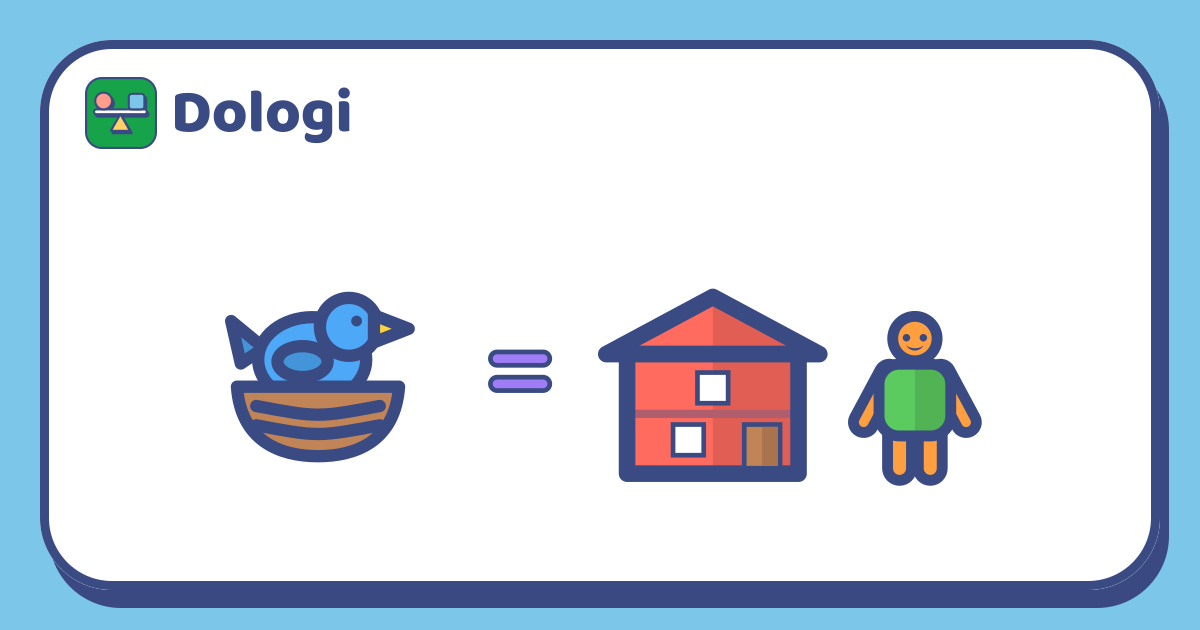
"A bird lives in a nest, and a person lives in…?" Most children shout "a house!" straight away. Without knowing it, they have just solved an analogy: they noticed the link between the first pair and found the same link in a second pair.
Analogies are a quiet but powerful thinking tool. They help children notice relationships, not just objects, and they're behind a lot of later learning, from understanding new words to explaining ideas. This article explains what an analogy is, the kinds of links children can look for, and simple games to play at home.
What is an analogy?
An analogy compares two pairs of things that are connected in the same way:
bird → nest in the same way as person → house
The things themselves are very different. A bird and a person have little in common. What matters is the link: "lives in". To solve an analogy, your child has to:
- Look at the first pair and find how the two things are connected.
- Put the link into words: "A bird lives in a nest."
- Use the same link on the second pair: "A person lives in… a house."
That middle step, saying the link out loud, is the heart of it. Children who can name the link are thinking about relationships, not just guessing.
Kinds of links children can spot
Some links are easy to see, others take more thought. Here are common ones, roughly from easiest to hardest.
| Link | Example | Ask your child |
|---|---|---|
| Lives in | bird → nest, fish → water | "Where does it live?" |
| Eats | cow → grass, rabbit → carrot | "What does it eat?" |
| Used for | spoon → soup, brush → hair | "What do we use it for?" |
| Grown-up and baby | dog → puppy, cat → kitten | "What's its baby called?" |
| Part of | petal → flower, wheel → bike | "What is it part of?" |
| Opposite | hot → cold, up → down | "What's the opposite?" |
| Makes or does | cook → meal, bee → honey | "What does it make?" |
Start with links that come from your child's everyday life. Opposites and "part of" links usually come a bit later.
A pairing game to start
You can play this with real objects, toy figures or quick drawings on paper.
- Lay out four or five cards with pictures: a bird, a nest, a dog, a kennel, a house.
- Show one finished pair: put the bird next to the nest. "Why do these two go together?"
- Start the second pair: put the dog down. "Which card goes with the dog in the same way?"
- Ask for the reason: "Why the kennel and not the house?" Both are homes, so this is a nice moment to talk.
- Swap roles: your child builds a pair and you find the match.
Keep the game short. Three or four pairs are plenty for a young child, and it's fine if they need help putting the link into words at first.
From easy pairs to surprising ones
Once your child enjoys simple pairs, you can make the game a little harder.
- Use links they haven't met yet. "A glove is to a hand as a sock is to…?"
- Add tempting wrong answers. For "a cow eats grass, a rabbit eats…", offer a carrot, a field and a hutch. The field is "near grass", which makes children check the link carefully.
- Use words without pictures. Older children, from around 7 or 8, often enjoy analogy riddles at the dinner table: "Day is to sun as night is to…?"
- Allow more than one answer. "A pen is to writing as a brush is to… painting? Or hair?" Both can be right if your child explains the link.
Ages here are only rough guides; every child is different, so follow your child's interest rather than a timetable.
Let your child make up analogies
The best practice of all is inventing analogies, because your child has to choose the link first.
- Start from one pair your child likes: "Rain and umbrella. Can you think of another pair that goes together like that?" (Sun and hat. Cold and coat.)
- Play "same link, new world": pick a link such as "used for" and take turns finding pairs in the kitchen, then in the bathroom, then in the garden.
- Draw them: fold a sheet in four, draw one pair on the left and the matching pair on the right.
When your child gives an unusual answer, ask about it before correcting. Children sometimes see links that adults miss.
In Dologi, "Sort into groups" puzzles in the Logic topic ask children to put things together by what they have in common. Talking about what links two things is the same habit that makes analogies easier.
In short
- An analogy finds the same link between two different pairs: bird and nest, person and house.
- The key step is putting the link into words before looking for the second pair.
- Start with everyday links (lives in, eats, used for) and move slowly to opposites and "part of".
- Ask "why?", accept more than one answer if it's explained, and let your child invent analogies of their own.
Read more: Sorting and comparing: the first thinking skills children use