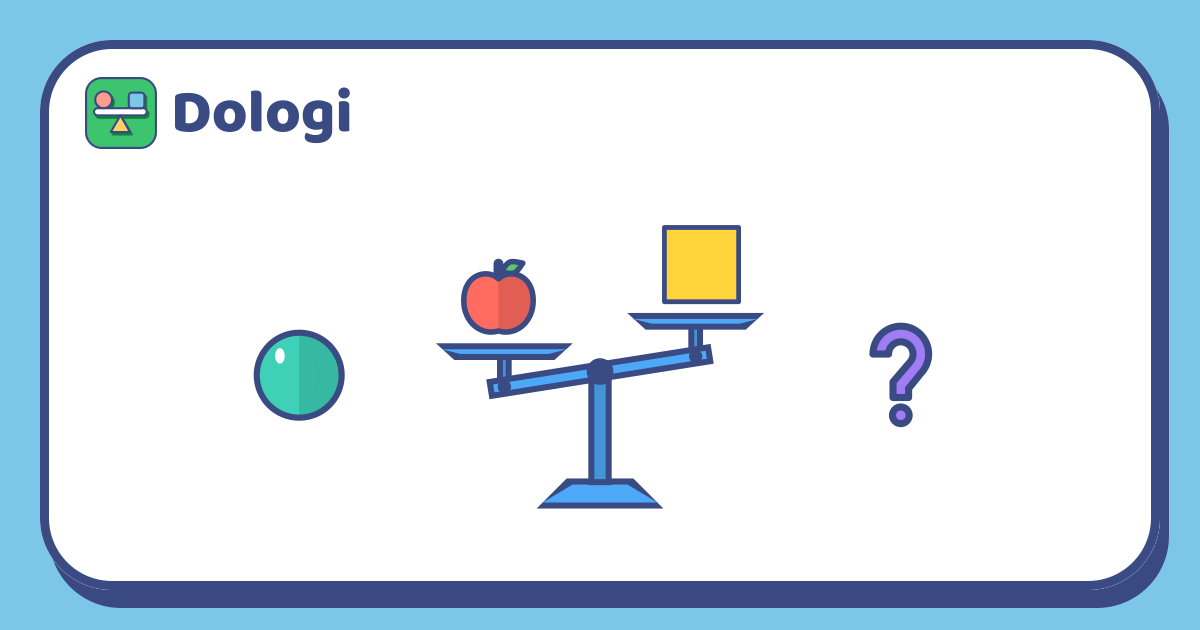
Put an apple on one side of a balance and a wooden block on the other, and the scale tips. Children understand straight away that the lower side is heavier. What's less obvious, and much more interesting, is everything they can work out from a balance without weighing everything at once.
Balance puzzles are a lovely way to practise reasoning: comparing, ordering, and drawing conclusions from what the scale shows. This post covers a homemade balance, a few experiments, and paper puzzles for older children.
A balance from a coat hanger
You don't need special equipment. A simple balance takes five minutes:
- Hang a coat hanger from a door handle or a hook so it can swing freely.
- Tie a paper cup or a small bag to each end with string of the same length.
- Check that the empty hanger hangs level. If it doesn't, slide one string a little until it does.
Now your child can put an object in each cup and watch which way the hanger tips. Keep the objects small and light: toy cars, spoons, blocks, pieces of fruit, a handful of pasta.
Big doesn't always mean heavy
Before each comparison, ask for a prediction: "Which one do you think will go down?" Young children often expect the bigger object to be heavier. A few surprises help them separate the two ideas:
- A big ball of scrunched-up paper and a small stone. The stone usually wins.
- A large plastic toy and a small metal spoon. Try it and see.
- Two cups of the same size, one filled with cotton wool and one with rice.
After each test, talk about it: "It was bigger, but it went up. Why do you think that is?" There's no need for a full explanation of density; noticing that size and weight are different things is the real lesson.
Three objects, two weighings
Here's a classic puzzle. You have three objects, say an apple, a block and a ball. Can your child put them in order from heaviest to lightest?
The obvious way is to compare every pair. But there's a clever shortcut:
- Weigh the apple against the block. The apple goes down: apple is heavier than block.
- Weigh the block against the ball. The block goes down: block is heavier than ball.
- Now ask: "Do we need to weigh the apple against the ball?"
If the apple is heavier than the block, and the block is heavier than the ball, then the apple must be heavier than the ball. This kind of chain reasoning is a big step in logical thinking, often understood from around age 7, though children differ.
Let your child check it with a third weighing anyway. Seeing the prediction confirmed builds confidence in the reasoning.
Balance puzzles on paper
Once children have played with a real balance, they can solve balance puzzles drawn on paper. Draw a level scale and pictures instead of numbers.
| What the scales show | Question |
|---|---|
| 2 apples balance 1 melon | How many apples balance 2 melons? |
| 1 block balances 3 marbles | How many marbles balance 2 blocks? |
| 1 cup balances 2 spoons, 1 spoon balances 3 beads | How many beads balance 1 cup? |
The key idea is that a level scale means both sides are equal, so you can swap one side for the other. That's the beginning of thinking about equations, without any symbols.
For younger children, use real objects first: if one toy car balances three blocks, put two toy cars on one side and let your child find how many blocks are needed.
Make the test fair
Real balances teach a useful lesson about fair testing:
- Check the empty balance is level before every session.
- Put objects in the middle of the cup, not hanging over the edge.
- Change one thing at a time. If you swap both objects at once, you won't know which one made the difference.
When a result seems odd, ask: "Was it a fair test? Shall we try again?" That habit of checking matters more than any single answer.
In Dologi, "Balance scales" puzzles show blocks on balances, and children use what the scales show to work out which block is the heaviest or how many blocks will make a scale balance, the same reasoning as the paper puzzles above.
In short
- A coat hanger and two cups make a balance your child can experiment with.
- Predict before each weighing, and use surprises to show that big doesn't always mean heavy.
- Order three objects with two weighings, using chain reasoning.
- Try paper balance puzzles, where a level scale means both sides are equal.
Read more: Teaching children to measure: long and short, heavy and light, full and empty