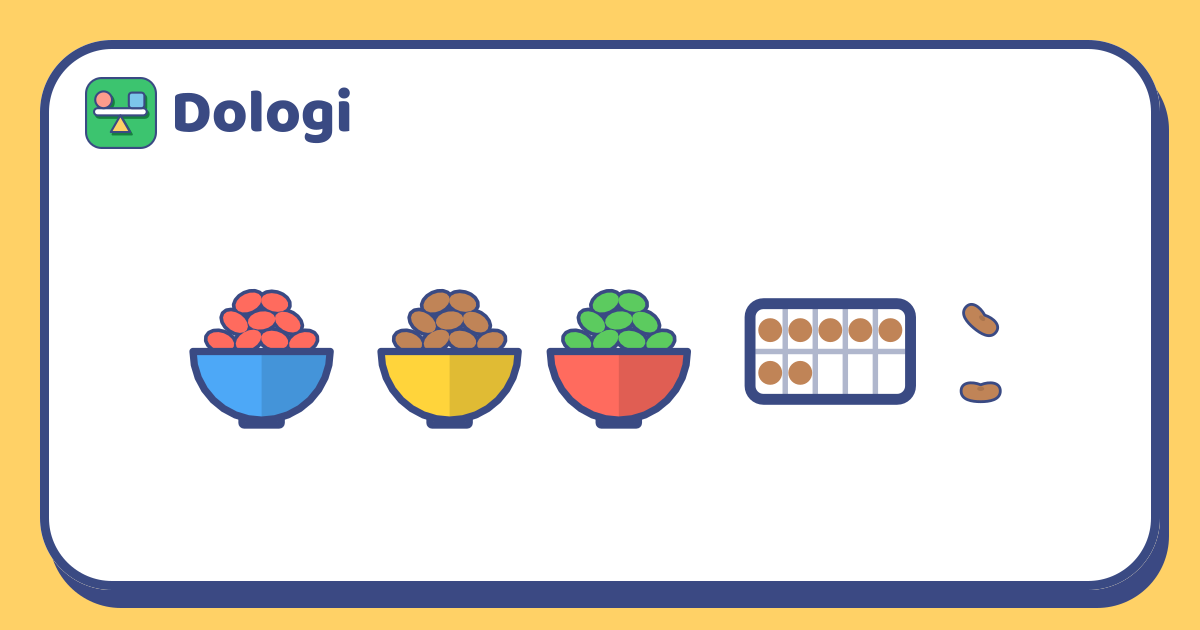
"I've got five, five, five and three. That's… eighteen!"
Dried beans are one of the best maths materials you can find in a kitchen cupboard. They're small enough to count in large numbers, they come in different colours and sizes, and a bag costs very little. With a few bowls and some paper, they turn into sorting games, counting games and the first steps of multiplication and division.
Before you start
- Sit next to your child. Beans are small, and young children may put them in their mouths, noses or ears. Keep them away from babies and toddlers.
- Dried beans are not for eating raw. Keep the play beans separate from the cooking beans.
- Use a tray or a tea towel so beans don't roll everywhere, and a bowl for each kind.
Sorting beans
Mix two or three kinds of beans in one bowl: for example red beans, white beans and green split peas.
- Sort them into separate bowls. Younger children can sort by colour; older ones can sort by size or shape too.
- Ask: "Which bowl has the most? How can we find out?" Some children guess by looking; others decide to count.
- Hide a few beans of a fourth kind in the mix. Who spots them first?
Sorting by hand also trains careful fingers: picking up one small bean at a time takes concentration.
Counting in groups of five and ten
Counting a big pile one by one is slow and easy to lose track of. Groups make it easier.
- Groups of five. Make little piles of five beans each, then count the piles: "five, ten, fifteen…" and add the leftovers.
- Ten frames. Draw a rectangle with two rows of five boxes. One bean per box. A full frame is ten. How many full frames can you make?
- Tens and ones. Put ten beans into a small cup or bag. Count the cups as tens and the loose beans as ones: "Three cups and four beans makes thirty-four."
This is the beginning of place value, the idea behind how we write numbers like 34.
How many in the jar?
Fill a clear jar with beans and ask everyone to guess how many are inside. Write the guesses down. Then count together, in groups of ten.
- Whose guess was closest?
- Try again with a different jar. Do the guesses get better?
- For older children: count a small spoonful, then estimate how many spoonfuls fill the jar.
Estimating, then checking, helps children get a feel for what 50, 100 or 300 actually looks like.
Sharing equally
- Give your child twelve beans and two plates: "Share them so both plates have the same." Then three plates, then four.
- What happens with thirteen beans and two plates? Talk about the one left over.
- Turn it around: "Four plates with three beans each. How many beans altogether?"
Sharing is division, and plates with the same number of beans are multiplication, long before these words appear at school.
| Rough age | What to try |
|---|---|
| 4–5 | Sorting two kinds of beans; counting up to ten; sharing between two plates (with an adult beside them) |
| 6–7 | Groups of five; ten frames; jar estimates; sharing between three or four plates |
| 8–9 | Tens and ones with cups; leftovers when sharing; plates with the same number as multiplication |
| 10 and up | Estimating with spoonfuls; large jars; making their own bean puzzles for others |
Ages are only a rough guide, and every child is different.
In Dologi, the Math topic has "Sort into boxes" puzzles, where children sort things by a feature, such as the number of dots on a die. It's the same careful looking and sorting your child does with the bean bowls.
In short
- Beans are a cheap maths kit; sit next to young children and keep them away from babies.
- Sort by colour, size and shape, then ask which bowl has the most.
- Groups of five and ten, ten frames and cups of ten make big numbers easy to count.
- Jar estimates and sharing equally lead to number sense, multiplication and division.
Read more: When can children count to 10, 20 or 100? Reciting numbers vs really counting