"Can the computer read my writing?" In fact, a computer doesn't understand letters, or even numbers, the way we do. Inside it are billions of tiny switches, and each switch has only two states: on or off. People write on as 1 and off as 0. Every photo, song and game on a computer is stored as long strings of 0s and 1s. This way of writing things down is called binary.
This article shows you how to make five dot cards so your 8-to-12-year-old can count like a computer, then use them to write names, send messages and perform a magic trick. All you need is paper, a pen and a little time.
Just two symbols for every number
We count with ten digits, from 0 to 9. A computer has only two: 0 and 1. So how can it write 5, or 20?
The secret is that each position in the string has its own value, and that value is double the one to its right: 1, 2, 4, 8, 16, 32… If a position shows 1, you count its value; if it shows 0, you skip it. Add them up and you have the number. Each of these positions is called a bit.
It's hard to explain in words, but with the cards in their hands, children get it quickly.
Making five dot cards
- Cut five hand-sized cards from stiff paper.
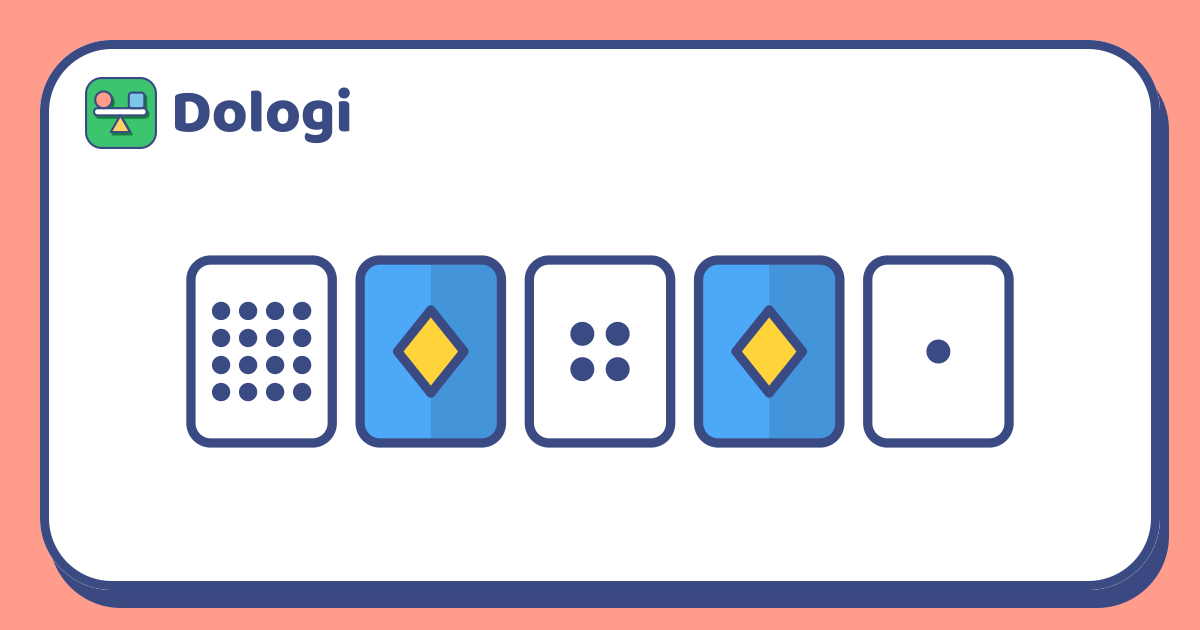
- Draw dots on one side: 1 dot on the first card, then 2, 4, 8 and 16. Leave the other side blank or colour it in.
- Lay the cards in a row with the card with the most dots on the left: 16, 8, 4, 2, 1.
Before you start, let your child spot the pattern: "How many dots does each card have compared with the one on its right?" If you added another card on the left, how many dots would it need?
There is only one rule: face up means 1, face down means 0. The number is the total of the dots on the face-up cards.
Building numbers with the cards
Start with a few small numbers:
- 5: turn up the 4 card and the 1 card, and turn the rest down. Reading from the left: down, down, up, down, up, which is 00101.
- 6: turn up the 4 and the 2: 00110.
- 31: turn up all five: 11111. That is the biggest number five cards can make.
- 0: all face down.
Then challenge your child: what about 9, 13, 20 or 27? Each number has exactly one way of being made. A tip: start with the biggest card and ask, "Does this one fit?" If it does, turn it up and subtract; if not, turn it down and move to the next card.
Counting challenge: your child counts from 0 to 31, flipping cards each time to show the next number. Notice that the 1 card flips every time, the 2 card every second time, and the 4 card every fourth time. It is a very regular pattern, like a clock with lots of hands.
Writing names and sending messages in code
Writing names: number the letters of the alphabet in order: a is 1, b is 2, c is 3, and so on. Five cards go up to 31, enough for every letter. Your child writes their name as a series of five-digit strings of 0s and 1s; for example, "c" is 00011. Hand it to you to decode.
Torch messages: light on is 1, light off is 0. Each letter is five equal beats, say one clap per beat. The receiver writes down each beat, then looks up the letter. The beats must be steady to be read correctly, just as machines sending messages to each other have to keep to the same rhythm.
Younger children can send a single word rather than a whole sentence, or just numbers.
The magic trick: find the flipped card
This trick shows your child how computers spot errors when data is sent or stored.
- Use 36 cards (or bottle caps) with a different colour on each side. Your child lays out a grid of 5 rows by 5 columns, face up or down however they like.
- Say "let's make it harder", and add an extra column on the right and an extra row at the bottom. Secretly, you choose each new card so that every row and every column has an even number of face-up cards.
- Turn your back. Your child flips exactly one card, any card.
- Turn round and find the row with an odd number of face-up cards and the column with an odd number. The flipped card is where that row and column meet.
After a few goes, share the secret and let your child be the magician. Computers add check bits like these to data: when a bit gets changed by mistake along the way, the computer can tell something is wrong, and sometimes even find exactly where.
These ages are only a rough guide, and every child is different. Eight- and nine-year-olds usually enjoy building numbers and sending messages; ten-to-twelve-year-olds tend to love the magic trick and the question "how high could you go with six cards?"
Binary is a kind of code key: one shared rule, and anyone who knows it can read the message. In Dologi, the "Crack the code" puzzles give your child a solved message to help finish a code key, then ask for the secret number of a lock.
In short
- Computers store everything with two symbols, 0 and 1, like switches that are off or on.
- Five cards with 1, 2, 4, 8 and 16 dots, face up for 1 and face down for 0, can make every number from 0 to 31.
- Your child can use the cards to write their name in code and send torch messages.
- The flipped-card trick shows how computers add check bits to spot errors.
Read more: Picture codes for children: a code-breaking game for home and Coding without a computer: algorithm games for children aged 5 to 10.