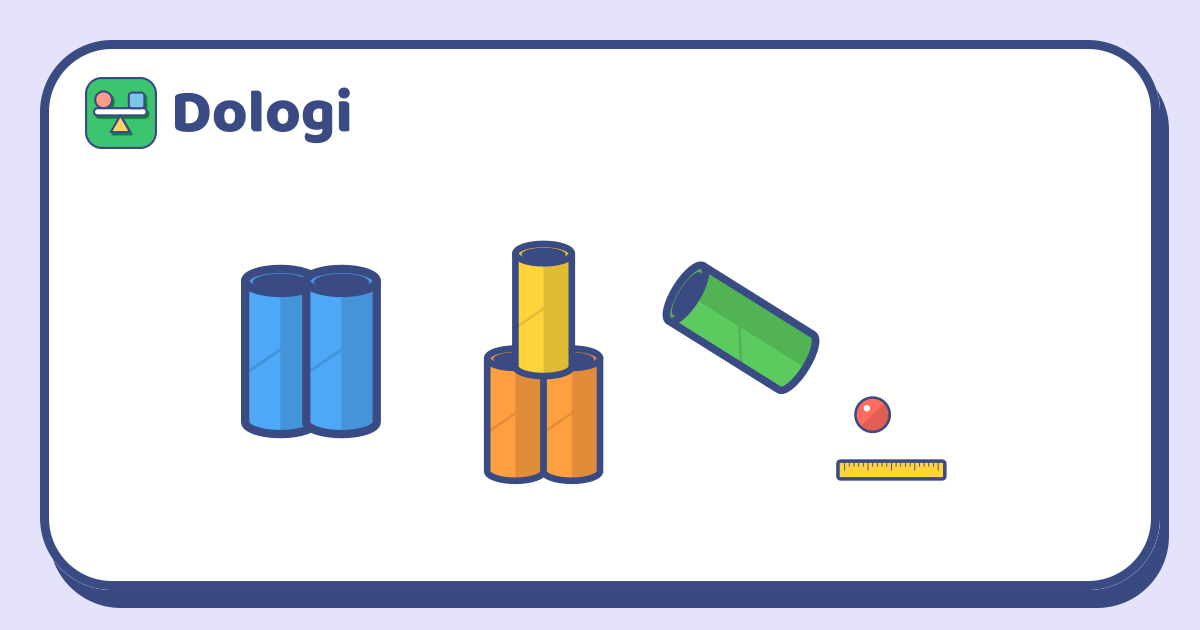
"Can we keep the tube? I need it for my ball run!"
Cardboard tubes from kitchen rolls and wrapping paper pile up in every home. Instead of recycling them straight away, keep a box of them. They're light, sturdy and easy to cut and tape, which makes them a great free material for building, looking and experimenting. Many of the games are about space: where things are, how they fit together, and where a rolling ball will go.
What you need
- Cardboard tubes of different lengths. Kitchen roll and wrapping paper tubes are cleaner and longer than small ones.
- Masking tape or painter's tape, which comes off walls more easily.
- Child-safe scissors, used with an adult for cutting slits.
- A ball that fits through the tubes: a ping-pong ball, a pom-pom or, for older children, a marble. Marbles are a choking risk for small children, so keep them for children who no longer put things in their mouths.
Binoculars and spyglasses
Tape two tubes side by side to make binoculars, or use a single tube as a spyglass.
- Play I spy through the tubes: "I can see something round and red." Looking through a tube narrows what you can see, so your child has to move and search.
- Describe positions: "It's above the window, to the left of the clock."
- Swap roles: your child finds something through the tube and gives you clues to find it.
Towers and structures
- How tall a tower can you build with tubes standing upright? Does it work better with two at the bottom and one on top?
- Cut short slits at the ends so tubes slot into each other, and build a frame, a bridge or a house.
- Lay tubes side by side as a raft or a fence. How many do you need to go across the table?
Each collapse is a chance to ask: "Where was it weak? What could hold it up?"
Ball runs
Tape tubes to a wall, a large box or the back of a door to make a run for a ball. Some can be whole, some cut in half lengthwise to make open chutes.
- Start with a single tube at a slope. Drop the ball in the top. Where will it come out?
- Add a second tube that catches the ball and sends it the other way, then a third.
- Before each drop, ask your child to predict: will the ball make it to the end? Where might it get stuck?
Building a run means imagining the ball's path before it moves, a lovely piece of spatial planning.
How far does it roll?
Prop one tube at a slope on a table or the floor, let the ball roll out, and mark where it stops.
- Measure the distance with a ruler, a tape measure or footsteps.
- Make the slope steeper. Does the ball roll further? Make it shallower and test again.
- Change only one thing at a time: the slope, the ball, or the floor. That's how scientists test ideas.
Tubes in order
Cut tubes to different lengths. Line them up from shortest to longest, or stand them up like a staircase. Then ask: "How many short tubes make one long one?"
| Rough age | What to try |
|---|---|
| 3–4 | Looking through a tube; stacking two or three tubes; rolling a pom-pom through a tube |
| 5–6 | Binoculars and I spy; towers; a single slope with a ping-pong ball |
| 7–8 | Ball runs with three or more tubes; predicting where the ball comes out; measuring how far it rolls |
| 9 and up | Changing the slope and recording results; bridges and frames with slotted tubes; designing a run on paper first |
Ages are only a rough guide, and every child is different.
In Dologi, "Water the flower" puzzles in the Space topic ask children to turn pipes so that water flows from the tank to the flower pot. Like a ball run, every piece has to line up with the one before it.
In short
- Keep a box of cardboard tubes; they're free, light and easy to cut and tape.
- Binoculars and I spy turn looking and describing positions into a game.
- Towers, frames and ball runs train children to picture how pieces fit and where a ball will go.
- Measuring how far a ball rolls is a first experiment: change one thing at a time.
Read more: How many uses can you find for a cardboard box? A challenge in thinking differently