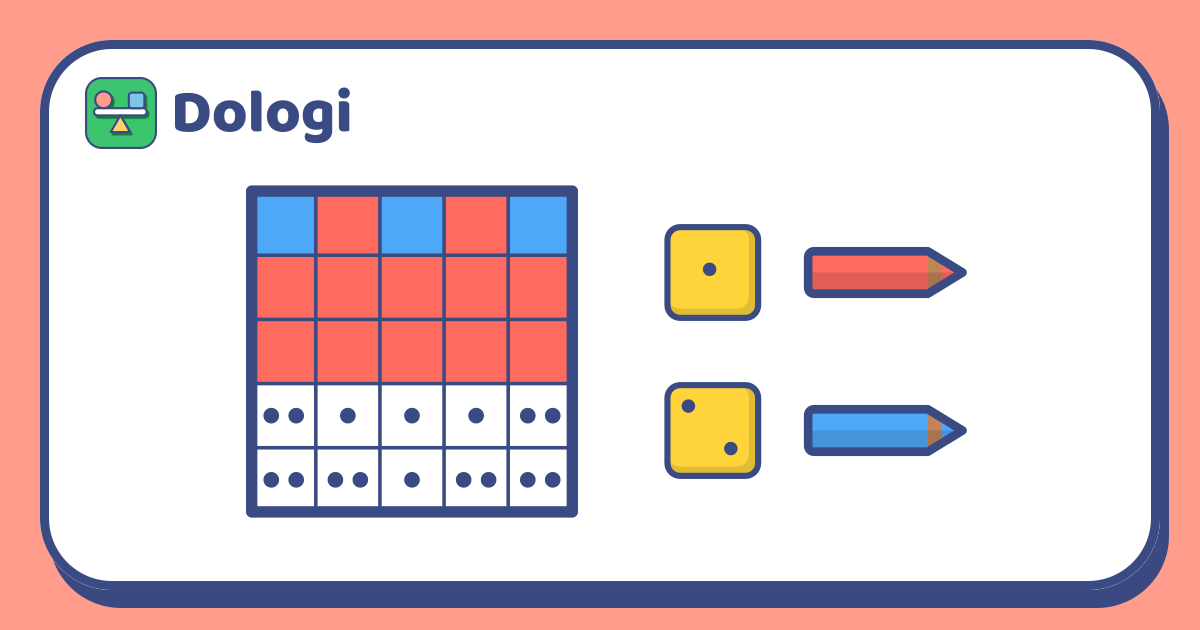
A grid of squares with one or two dots in each. Beside it, a small key: one dot means red, two dots mean blue. Your child colours square after square, and slowly a picture appears that nobody could see at the start.
Wanting to see the picture keeps children going. Along the way they practise reading a key, working through a task in order and noticing their own mistakes.
Making one in five minutes
- Draw a grid of five rows of five squares. Squared paper makes it easy.
- Decide on a simple picture: a heart, a house, a fish. Work out for yourself which squares belong to the picture and which to the background.
- Put the code in each square: one dot for the picture, two dots for the background.
- Draw the key next to the grid: one dot beside a scribble of red, two dots beside a scribble of blue.
Make the first one together, so that your child sees how the dots and the key belong to each other.
Two ways through the grid
Before the first square is coloured, read the key aloud together. Then there are two sensible ways to work.
| Way | How it goes | What it asks for |
|---|---|---|
| Row by row | Colour every square from left to right, then the next row | Changing pencils often, never losing your place |
| Colour by colour | Find and colour all the one-dot squares first, then the two-dot squares | Searching the whole grid for one code at a time |
Let your child try both on different pictures and say which one led to fewer mistakes. There is no right answer, and comparing the two is the valuable part.
A slip shows up by itself: one blue square in the middle of a red heart looks wrong. Ask "Does anything look odd?" and let your child check that square against the key.
Six levels
| Level | The grid | The code |
|---|---|---|
| 1 | Five by five, two colours | One dot and two dots |
| 2 | Up to eight by eight, three or four colours | One to four dots |
| 3 | The same grids | Numerals |
| 4 | The same grids | Small sums: a square says "2 + 1", and 3 means green |
| 5 | An empty grid with letters across and numbers down | A list beside it: "B3 red, C3 red, D4 blue" |
| 6 | Your child's own grid | A secret picture designed for someone else |
Level 6 turns the game round. To hide a picture in a code, your child has to plan the picture, choose the key and write the right code into every square without a single mistake.
What reading a key teaches
A key is an agreement that one thing stands for another. Two dots are not blue. They mean blue because the key says so, and with another key they could mean yellow.
The same idea is behind the legend of a map, the notes of a song and the letters of a word. A child who has coloured by code a few times has met that idea in a form they can see and correct.
| Rough age | What to try |
|---|---|
| 4–5 | A five-by-five grid with two colours and dots, made together |
| 6–7 | Three or four colours; numerals; working colour by colour |
| 8–9 | Sums as the code; designing a picture for a brother, a sister or a friend |
| 10 and up | Grid references; bigger grids; a picture that is the same on both sides of a middle line |
Ages are only a rough guide, and every child is different.
In Dologi, "Secret picture" puzzles in the Focus topic work the same way: children fill in the squares using the code key until the secret picture appears.
In short
- A grid, a code of dots and a key are enough for a picture that only appears through colouring.
- Row by row and colour by colour are two ways through the grid, and they are worth comparing.
- Mistakes show up in the picture, so children can find and fix them without being told.
- Designing a coded picture for someone else is the hardest and most rewarding level.
Read more: Picture codes for children: a code-breaking game for home