Your child adds 5 + 3 and you see little fingers popping up under the table. Many parents wonder whether this is a problem, or whether they should tell their child to stop. The short answer: counting on fingers is a normal and useful step. What matters is that, little by little, children add other ways of thinking about numbers, so their fingers become one tool among several rather than the only one.
Why children use their fingers
- Fingers are always there. Unlike blocks or counters, they come everywhere.
- Ten fingers match our number system. Our numbers are built around tens, and hands show five and ten naturally.
- Fingers make quantities visible. Holding up three fingers turns the idea "three" into something you can see and feel.
- They lower the load on memory. A young child cannot yet hold several numbers in mind at once, so fingers help keep track.
For many children aged around 4 to 7, fingers are an important bridge between counting objects and working with numbers in the head. Every child is different, so there is no exact age to stop.
When fingers help, and when to add something new
Fingers are most useful at the start. It may be time to offer new strategies when your child:
- Counts everything from 1 every time: for 5 + 3, counts "1, 2, 3, 4, 5, 6, 7, 8" instead of starting from 5.
- Is still slow on very small sums that come up again and again, like 2 + 2 or 5 + 5.
- Loses track when numbers get bigger than ten.
This is not a reason to forbid fingers. Forbidding them often just means children count secretly, with more stress. The goal is to offer faster and more flexible ways, so that your child chooses them naturally.
From counting to knowing: the usual steps
| Step | What it looks like for 5 + 3 |
|---|---|
| Count everything | Counts 1 to 5, then 1 to 3, then all of them from 1 |
| Count on | Starts at 5 and counts "6, 7, 8" |
| See groups | Sees 5 as "one full hand" and adds 3 more |
| Use known facts | "5 + 5 is 10, so 5 + 3 is 2 less: 8" |
| Just know it | Answers 8 straight away |
Children move between these steps, sometimes going back to an earlier one when a problem is new or hard. That is normal.
Games that help children see numbers
- Quick look. Show a card with dots (like a dice face) for one or two seconds, then hide it. "How many did you see?" Recognising small amounts without counting is a skill that grows with practice.
- Ten frames. Draw a grid of two rows of five, or use an egg box with ten holes. Put in seven buttons: "How many are there? How many empty spaces?" Children start to see 7 as "5 and 2" and "3 less than 10".
- Make ten with your hands. Hold up seven fingers. "How many fingers are down?" This uses fingers in a smarter way, to learn pairs that make ten.
- Doubles. 2 + 2, 3 + 3, 4 + 4. Use both hands, then dominoes with matching sides. Doubles become anchors for other sums: 4 + 5 is "4 + 4 and one more".
- Dice and dominoes. Board games with dice, matching domino halves, comparing which domino has more dots.
- "How did you see it?" Show six dots arranged in two rows of three. Ask your child how they saw them. Some see 3 + 3, some see 2 + 2 + 2, some count. All answers are interesting.
What to avoid
- Forbidding fingers or asking your child to hide them.
- Timed drills before your child understands what the numbers mean. Speed comes after understanding, not before.
- Comparisons: "Your cousin does it in her head already." Each child builds number sense at their own pace.
- Making a fuss. If your child uses fingers for a hard problem, that is a sensible choice.
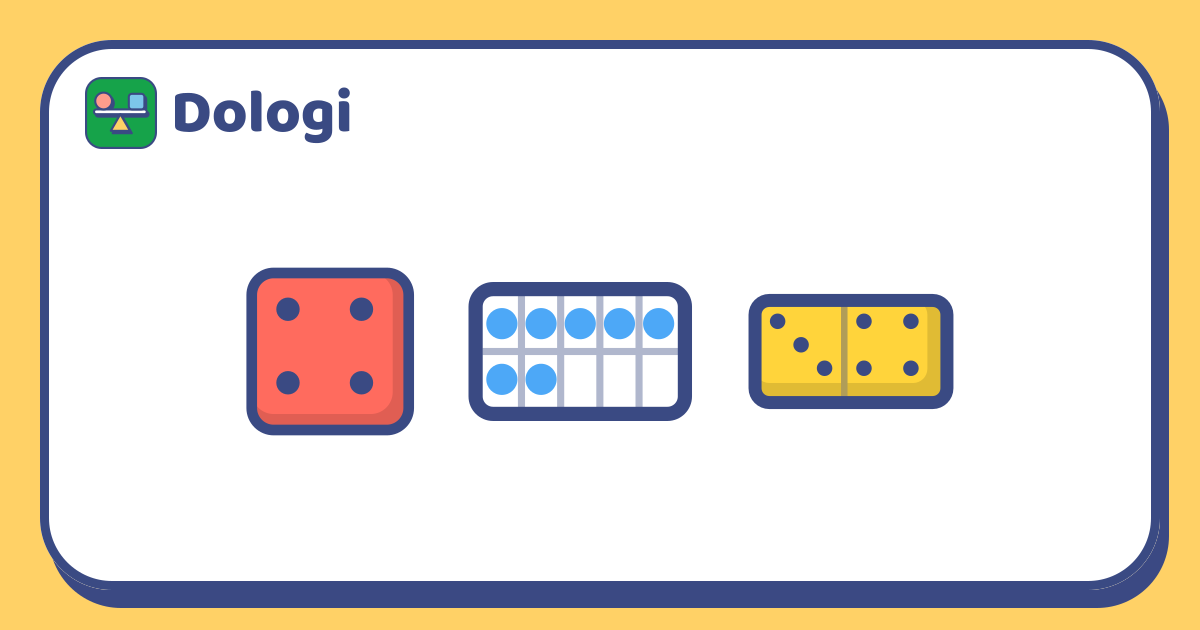
In Dologi, several puzzles show amounts in ten frames, dice patterns and dominoes, so children get used to seeing quantities at a glance. Short, regular games like the ones above work in the same direction.
In short
- Counting on fingers is a normal step, especially for younger children.
- The aim is not to forbid fingers but to add faster strategies: counting on, seeing groups of five and ten, using doubles.
- Quick-look dots, ten frames, "make ten" with your hands and dominoes build these strategies through play.
- Understanding comes first; speed follows.
Read more: What is mathematical thinking? How it differs from school math, and whether your child needs extra classes.