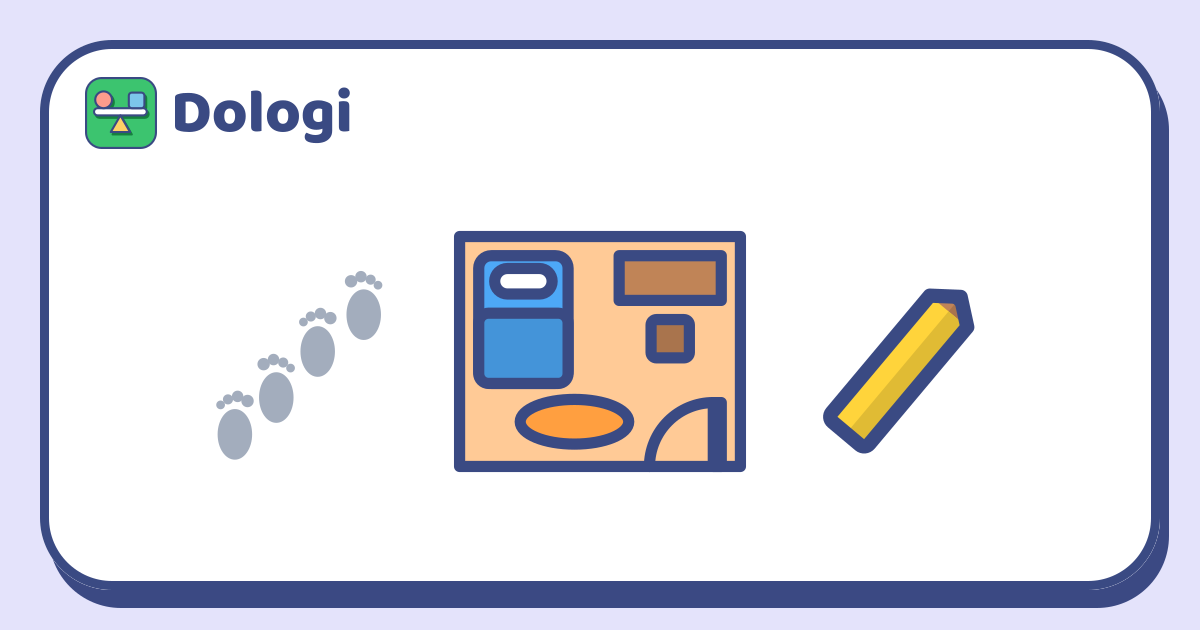
Imagine you're a fly on the ceiling. The bed becomes a long rectangle, the rug an oval, the door a line with a curve showing how it swings open. That view from above is exactly what a floor plan shows, and drawing one of your child's own room is a lovely way to practise spatial thinking.
The room is familiar, so children can always check the drawing against the real thing. All you need is paper (squared paper helps), a pencil and a little time.
Why draw a plan of the room
- Seeing from above. Children usually see furniture from the side. Imagining the top view, then drawing it, builds the mental flexibility behind maps, diagrams and geometry.
- Where things are. "The desk is next to the window, opposite the bed." A plan makes position words concrete.
- Size and distance. Is the bed longer than the desk? How far is the door from the window? Measuring and drawing makes children compare.
- Planning. Once the room is on paper, you can move furniture around without lifting anything.
First, look at things from above
Before drawing the room, play with top views:
- Toys on the table. Put a cup, a book and a ball on the table and look straight down at them. "What shape is the cup from up here?"
- Guess the object. Draw the top view of something in the room (a round rug, a square stool, the bed) and let your child guess what it is.
- Lie on the floor, then stand up. A chair looks very different from the floor and from above. Talk about what changes.
Measure the room in footsteps
Real plans are drawn to scale. Children can do a simple version with their feet:
- Walk heel to toe along one wall and count the steps. Write the number down.
- Do the same for the other walls, and for the bed and the desk.
- On squared paper, one square is one step. A wall of eight steps is eight squares long.
The numbers won't be perfect, and that's fine. The point is that the drawing keeps the room's proportions: a long wall stays long, a small stool stays small.
Draw the plan together
- Walls first. Draw the outline of the room using your step counts.
- Door and windows. Show the door as a gap with a curve for its swing, and windows as a double line in the wall.
- Big furniture. Bed, wardrobe, desk: simple rectangles in the right places.
- Small things. Rug, toy box, lamp, chair.
- Check it. Stand at the door with the plan, turn it so it matches the room, and check each piece. "Is the bed really in that corner?"
Let your child do as much of the drawing as they can. A wobbly plan they drew is worth more than a neat one you drew.
Games to play with the plan
- Hide and find. Hide a small toy, mark it on the plan with a cross, and let your child find it. Then swap.
- Where am I? Point to a spot on the plan; your child goes and stands there in the real room.
- Draw a route. "Draw the way from the bed to the door without walking on the rug."
- Design a dream room. Cut the furniture out of paper at the same scale and move it around on the plan. Does the bed still fit if it goes under the window? Can the door still open? Children quickly discover that some arrangements simply don't work.
Ideas by age
Ages are rough guides; follow your child.
- Around 4–5: top views of toys, guessing objects from above, a simple plan you draw together with a few big pieces of furniture.
- Around 6–7: measuring in footsteps, drawing walls and furniture in the right places, hide-and-find on the plan.
- Around 8 and up: squared paper and scale, doors and windows in plan style, cut-out furniture and a dream room design, or a plan of the whole home.
In Dologi, the Space topic has "Build from the plan" puzzles: a plan seen from above shows how many cubes stand on each square, and children pick the stack that matches it. It's the same skill of linking a top view to a real shape.
In short
- A floor plan shows a room from above, which builds spatial thinking.
- Warm up with top views of toys, then measure the room in footsteps.
- Draw walls, door, windows and furniture together, and check the plan against the real room.
- Play hide-and-find, draw routes and rearrange paper furniture to design a dream room.
Read more: Reading simple maps with your child: symbols, directions and the way to the park