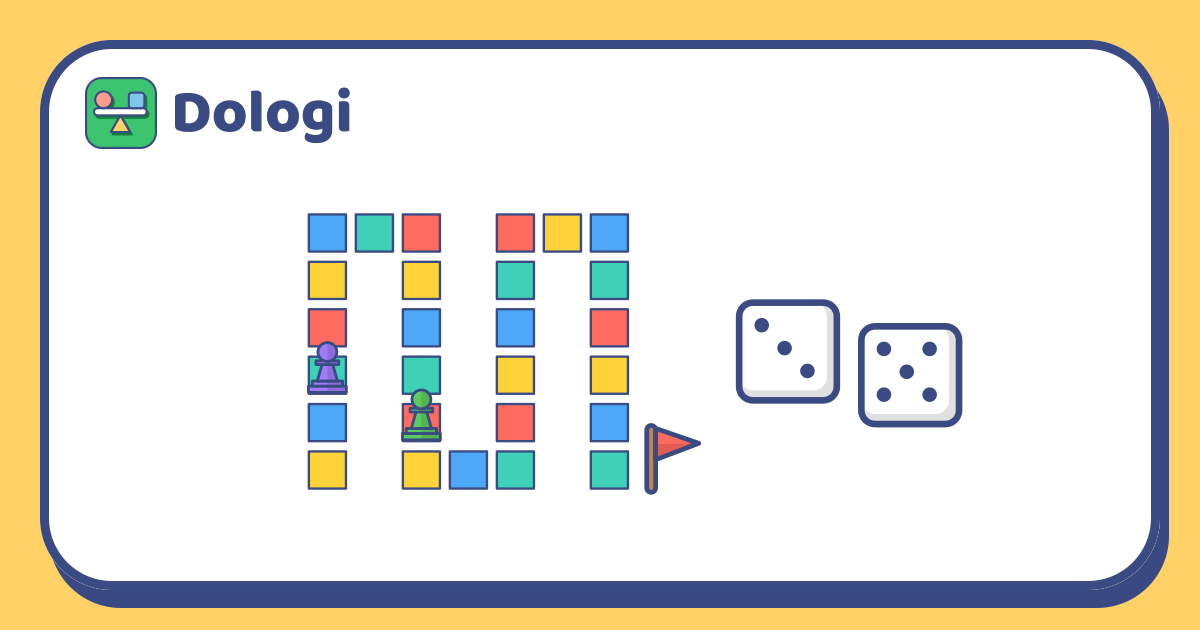
"Three! One, two, three… I'm on the star! I can jump forward two!"
A race track game is a winding path of squares, a start, a finish and a die. Bought versions exist, but drawing your own is half the fun: your child decides how long the track is, where it bends, and what happens on the special squares. And every turn is a little piece of counting practice.
What you need
- a large sheet of paper, or two sheets taped together;
- a thick pen and a few coloured pencils;
- one die (two for older children);
- a playing piece for each player: buttons, bottle caps or small toys.
Plan about twenty to thirty minutes for drawing the board. It is part of the game, not just the preparation.
Drawing the track
- Draw a start picture in one corner (a house) and a finish picture somewhere else (a flag or a cake).
- Join them with a winding road. Let your child choose where it bends.
- Divide the road into squares about the size of a playing piece.
- Colour the squares in a repeating pattern: red, yellow, blue, red, yellow, blue.
- Count the squares together. How many steps from start to finish?
How long should the track be? Twenty squares is enough for four- and five-year-olds; one game takes a few minutes. Older children enjoy forty or fifty squares, especially with two dice.
Special squares, in pictures
Special squares make the game more exciting, and they can be drawn instead of written, so children who can't read yet can play too.
| Picture | What happens |
|---|---|
| A star | Move forward two squares |
| A puddle | Move back one square |
| A bed | Miss your next turn |
| A ladder or a bridge | Jump ahead to the square it leads to |
| A heart | The player behind you moves forward one |
Keep it to four or five special squares on a short track. Too many, and the counting gets lost among the surprises.
How to play, and the counting mistake
Players take turns rolling the die and moving that many squares. The first one to reach the finish wins, or, for a gentler game, everyone keeps playing until all the pieces are home.
Almost every young child makes the same mistake at first: they count the square they are standing on as "one". If they roll a three, they move only two squares forward. Show the difference with your finger:
- Counting from where you stand: "I'm here. Now I move: one, two, three."
- Counting the square you stand on: "One (where I am), two, three." That's only two moves.
Let your child count aloud and tap each square. Making the mistake and fixing it together is exactly how counting on is learned. After a while, many children start to see the dice dots as a whole number without counting them one by one.
Two dice for older children
With two dice, every turn becomes a small sum.
- Add them up. Roll both dice and move the total. Encourage counting on from the bigger number: "Five… six, seven, eight."
- Choose a die. Roll both dice and choose one of the two numbers. Which one lands you on a star and avoids the puddle?
- Doubles. Two of the same number means you roll again.
- The exact finish. You have to land exactly on the finish. If you roll too much, you bounce back the extra squares. Now the game is about subtraction too: "I'm four away. What do I need?"
| Rough age | What to try |
|---|---|
| 4–5 | Twenty squares; one die; counting aloud and tapping each square; three or four picture squares |
| 6–7 | Thirty squares; counting on from where you stand; a ladder or a bridge |
| 8–9 | Two dice and adding; choosing one die; the exact finish |
| 10 and up | Designing the rules; tracks with forks; working out the best move before rolling |
Ages are only a rough guide, and every child is different.
In Dologi, the Math topic has puzzles such as "Add and answer", where children combine two small groups and find the total, the same quick sums that come up with every roll of two dice.
In short
- Drawing the board together is part of the game: start, finish, a winding road and squares.
- Picture squares (star, puddle, bed) let children who can't read yet play fully.
- Watch for counting the square you stand on; counting aloud and tapping each square fixes it.
- Two dice, choosing a die and an exact finish turn each turn into a sum for older children.
Read more: Dice games for children: counting and mental math with a pair of dice