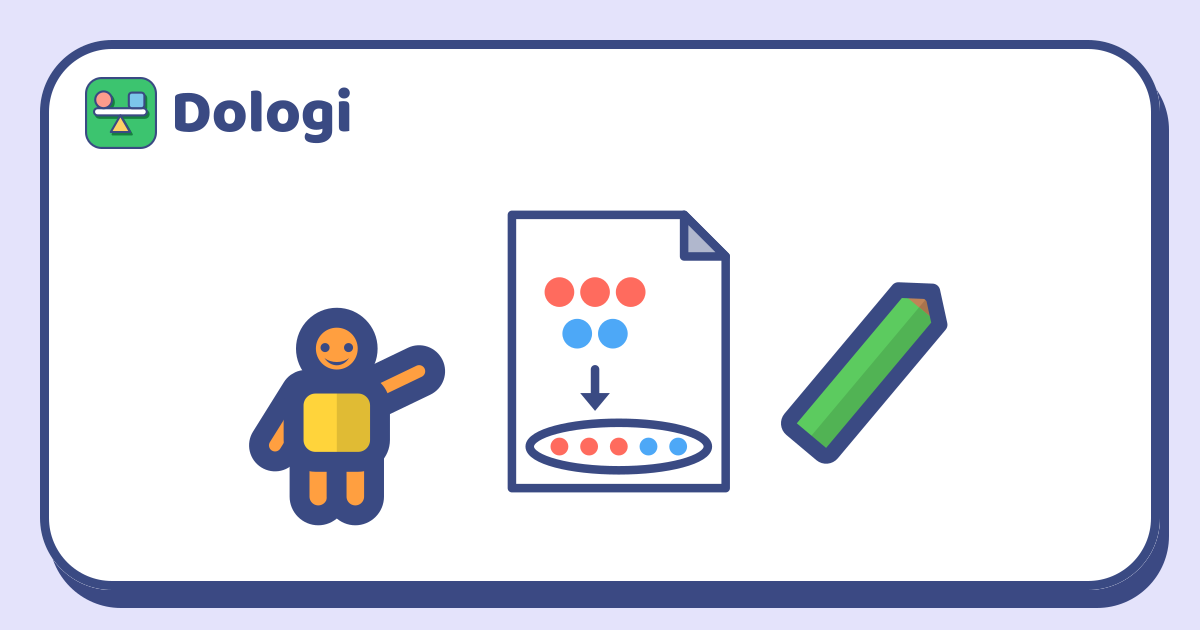
"There are 3 birds on a branch. 2 more birds land. How many birds are there now?" Many children freeze when a maths question comes wrapped in words. Yet the same child might solve it in seconds if they could see the birds.
That's the idea behind drawing to understand: turning a word problem into a quick sketch before doing any calculation. It's one of the most useful thinking tools a child can learn, and it works from the first simple sums all the way to much harder problems later on.
Why drawing helps
A word problem asks children to do several things at once: read, remember the numbers, picture the situation and choose an operation. A drawing takes some of that load off their memory.
- It makes the situation visible. Children can see what's happening instead of holding it in their head.
- It shows what's known and what isn't. The missing part becomes a visible gap.
- It slows children down. Drawing makes them read the problem properly before they start calculating.
The goal isn't a beautiful picture. It's a thinking tool.
Dots, not drawings
The most common trap is spending ten minutes drawing perfect birds. Teach your child to use simple marks instead:
| Instead of drawing... | Draw... |
|---|---|
| Birds, sweets, cars | Dots or small circles |
| Long amounts, distances | Bars or lines |
| Groups, bags, plates | Rings around the dots |
| The thing we don't know yet | A question mark |
Say it plainly: "Your drawing just needs to show how many and what happens. A dot is a bird."
Step by step
Practise the same simple routine every time:
- Read the problem (or listen to it) all the way through.
- Draw what you know. Three dots for three birds.
- Draw what happens. Two more dots arriving, with an arrow.
- Mark what you're looking for with a question mark or a ring.
- Solve it, by counting or calculating.
- Check against the story: "Does the answer make sense?"
At first, do the drawing together and talk through it aloud. Gradually, let your child take over the pencil.
Three kinds of problems to draw
Putting together or taking away. "5 apples, we eat 2." Draw 5 dots, cross out 2, count what's left.
Comparing. "One box has 7 pencils, the other has 4. How many more in the first box?" Draw two bars, one longer than the other, side by side. The extra piece at the end of the longer bar is the answer. Bar drawings are especially useful because they still work when the numbers become too big to draw as dots.
Sharing. "12 stickers shared equally between 3 children." Draw 3 rings (the children) and deal dots into them one at a time, like dealing cards. Then count the dots in one ring.
For each type, ask your child to explain the drawing: "Show me where the 3 children are. Where are the stickers?"
When to start, and how far to go
- Ages 5–6: act out problems with real objects first, then draw dots for very small numbers.
- Ages 6–8: dots, rings and crosses for adding, taking away and sharing.
- Ages 8 and up: bars for comparing and for bigger numbers, and drawings for problems with two steps.
Some children love drawing, others find it slow at first. Keep it short and praise the thinking, not the artwork. Once children see that a sketch makes hard problems easier, most start doing it on their own.
In Dologi, "Fruit swap" puzzles show trade cards where one fruit swaps for several of another, and children work out how many they'd get. Drawing the fruit in groups, one ring for each swap, is exactly the kind of sketch that helps.
In short
- A quick drawing turns a word problem into something children can see.
- Use dots, bars, rings and a question mark, not detailed pictures.
- Follow a routine: read, draw what you know, draw what happens, mark the unknown, solve, check.
- Practise with adding, comparing and sharing problems, and move to bars as numbers grow.