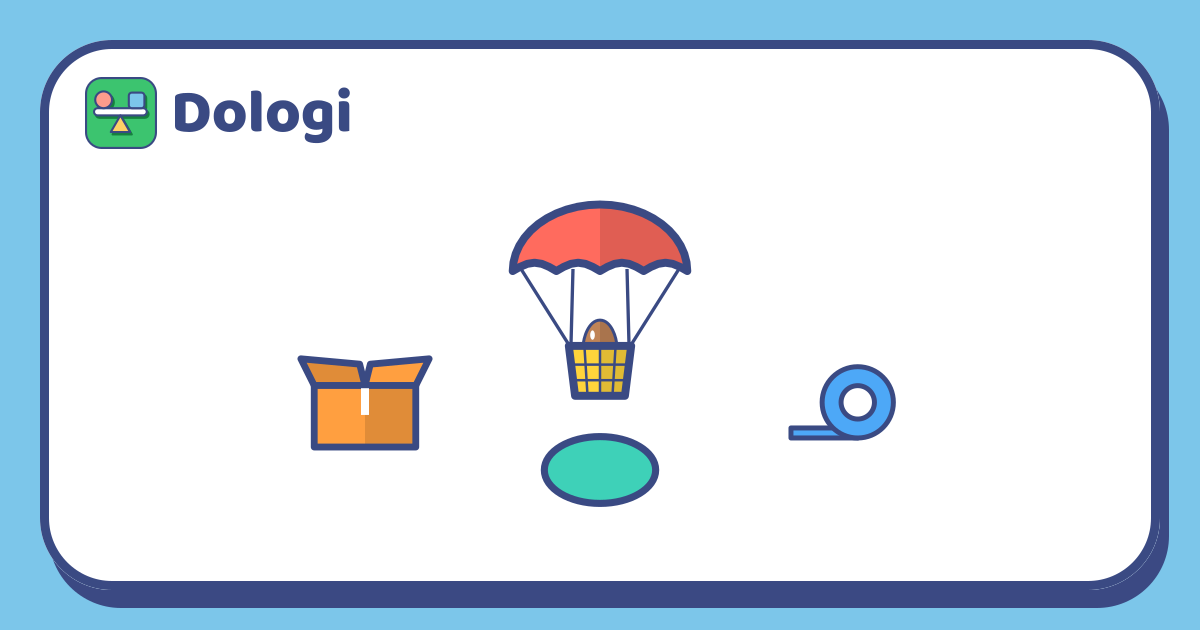
Give a child an egg and tell them to drop it on purpose, and you will have their full attention. Add one condition, the egg must not break, and you have one of the best design challenges you can do at home. It needs no special kit, only an egg, a few things from the recycling bin and somewhere to make a little mess.
This article explains how to run the egg drop challenge with children of roughly 6 to 12, with a gentler version for younger ones. The heart of it is not the first drop but what comes after: looking at why the egg broke, and building a better version.
What you need and who does what
- Eggs: one per attempt, plus a few spare. For a first try or for younger children, a hard-boiled egg makes far less mess.
- Building materials: straws, newspaper, kitchen roll, paper cups, small cardboard boxes, plastic bags, string, rubber bands, sticky tape. Set a limit, for example "ten straws, one bag and an arm's length of tape", so the challenge is about ideas, not quantity.
- A landing spot: an old sheet, a plastic tablecloth or a few sheets of newspaper on a hard floor, or a patch of ground outside.
Roles are simple:
- You: choose the drop spot and do the dropping from any height above your child's reach. Your child never climbs on chairs, tables or railings, and nothing is dropped from a window or balcony.
- Your child: design, build, guess and record. Everyone washes their hands after handling a raw egg.
Rules for a fair drop
To compare designs, every drop should be the same in every way except the capsule:
- Same height: for example from your outstretched arm while standing, or from the same step on the stairs. Mark the spot with a piece of tape.
- Same landing surface: always on the sheet, always on the same floor.
- Same kind of egg: all raw or all boiled.
Talk about it before you start: "If I drop your egg from higher than your sister's, is that fair?" Children quickly see why the rules matter, and you are teaching the idea of a fair test without naming it.
Guess first, then drop
Before each drop, ask your child to say what they think will happen and why. Write it on a simple sheet:
| Design | My guess | Result | What I noticed |
|---|---|---|---|
| Egg wrapped in paper | Will crack | ||
| Egg in a straw basket under a bag parachute | Will survive | ||
| Egg in a cup packed with kitchen roll |
The reason matters more than the guess: "The bag will slow it down", "The straws will squash like springs". After the drop, look at the egg together, gently, then compare the result with the reason.
Why an egg breaks, and three ideas that help
A falling egg breaks when it stops too suddenly against something hard. Most good designs use one or more of these ideas:
- Slow the fall: a parachute made from a plastic bag and four strings catches air and lowers the egg more gently.
- Cushion the landing: crumpled paper, kitchen roll or a cage of straws squashes on impact, so the egg stops more gradually.
- Spread the bump: holding the egg snugly in the middle, so it doesn't knock against one hard wall, protects it from any single hit.
You don't have to explain all three at the start. Let your child discover them through broken eggs. When a straw cage crumples and the egg survives, ask: "What happened to the straws? Where did the bump go?"
Improve, then drop again
The most valuable step is the second version. After each drop, ask three questions:
- What worked? Keep it.
- What failed? Look closely: did the egg crack on the bottom, on the side, or did it fall out?
- What one thing will you change? Changing just one thing at a time shows clearly what made the difference.
A child who goes from "my egg broke" to "it cracked on the bottom, so I'll add more paper underneath" has done the whole cycle of an engineer: design, test, look, improve. A broken egg is not a failure; it is information.
For children around 4 to 5: let them choose materials and guess "break or not break" for capsules you build together. They can also do the tidy-up checks: is the egg whole?
Dologi follows a similar spirit: when an answer is not right, the puzzle invites your child to look again and try another way, rather than ending the game.
In short
- One egg, a few recycled materials and a limit on what can be used make a strong design challenge for children aged about 6 to 12.
- Keep every drop fair: same height, same floor, same kind of egg; you do the dropping.
- Always guess first with a reason, then look closely at where and why the egg broke.
- Change one thing at a time and drop again: the second version is where the learning happens.
Read more: Try, see what goes wrong, fix it: a builder's way of thinking for children