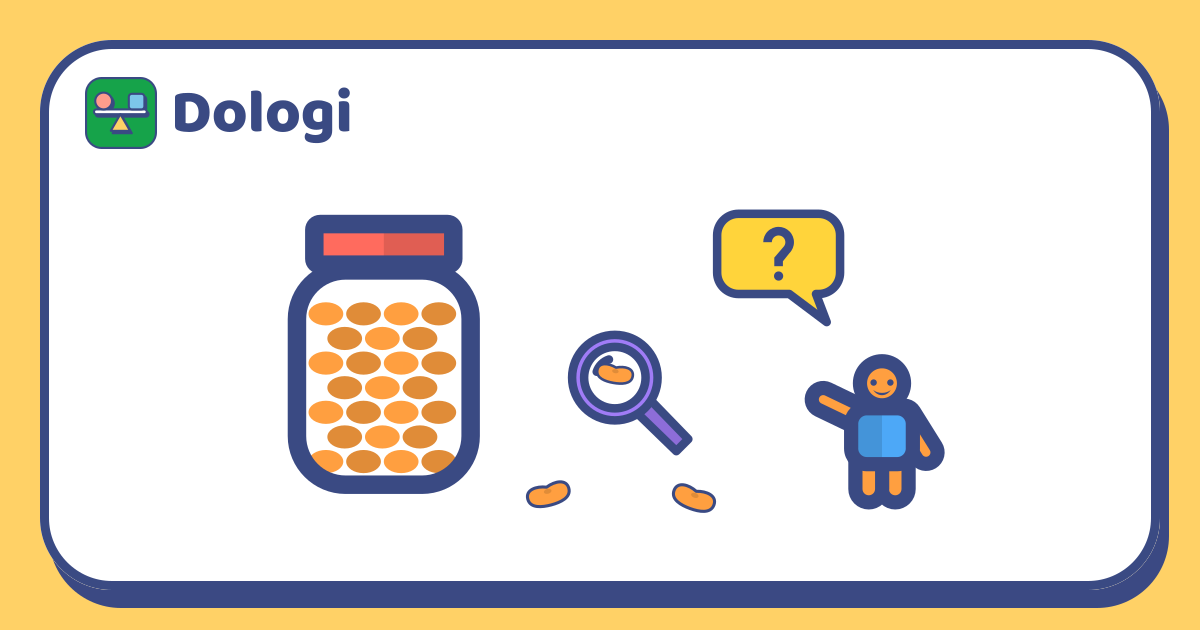
"How many beans do you think are in this jar?" Some children answer "a million!", others shrug, and some start counting one by one. Estimating sits between those reactions: it's a sensible guess that you can then check.
Estimation is a quietly useful thinking skill. Adults use it all the time: how long the drive will take, whether there's enough pasta for everyone, whether a shelf will fit. For children, it builds number sense, a feeling for how big numbers are, and it teaches that a good guess is something you can improve. This article explains the idea and suggests simple games for home.
What is estimating?
Estimating means finding a number that is close enough, quickly, without counting or measuring everything.
- It's not a wild guess. A good estimate uses something you know: "Ten beans fill this much, and the jar is about five times bigger."
- It's not about being exactly right. "About 50" is a great estimate if there are 46.
- It's always checked afterwards, at least while learning. Checking is what turns guessing into thinking.
Words like "about", "nearly", "more than" and "less than" are part of the skill, so use them often.
The bean jar game
You need a clear jar and something small to fill it with: dried beans, pasta shapes, buttons or blocks.
- Fill the jar with a number that suits your child: around 10 to 20 for young children, more for older ones.
- Everyone makes a guess and writes it down or draws it. Grown-ups too.
- Tip the jar out and count together. Make groups of ten on the table: it's easier to count and easier to see.
- Compare the guesses with the real number. "Who was closest? Was it more or less than we thought?"
- Play again with the same jar and a different amount. Children often get much closer the second time.
There are no winners or losers here. The interesting part is the conversation: "Why did you think 30?"
Estimating length, weight and time
Numbers aren't the only things you can estimate.
- Length: "How many of your steps to the front door?" "Is the table longer than three of your arms?" Then check by walking or measuring with hands.
- Weight: Hold two things, one in each hand. "Which is heavier? Is the bag of apples heavier than the book?" Check with kitchen scales if you have them.
- Time: "How long do you think brushing your teeth takes?" Use a timer and compare. Many children are surprised by how short or long a minute feels.
- Amounts in the kitchen: "Will this water fill the glass? Half? To the top?" Then pour and see.
Helping your child make better guesses
Better estimates come from using what you already know.
- Start with a reference: count the first ten beans and look at how much space they take. "How many of those groups would fit?"
- Use the last try: "Last time there were 20 and the jar was half full. What about now?"
- Use round numbers: encourage answers like "about 30" rather than "31". Round numbers make estimating easier.
- Think aloud yourself: "I can see about five in a row, and there are about four rows, so I'll say 20."
- Celebrate improvement, not exact answers: "You were much closer this time!"
Ideas by age
Ages are only rough guides; every child is different, so start where your child is.
| Approximate age | What to estimate | Example question |
|---|---|---|
| 4–5 | Small groups up to about 10, "more" or "fewer" | "Are there more red cars or blue cars?" |
| 6–7 | Amounts up to about 20–50, simple lengths | "How many grapes on your plate, about?" |
| 8–10 | Larger amounts, lengths, weights and times | "How many steps to school? How long will it take?" |
In Dologi, several Math puzzles show amounts as dice patterns, ten frames and dominoes, so children get used to seeing how many there are at a glance, a helpful starting point for estimating larger amounts.
Keep it light
- No scores, no prizes for the closest. Prizes push children to guess wildly or not try at all.
- Accept silly guesses with a smile, then ask: "Could it really be a million? Let's think about how big a million is."
- Make it a habit, not a lesson. A quick "How many do you think?" while unpacking shopping is enough.
In short
- Estimating is making a sensible guess and then checking it, not guessing wildly.
- Play the bean jar game: guess, count in groups of ten, compare, play again.
- Estimate length, weight and time too, and always check together.
- Help your child use references and round numbers, and celebrate getting closer, not being exact.
Read more: Math with everyday things: counting, comparing and sharing at home