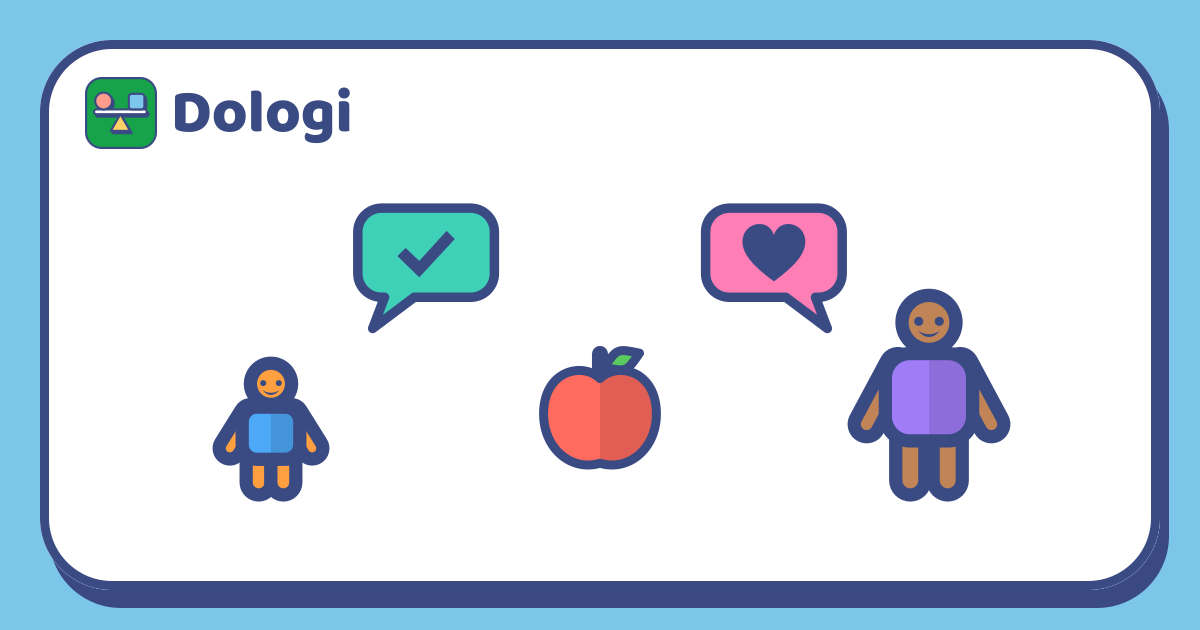
"This apple is red." "This apple is the tastiest." Both sentences are about the same apple, and both are said with the same confidence. But they are different kinds of sentences: the first can be checked by anyone who looks, while the second tells you what one person thinks.
Telling facts from opinions is a thinking skill children will use for the rest of their lives: in conversations, in school work, and later when they read things online. Many children start to grasp the difference somewhere around age 7, though younger children can play simple versions too. This article explains the idea in plain words and offers games and questions to use at home.
What's the difference?
| Fact | Opinion | |
|---|---|---|
| What it is | Something that can be checked | What someone thinks or feels |
| Example | "The apple is red." | "Apples are the best fruit." |
| How we know | We look, count, measure or look it up | We ask the person |
| Can people disagree? | Only until they check | Yes, and that's fine |
A useful way to explain it to a child: a fact is something we could prove together; an opinion is something that belongs to the person who says it.
Facts can also be wrong. "There are five apples in the bowl" is a fact-type sentence even if there are really four. It's checkable, and checking shows it's not true. That's an important idea: a fact-type sentence isn't automatically true; it's something you can test.
Start with an apple
Put a real apple (or any object) on the table and take turns saying sentences about it.
- Say a sentence each: "It's red." "It's round." "It's delicious." "It's the prettiest apple in the shop."
- Sort them into two piles, with cards or just two plates: "we can check it" and "it's what someone thinks".
- Check the first pile: look at the colour, roll it to see if it's round, weigh it in your hands.
- Ask about the second pile: "Does everyone think so? Is anyone wrong?"
Children often enjoy the moment when they realise that "delicious" can't be checked with a ruler. Repeat the game with a toy, a picture book or the weather outside.
Words that often signal an opinion
Some words are clues that a sentence is an opinion. You can collect them together.
- Feeling and judging words: best, worst, beautiful, ugly, boring, fun, delicious, horrible.
- Thinking phrases: "I think…", "I believe…", "In my opinion…", "I feel…".
- Should words: "Everyone should…", "Children shouldn't…".
These are clues, not rules. "I think it's raining" is about something you can check by looking outside. That's a nice puzzle to discuss with older children.
"How could we check?"
This one question does most of the work. When your child hears a sentence, ask: "How could we check that?" Possible answers include:
- Look: "The door is blue."
- Count: "There are seven people in our family."
- Measure or weigh: "The table is longer than the sofa."
- Look it up in a book, a map or a reliable source together.
- Ask someone who knows, such as a doctor about the body or a librarian about books.
If there's no way to check, it's probably an opinion. If there is a way to check, it's a fact-type sentence, and you can find out whether it's true.
Opinions are welcome too
The goal isn't to teach children that opinions are bad. Opinions are how we share who we are.
- Ask for reasons: "Why do you think it's the best?" A good opinion often comes with a reason.
- Show that people can disagree kindly: "I prefer pears, you prefer apples. We can both be happy."
- Separate the two in conversations: "That's a fact we can check. That part is your opinion, and it's interesting."
- Notice it in stories and adverts: "Is the character saying a fact or an opinion?" With older children, you can talk about why adverts use lots of "best" and "favourite".
Dologi's puzzles are a small example of facts: each one has a rule, and an answer is right because it follows the rule, not because someone prefers it. After a puzzle, you can ask your child, "How do we know it's right?"
In short
- A fact can be checked; an opinion is what someone thinks or feels.
- Start with an object on the table and sort sentences into "we can check it" and "it's what someone thinks".
- Use the question "How could we check?" and look for opinion words like best, boring and should.
- Welcome opinions, ask for reasons, and show that people can disagree kindly.
Read more: Critical thinking for children: when your child asks "why?" all day long