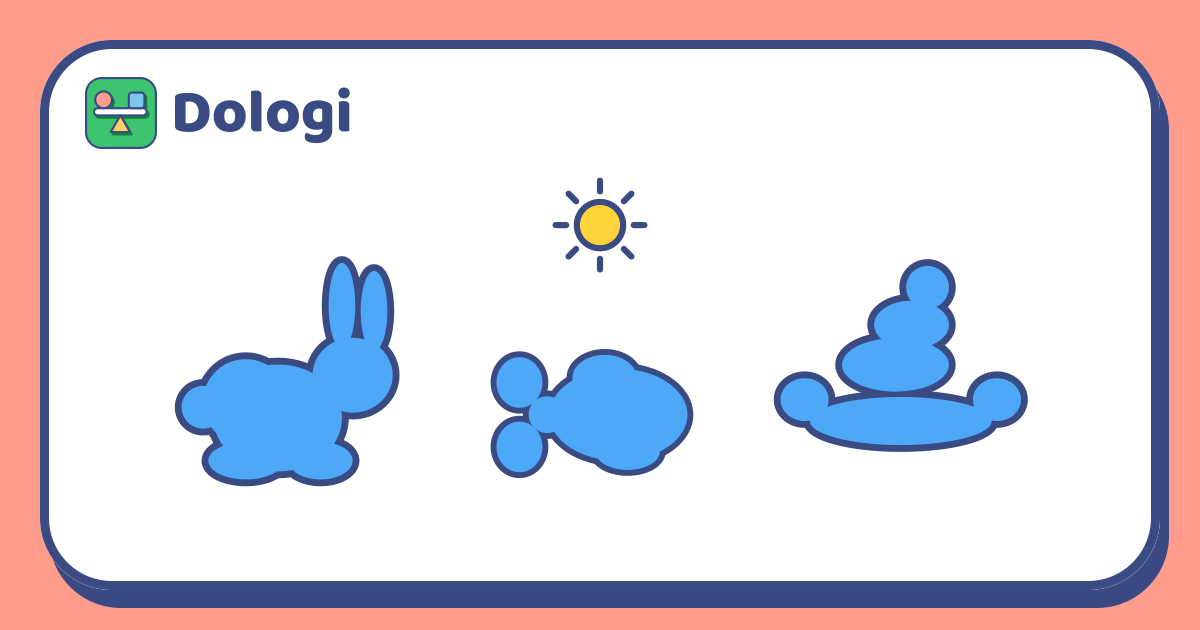
Lying on the grass, looking up. "That one looks like a rabbit." "Where?" "There, above the tree. Those two bits are the ears."
Finding shapes in the clouds costs nothing and can be played anywhere there is sky. It is also real thinking. Your child matches a vague outline to something they know, puts it into words so that you can see it too, and learns that one shape can be many things.
How to play
- Lie down, or sit at a window, and choose a part of the sky well away from the sun. Nobody looks towards the sun.
- One person says what they see and where it is.
- The other tries to find it, and then looks for something different in the same cloud.
- Keep watching. Clouds drift and change, and the rabbit may turn into something else.
There are no wrong answers. That makes it a good game for children who worry about getting things right.
Describe it so that I can see it
Pointing doesn't work with clouds: they are too far away, and two people never point at quite the same spot. Your child has to use words for where things are and for the parts of a shape.
| Instead of | Try |
|---|---|
| "There!" | "Above the roof, the long one" |
| "It's a dog" | "It's a dog lying down, with its head on the right" |
| "I can't see it" | "Which part is the head? Show me the tail" |
| "No, it isn't" | "I see something else: a boat. This tall part is the sail" |
Describe your own clouds this way first. Children pick up "above", "to the left of" and "the bigger one" quickly when they hear them used for something they want to find.
One cloud, three answers
When your child has found one thing in a cloud, ask for a second and a third. The first idea comes easily. The next ones take more work: the shape has to be turned round in the mind, and some parts have to be ignored.
Take turns. If your child sees a fish, you see a shoe, and they see a leaf, all three of you are right. Talking about why two people see different things in the same cloud is a gentle start to understanding that others may see the world differently.
From the sky to paper
- Draw it. Sketch the outline of a cloud, then add eyes, legs or wheels to show what it was.
- Tell it. Choose three clouds and join them in a story of three sentences. A rabbit, a fish and a boat: who wanted what, and what happened?
- Watch it change. Pick one cloud and look at it every minute. What is it turning into?
- The scribble game. For days without clouds: one person draws a loose scribble, the other turns it into a picture.
| Rough age | What to try |
|---|---|
| 4–5 | Naming one thing in a cloud; using one position word to say where it is |
| 6–7 | Three things in one cloud; naming the parts; drawing the cloud and what it became |
| 8–9 | A three-sentence story from three clouds; the scribble game; describing how a shape changes |
| 10 and up | A sky diary with sketches; explaining why two people see different things in one cloud |
Ages are only a rough guide, and every child is different.
In Dologi, "Find the shadow" puzzles in the Focus topic show an object and several shadows, and children pick the one that belongs to it. Like cloud watching, it is about recognising something from its outline alone.
In short
- A piece of sky away from the sun is all the game needs.
- Saying where a cloud is and which part is which trains describing as well as looking.
- Asking for three answers to one cloud practises seeing a shape in more than one way.
- Drawing, storytelling and the scribble game carry the idea on when the clouds have gone.
Read more: Creative thinking: helping children find more than one way