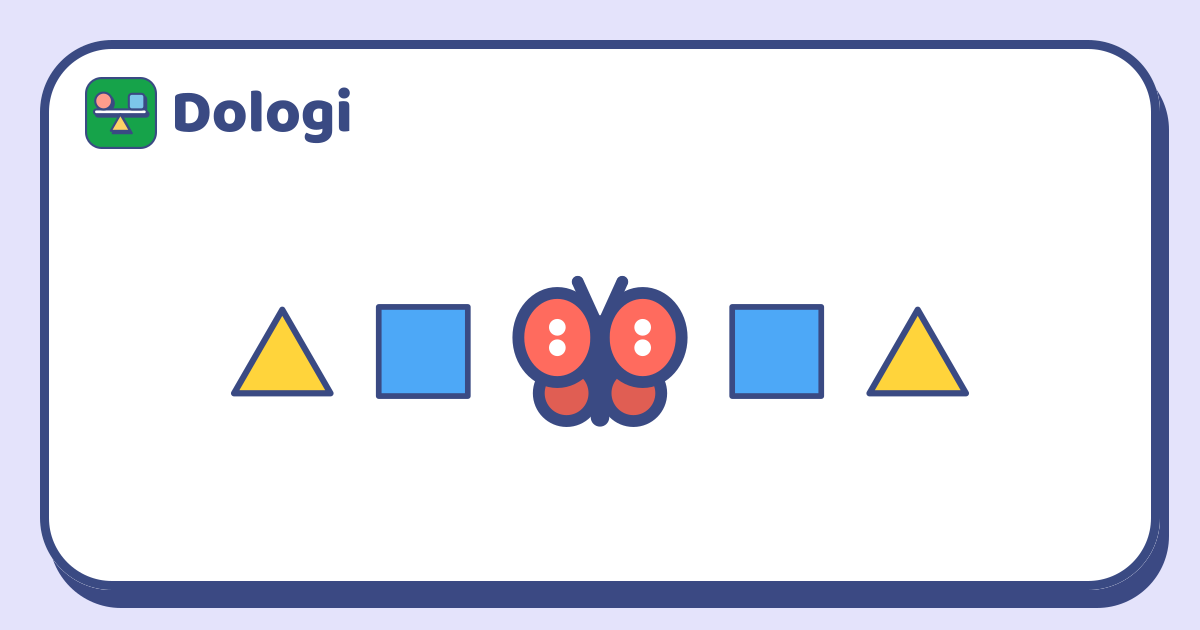
Fold a sheet of paper, paint on one half, press, open it: a butterfly appears, the same on both sides. Children love this little surprise, and it is a first step into symmetry. Drawing on squared paper takes the idea further: counting squares, copying a picture exactly, and drawing the other half of a shape. This article suggests grid and symmetry activities for ages 4 to 10, using things you already have at home.
Why grids and symmetry are worth practising
- Careful looking. Copying a picture square by square asks children to notice exactly where each line goes.
- Counting and position. "Three squares to the right, two squares down" combines counting with direction.
- Left and right. A mirror image swaps left and right, which children find tricky at first.
- A built-in check. Folding or a small mirror shows straight away whether the two halves match, so children can check their own work.
What you need
- Squared paper. Big squares (1 to 2 cm) for young children; smaller ones later. You can draw a grid yourself with a ruler.
- Pencils, coloured pencils and an eraser.
- Plain paper for folding, and some paint for the printing activity.
- A small mirror that won't break, if you have one, for checking.
Fold and print (around ages 4–5)
- Butterfly prints. Fold a sheet in half and open it again. Your child dabs paint on one half only, close to the fold. Fold, press, open. Talk about what you see: "Is it the same on both sides?"
- Folded cut-outs. Fold a sheet and draw half a heart, a tree or a house against the fold. An adult or an older child cuts along the line. Open it: a whole shape, the same on both sides. Use child-safe scissors and help with cutting.
- Find the fold line. Show a shape cut this way and ask your child to fold it so both halves sit exactly on top of each other.
Copying on the grid (around ages 5–7)
- Draw two small grids, 5 squares by 5, side by side.
- Colour a few squares on your grid: a small L shape, a plus sign, a diagonal line.
- Your child copies the picture onto their grid.
- Check together, square by square: "Your top row has two squares coloured. Does mine?"
Make it harder step by step: bigger grids, more colours, shapes made of lines along the edges of the squares instead of filled squares, and finally diagonal lines that cut across squares.
A fun variation is giving directions: one person describes a picture ("Start at the top-left corner, colour two squares to the right, then one down") and the other draws it without looking. Then compare.
Drawing the other half (around ages 6–10)
- Draw a thick line down the middle of a grid. This is the mirror line.
- Draw half a picture on one side: half a house, half a rocket, half a face, half of a pattern of coloured squares.
- Your child completes the other half so that it mirrors the first one.
- Check it: stand a small mirror on the line, or fold the paper along the line and hold it up to a window.
The most common mistake is copying the half instead of mirroring it, so the second half points the same way as the first. That is a useful mistake: put the mirror on the line and look together at how it should go.
For older children, try a horizontal mirror line, or two lines that cross, so the picture is mirrored into four parts.
A symmetry hunt
Look for things that are the same on both sides of a line:
- At home: a window, a chair, a plate, a face drawn on a balloon.
- Outside: leaves, butterflies, the front of a house.
- Numbers and letters: 0 and 8 can be folded both up-down and left-right; capital A, H, M, O, T can be folded down the middle; H and O also fold the other way.
Ask, "Where would you put the mirror?" Some things have one line, some have several, and some have none.
| Age (approximate) | Activity | What it practises |
|---|---|---|
| 4–5 | Fold and print, folded cut-outs | Noticing "the same on both sides" |
| 5–7 | Copying on a 5×5 grid | Careful looking, counting squares |
| 6–8 | Drawing the other half | Mirroring, left and right |
| 8–10 | Two mirror lines, giving directions | Planning and precise description |
In Dologi, "Mirror painting" puzzles in the Space topic ask children to paint the mirror half of a picture on a grid, much like the drawing activity above.
In short
- Folding, copying on a grid and drawing the missing half all train careful looking and position.
- Start with fold-and-print and folded cut-outs, then copy small grid pictures.
- For mirroring, check with a fold or a small mirror; copying instead of mirroring is a common, useful mistake.
- Hunt for symmetry around the house, outdoors, and in numbers and letters.
Read more: Why does my child write letters and numbers backwards? b, d and a reversed 3