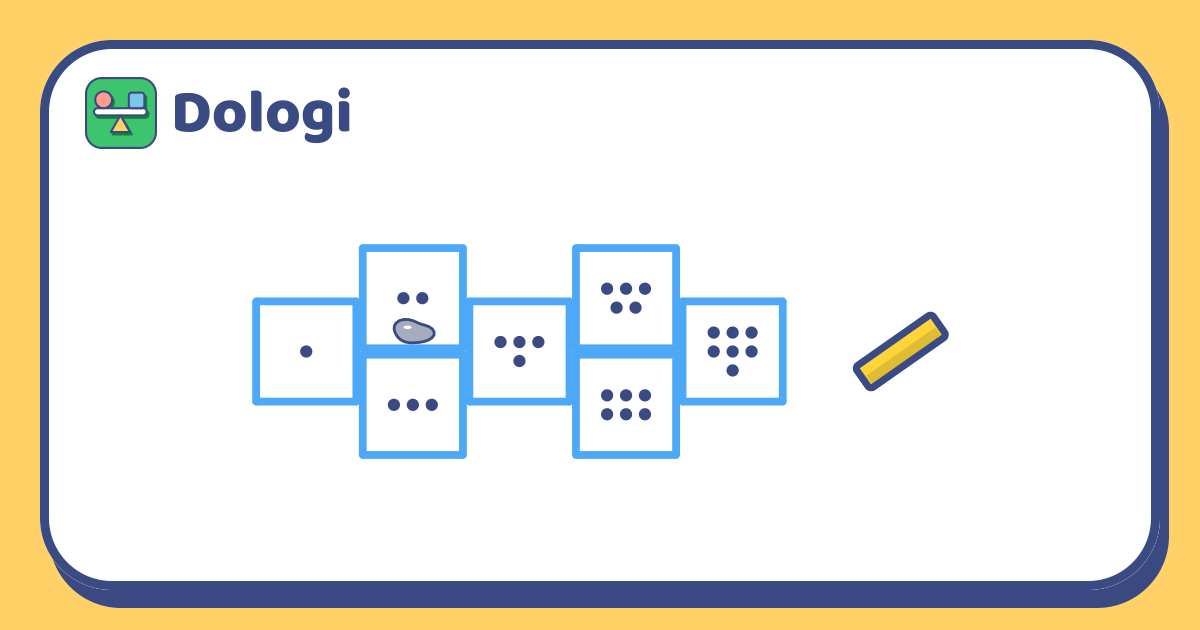
A piece of chalk, a pebble and a patch of pavement: hopscotch has been played with nothing more than that for a very long time. Children hop, wobble, laugh and start again.
Look closer and it is also a number line you can jump on. Every square has a number, the numbers come in order, and the body feels what "one more" and "two back" mean. This article explains the classic game and six ways of adding more maths to it.
Drawing the court
Draw seven or eight squares in a row, each big enough for a child's foot with room to spare. Make some of them pairs, side by side, as on the cover: a single square, then a pair, then a single, then a pair.
Write a number in each square, starting from 1. For children who don't read numbers yet, draw dots instead, as on the cover.
No pavement, or bad weather? Use masking tape on the floor indoors, and a rolled-up sock or a beanbag instead of a pebble.
The classic game
- Throw the pebble into square 1. It has to land inside the square.
- Hop through the court, jumping over the square with the pebble. Single squares: one foot. Pairs: two feet, one in each square.
- Turn round at the end and hop back.
- Pick up the pebble on the way back, balancing on one foot, then hop out.
- Next turn, throw to square 2, and so on.
Your turn ends if you step on a line, lose your balance or miss the square with your throw. Next time you carry on from the same number.
Rules differ from place to place and from playground to playground. Agree on yours before you start, and let your child explain them to anyone who joins in.
Six variations with more maths
| Variation | How it works | What it practises |
|---|---|---|
| Count aloud | Say each number as you land; count backwards on the way back | Number order, forwards and backwards |
| Even squares only | Hop over the odd numbers | Odd and even, counting in twos |
| The caller | Someone calls a number and the hopper goes straight to it | Recognising numbers quickly |
| Adding hops | "Start on 2 and go on 3 more. Where are you?" | Adding as moving forward |
| Hopping back | "Start on 7 and go back 2." | Taking away as moving back |
| Two pebbles | Throw two pebbles, add the two numbers and hop to the answer | Adding two numbers |
For the adding variations, a straight court works best: a single row of squares from 0 to 10, like a number line drawn on the ground.
What the body learns
Hopscotch asks for quite a lot at once: hopping on one foot, landing inside a square, stopping without falling, bending down and getting up again. Children improve visibly from week to week, and they notice it themselves.
A few adjustments keep it enjoyable:
- Bigger squares for younger children, and two feet allowed everywhere.
- The other foot for children who find it easy.
- A slow round, where the aim is to land without a sound.
| Rough age | What to try |
|---|---|
| 4–5 | Jumping with two feet; saying the numbers; throwing the pebble into a square |
| 6–7 | The classic game on one foot; counting backwards on the way back |
| 8–9 | Adding and taking away with hops; even squares only |
| 10 and up | A court with the three times table; inventing new rules and teaching them |
Ages are only a rough guide, and every child is different.
In Dologi, "Connect the dots" puzzles in the Math topic ask children to join numbers from the smallest to the largest. Like hopscotch, they practise number order, with a finger instead of a foot.
In short
- Chalk and a pebble outdoors, or tape and a sock indoors, are all you need.
- Hop over the square with the pebble, turn, come back and pick it up.
- Add maths by counting aloud, hopping on even numbers and adding with hops.
- Adjust the size of the squares and the rules so that every child can succeed.
Read more: When can children count to 10, 20 or 100? Reciting numbers vs really counting