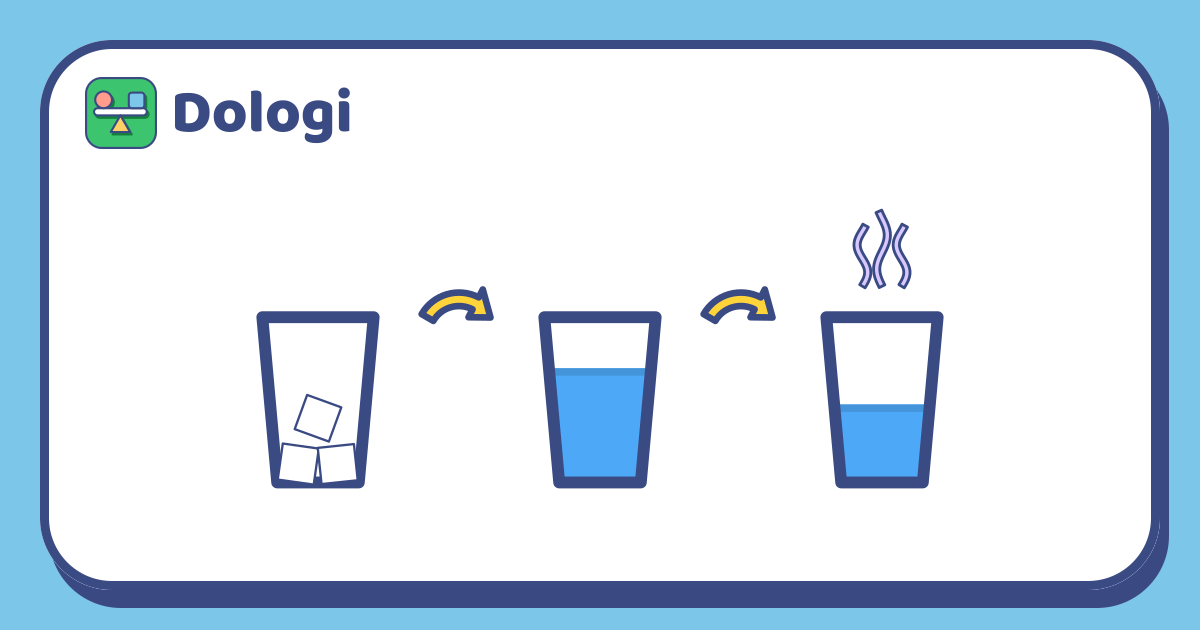
Ask a young child whether ice and water are the same thing, and many will say no. One is hard and cold, the other splashes. The idea that it is the same water, just in a different form, is a real discovery, and it is one your child can make at home with a freezer, a few cups and a bit of patience.
This article suggests a set of small experiments for children of roughly 4 to 10, arranged around the three forms water can take: solid (ice), liquid (water) and gas (water vapour). As in any home experiment, keep the same rhythm each time: guess first, test, look closely, then explain.
Who does what
Most of these experiments only need cold water and the freezer. The part with hot water belongs to a grown-up:
- You do: heat the water, hold anything above a steaming pan or kettle, and keep your child at arm's length from the cooker. Steam can scald even when you can barely see it.
- Your child does: fill the ice tray, choose the containers, make the guesses, watch, time and draw.
- One simple rule: "Hot water is for grown-up hands; your job is to be the eyes."
A sheet with three columns works well: "My guess", "What happened", "Why?". Children who can't write yet can draw or tick, and you can write down what they say.
Ice: water you can hold
Ice is water in its solid form. A solid keeps its own shape: an ice cube stays a cube until it starts to melt.
- Shape test: pour water into different containers (an ice tray, a yoghurt pot, a small silicone mould) and freeze them overnight. In the morning, push the ice out. Ask: "Where did the ice get its shape from?"
- The rising line: fill a small plastic cup to the brim, draw a line at the water level with a marker, and freeze it. Next day, the ice usually bulges above the line. Water takes up a little more room when it freezes, which is why a full glass bottle in the freezer can crack (try it only with plastic).
- Melting race: put one ice cube on a plate in the kitchen and hold another in a clean hand inside a sealed sandwich bag. Which melts first? Why might a hand be warmer than the kitchen?
Water: it takes the shape of its container
Liquid water has no shape of its own. It flows and takes the shape of whatever holds it.
Pour the same cup of water into a tall thin glass, then into a wide bowl, then onto a flat tray. Each time, ask: "Is there more water now, less, or the same?" Many children aged 4 to 6 say the tall glass holds "more" because the level is higher. Don't correct straight away: pour it back into the first cup together and see whether it fills the same height. Older children can measure with a measuring jug.
This is a good moment to talk about the difference between a solid and a liquid:
| Ice | Water | |
|---|---|---|
| Keeps its own shape? | Yes | No, it takes the shape of the container |
| Can you pour it? | No | Yes |
| Can you hold it in your hand? | Yes, for a while | It runs through your fingers |
Steam: water you can't see
When water is heated, part of it turns into water vapour, a gas. Water vapour is invisible. The white cloud above a pan is in fact millions of tiny droplets, formed when the vapour meets cooler air.
Watching a pan (grown-up holds everything): boil a little water in a pan while your child watches from a safe distance. Point out the clear gap just above the water and the white cloud a little higher up. Then hold a cold metal lid above the pan for a moment and show your child the drops that form on it. Ask: "Where did these drops come from?"
Water that disappears without any heat:
- On a warm, dry day, give your child a paintbrush and a cup of water to "paint" on the pavement or a wall. Watch the picture fade. Where did the water go?
- After rain, draw round a puddle with chalk. Come back an hour later and draw round it again. The puddle shrinks, ring by ring.
- Hang one wet cloth in the sun and another in the shade. Which one dries first?
All of these show evaporation: water slowly turning into invisible vapour, even without boiling. Sun, warmth and wind make it happen faster.
And back again: drops on a cold glass
Take a glass of very cold water, or a glass straight from the fridge, and leave it on the table in a warm room. After a few minutes, drops appear on the outside of the glass. Ask your child to guess first: did the water leak through the glass?
The water came from the air. The air in a room always holds some invisible water vapour, and when it touches something cold it turns back into tiny drops. This is condensation. You see the same thing on a bathroom mirror after a shower, or when you breathe on a cold window.
Put the whole story together with your child:
| Change | What makes it happen | Where you see it |
|---|---|---|
| Ice → water (melting) | Warmth | Ice cube on a plate |
| Water → ice (freezing) | Cold | Ice tray in the freezer |
| Water → vapour (evaporation) | Heat, sun, wind | Puddle drying up |
| Vapour → water (condensation) | A cold surface | Drops on a cold glass |
Older children can draw these four arrows as a circle. They have just drawn a simple water cycle: the same journey that takes water from the sea to the clouds and back as rain.
In Dologi, the "Fill the jug" puzzle asks children how many cups of water it takes to fill a jug, a small step from playing with water to thinking about how much it holds.
In short
- Water has three forms: solid ice, liquid water and invisible vapour. It is the same water each time.
- Ice keeps its shape, water takes the shape of its container, and vapour spreads into the air.
- Hot water and steam are a grown-up's job; your child watches, guesses and records.
- A drying puddle and drops on a cold glass show evaporation and condensation without any heat at all.
Read more: Kitchen science for kids: experiments with eggs, flour and ice