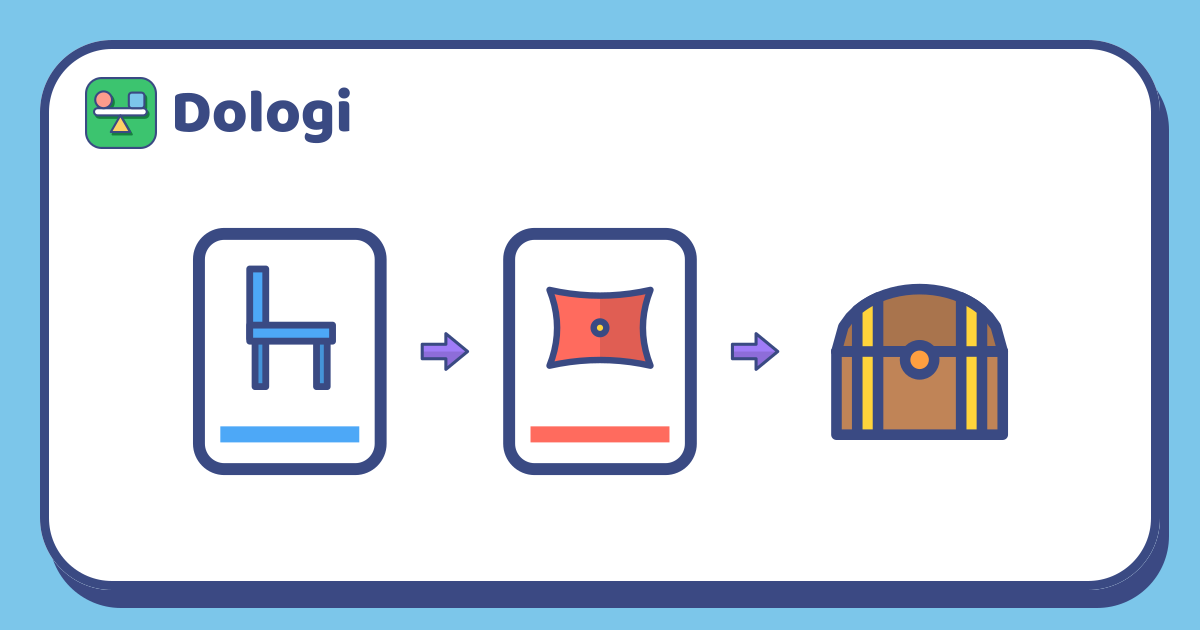
A slip of paper with a drawing of a chair. Under the chair, another slip with a drawing of a cushion. Under the cushion, a drawing of a shoe…
A treasure hunt is a chain of clues: each clue shows where the next one is hidden, and the last one leads to the treasure. With pictures instead of words, even a four-year-old can play. Setting it up takes about ten minutes, and it works in any weather. Along the way your child reads symbols, decides where to go and follows a sequence to the end.
How it works
- Choose a treasure and a final hiding place. A snack, a few stickers, or a note that says "you choose tonight's story".
- Choose three to six places around the home.
- Draw one clue for each place.
- Hide the clues in a chain, then hand your child the first one.
Here is a hunt with four clues:
| Where the clue is | What it shows | Where it sends your child |
|---|---|---|
| In your hand | A chair | To the chair |
| Under the chair | A cushion | To the sofa |
| Under the cushion | A shoe | To the shoe rack |
| Inside a shoe | A book | To the bookshelf, where the treasure is |
A practical tip: set the hunt up backwards, starting from the treasure. That way each clue is in your hand at the moment you need to hide it, and the order doesn't get muddled.
Four kinds of picture clue
| Kind of clue | Example | Rough age |
|---|---|---|
| A drawing of the thing itself | A chair means "go to the chair" | 4–5 |
| Only a part of the thing | Just the handle of the fridge, or the pattern on the rug | 5–6 |
| A riddle in pictures | A snowflake next to an apple: the cold place where food is kept | 6–7 |
| A plan of the room with a cross | A simple map seen from above | 7 and up |
You don't need to draw well. A wobbly chair is still a chair, and children are generous readers. Pictures cut from an old catalogue work too.
For older children, cut a clue into four pieces so that it has to be put together first, or use a picture code that you invent together.
Tips for a hunt that works
- Fewer clues than you think. Three are plenty for a four-year-old. Six is a long hunt.
- Let the clue peek out. For the youngest, a corner of paper should be visible once they are in the right place.
- Safe places only. Nothing high up, nothing in drawers with knives, nothing in the bathroom cabinet.
- When your child is stuck, ask rather than tell. "What can you see in the picture? Where in our home is something like that?"
- With two children, take turns reading the clue, or make two chains on paper of two different colours.
Let your child hide the clues
This is the best part, and the hardest thinking.
To set a hunt, your child has to plan the whole chain, draw clues that someone else can understand, and keep the order straight. The first attempts often break: two clues end up in the same place, or a clue points to itself. That's fine. Finding where the chain broke and mending it is very good practice.
When you are the seeker, play it honestly and think aloud: "This looks like a round thing with a handle. A pan? A cup? I'll check the cups first."
| Rough age | What to try |
|---|---|
| 4–5 | Three clues, each a drawing of the thing itself |
| 6–7 | Four or five clues; parts of things and picture riddles; hiding two clues for you |
| 8–9 | A plan of the room; a clue cut into pieces; setting a whole hunt |
| 10 and up | Picture codes; setting a hunt for a younger child and adjusting it so they succeed |
Ages are only a rough guide, and every child is different.
In Dologi, "Who lives here?" puzzles in the Logic topic also use clues made of pictures: children look at a few clue cards and work out who lives in the house with the question mark.
In short
- A treasure hunt is a chain: each picture shows where the next clue is hidden.
- Three to six clues are enough; set the hunt up backwards from the treasure.
- Move from drawings of the thing itself to parts, picture riddles and room plans.
- Swap roles: hiding the clues is the best thinking practice of all.
Read more: Picture codes for children: a code-breaking game for home