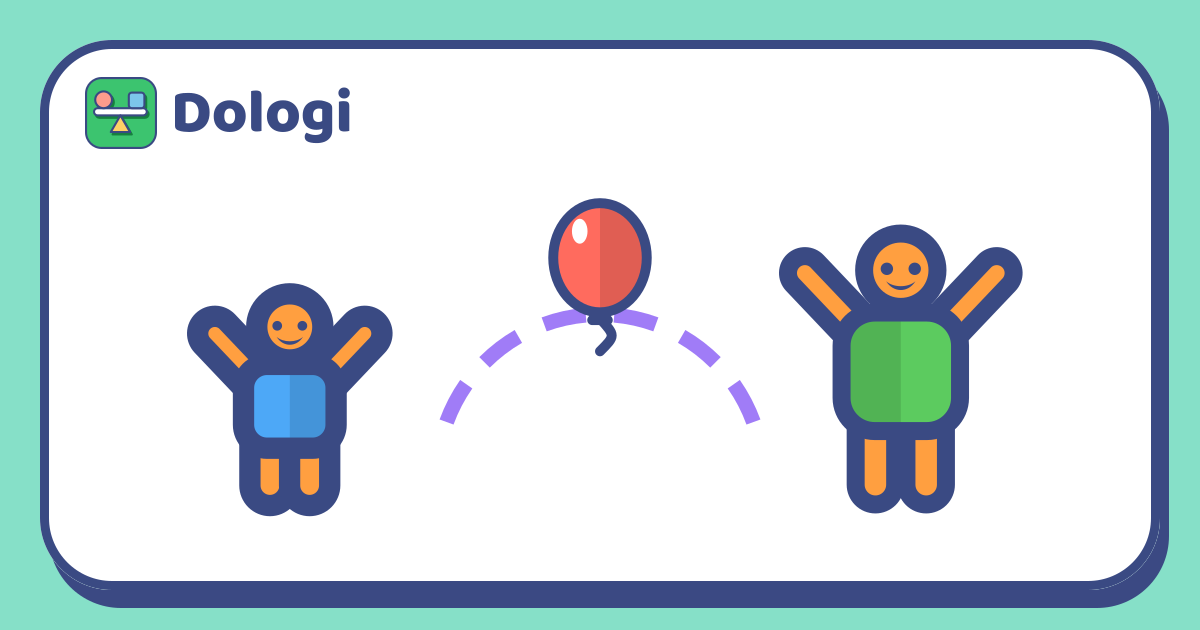
One balloon and one rule: it mustn't touch the floor. Children of almost any age will play this for ten minutes without a break, eyes fixed on a slow, floating target.
That is exactly why it is a good game for attention. Your child has to follow one thing, keep adjusting, and ignore everything else in the room. And because a balloon falls slowly, even young children have time to look, think and move. This article gives the basic rules, ten challenges, and a few ways of keeping score.
The basic game
- Blow up one balloon, not too hard, and clear some space.
- Tap it upwards with your hand.
- Count every tap aloud. When the balloon touches the floor, the count goes back to zero.
Play as one team at first: you and your child take turns tapping and share one score. Everybody wins or loses together, and the youngest player isn't the one who always "ruins it".
Safety and space
- An adult blows up the balloons. Burst or uninflated balloons can be a choking hazard for young children, so pick up any broken pieces straight away.
- Move breakable things, and play away from stairs, sharp corners and anything hot.
- If someone at home is allergic to latex, use a light beach ball or a silk scarf instead. A scarf falls even more slowly.
Ten challenges
Once the basic game is easy, change one rule at a time.
| Challenge | What it adds |
|---|---|
| Only the hand you don't write with | Careful control |
| No hands: head, elbows and knees only | Knowing where your body is |
| One finger only | Gentle, precise touches |
| Clap once between taps | Timing |
| Stay on the rug: it's an island | Staying in one place |
| Your partner calls a body part ("knee!") and you must use it | Listening and switching quickly |
| Count in twos, or backwards from twenty | Maths while moving |
| Hand, head, hand, head | Following a pattern |
| Sit down and stand up again between taps | Planning ahead |
| Two balloons at once | Sharing attention between two things |
Let your child invent challenges too. Thinking up a rule that is hard but possible is a good exercise in itself.
Beat your own record
- Keep a tally. After each round, write down the count. The best one of the day is the team record.
- Estimate first. "How many taps do you think we can manage with the left hand only?" Then compare the guess with what happened.
- Compare with yesterday, not with each other. A child who sees their own number grow has every reason to try again.
Playing with brothers and sisters
Different ages can play together if the rules are different for each player. The older child uses one finger or the weaker hand. The younger one may use both hands and catch the balloon once per round.
Children usually accept this as fair when it is agreed before the game starts. It is a small lesson in the difference between "the same for everyone" and "fair for everyone".
To finish, play one slow-motion round: the softest taps possible, then catch the balloon and sit down. It helps the game end calmly rather than at full speed.
| Rough age | What to try |
|---|---|
| 4–5 | Both hands; counting to ten together |
| 6–7 | One hand; body-part rules; counting in twos |
| 8–9 | Two balloons; patterns; keeping a record over a week |
| 10 and up | Inventing challenge cards; being the referee for younger children |
Ages are only a rough guide, and every child is different.
In Dologi, "Tap in order" puzzles in the Focus topic ask children to tap numbers one after another from the smallest to the largest. It is the same kind of attention: one thing at a time, in the right order, without getting distracted.
In short
- A balloon falls slowly, so children can follow it, think and react.
- Count the taps aloud and start again from zero when it lands.
- Change one rule at a time: weaker hand, no hands, a pattern, two balloons.
- Play as a team, compare with your own record and end with a slow round.
Read more: Stop-and-go games: building self-control through play