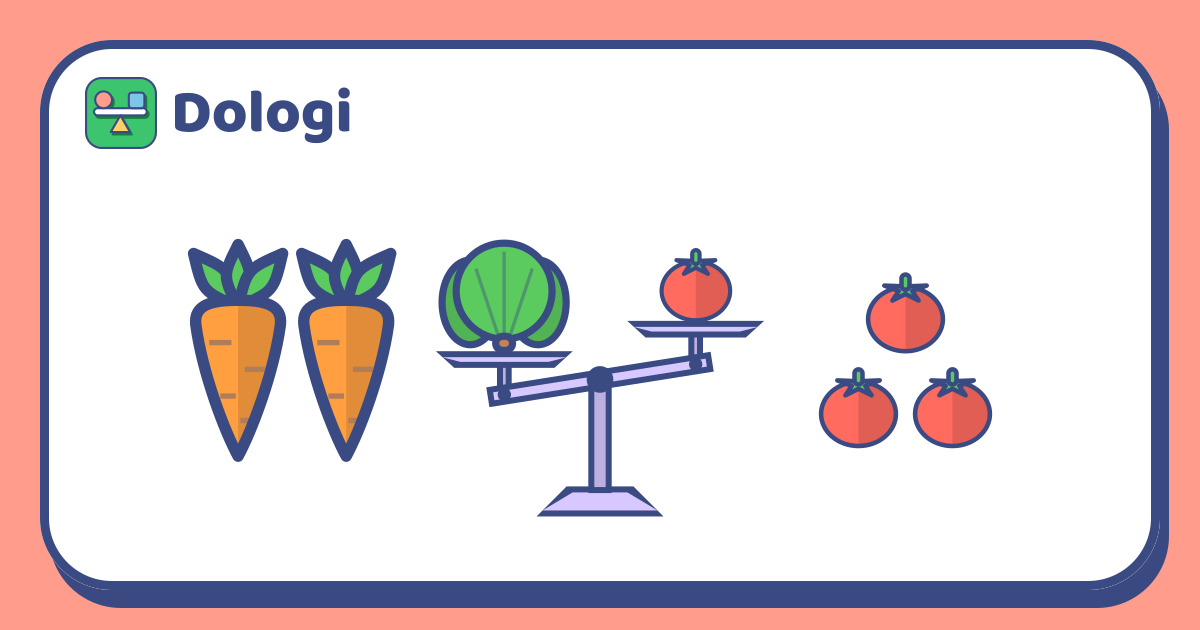
"These are all orange, and these ones are all round!"
You come home from the market with a heavy bag, and your child wants to help. Before everything disappears into the fridge, those vegetables can be a sorting game. They come in many colours, shapes and sizes, they can be held, rolled and weighed in two hands, and putting the shopping away has to happen anyway.
The games below take five to ten minutes on the kitchen table and need nothing you don't already have. Sorting and comparing are early thinking skills, and real food gives children plenty to notice and talk about.
Before you start
- Wash hands, and put a clean tea towel on the table so the vegetables have a place to land.
- Choose sturdy vegetables that won't bruise: carrots, potatoes, onions, tomatoes, peppers, a cabbage, a cucumber.
- Knives stay with the adult. If something needs cutting to look inside, you cut and your child watches.
- Small round foods such as cherry tomatoes, peas or beans are a choking risk for young children. Keep them for older children, and stay close by.
Sorting by colour
Tip the vegetables out and ask: "Can you put the ones that are the same colour together?"
- Start with clear groups: orange carrots, red tomatoes, green cabbage and cucumber.
- Then ask: "Which group has the most? Which has the fewest?" and count to check.
- Leave room for the tricky ones. Is a red onion red or purple? Is a potato brown or yellow? A pepper can be half green and half red. Let your child decide and explain the choice; there is no single right answer.
- Look inside: a cucumber is dark green outside and pale inside. Ask your child to guess the colour before you cut, then check together.
Sorting by shape
Now mix everything up again and sort a different way.
- Round ones, long ones and leafy ones: tomatoes and onions, carrots and cucumbers, cabbage and lettuce.
- The roll test: give each vegetable a gentle push across the table. Which ones roll away? Which ones roll in a circle? Which ones just wobble? Sort them into "rolls" and "doesn't roll".
- Swap roles: your child sorts by a secret rule, and you guess the rule from the groups.
Sorting the same vegetables in two different ways is the important part. It shows that the groups depend on the rule you choose, not on the vegetables themselves.
Counting and lining up
- Count each group out loud, touching each vegetable once.
- Compare two groups: "How many more potatoes than onions?" Line them up in two rows, one opposite the other, to see the extra ones.
- Line the carrots up from shortest to longest. Then add one more carrot: where does it go?
- Hold a carrot against your child's hand: longer or shorter than the hand?
If you drew a picture shopping list before going out, let your child tick off each vegetable as it comes out of the bag.
Heavier or lighter?
Give your child one vegetable in each hand: "Which one is heavier?"
- Try a big lettuce and a small potato. Big does not always mean heavy, and children are often surprised.
- Put three vegetables in order from lightest to heaviest by hand, then check.
- To check, use kitchen scales if you have them. Or make a simple balance: hang two small bags from the ends of a clothes hanger and see which side goes down.
- Older children can guess the weight before reading the scales, then see how close they were.
| Rough age | What to try |
|---|---|
| 3–4 | Sorting big vegetables by colour; the roll test; counting up to five (with an adult close by) |
| 5–6 | Sorting by shape; switching the rule; lining carrots up from shortest to longest; which one is heavier in two hands |
| 7–8 | Sorting by two features at once (red and round); how many more; putting three in order by weight and checking with a balance |
| 9 and up | Reading the kitchen scales; guessing the weight first; inventing a sorting rule for someone else to guess |
Ages are only a rough guide, and every child is different.
In Dologi, "Balance scales" puzzles in the Logic topic ask children to work out which block is heavier or lighter from the way the scales tip, the same question as a potato in one hand and a tomato in the other.
In short
- The vegetables from the market are a sorting game that comes home with the shopping.
- Sort by colour, then mix them up and sort by shape: the same vegetables, a different rule, different groups.
- Count, compare groups and line things up from shortest to longest.
- Guess which one is heavier by hand, then check with scales or a homemade balance.
Read more: Sorting and comparing: the first thinking skills children use