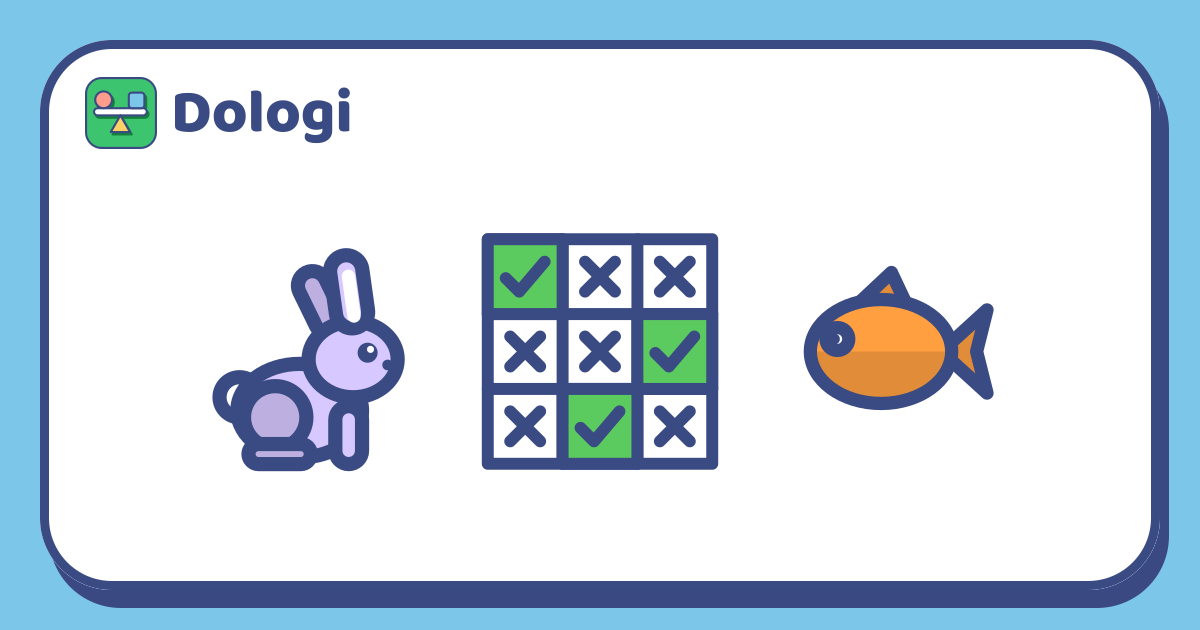
"The child in the red hat doesn't have the fish. The cat doesn't belong to the children in red or blue. Who has which pet?" Puzzles like this look simple, but solving them means keeping several facts in mind and ruling things out one by one. A grid of ticks and crosses makes that thinking visible.
Logic grid puzzles suit children from about eight years old, though younger children can start with smaller versions. All you need is paper and a pencil.
How a logic grid works
A logic grid is a table. Down the side are the people (or things) in the puzzle; across the top are the options.
- Each row has exactly one tick: every child has exactly one pet.
- Each column has exactly one tick: every pet belongs to exactly one child.
- Crosses mean "no". Every clue lets you put crosses in some squares.
- When you place a tick, cross out the rest of that row and column.
The magic is that you rarely find the answer directly. You find what is impossible, and the answer is what remains.
A first puzzle, step by step
Three children wear red, blue and green hats. Their pets are a rabbit, a fish and a cat.
- The child in the red hat doesn't have a pet that swims.
- The cat doesn't belong to the child in the red hat or the child in the blue hat.
Solve it together:
- Clue 1: put a cross where red meets fish.
- Clue 2: put crosses where red meets cat and where blue meets cat. The cat column now has only one empty square: green. Tick it, and cross out the rest of the green row.
- Look at the red row: fish and cat are crossed, so red has the rabbit. Tick it.
- Blue has the only pet left: the fish.
| Rabbit | Fish | Cat | |
|---|---|---|---|
| Red hat | ✓ | ✗ | ✗ |
| Blue hat | ✗ | ✓ | ✗ |
| Green hat | ✗ | ✗ | ✓ |
Finally, check every clue against the answer. Both are true, so the puzzle is solved.
A second puzzle to try
Three children wear yellow, purple and orange hats. Each likes a different fruit: apples, bananas or grapes.
- The child in the yellow hat doesn't like apples.
- The child in the purple hat doesn't like bananas.
- The child in the orange hat likes neither grapes nor apples.
Draw a three-by-three grid and try it before reading the answer.
Answer: orange likes bananas (clue 3). Yellow can't have apples (clue 1) or bananas (taken), so yellow likes grapes. Purple likes apples, which fits clue 2.
Make your own puzzles
Inventing a puzzle is even better thinking than solving one:
- Start with the answer. Decide who has which pet, and write it down secretly.
- Write clues that are true. "Not" clues are easiest: "The child in red doesn't have the cat."
- Test it. Give the clues to someone else. If they get stuck or find two answers, add or change a clue.
- Remove extra clues. The best puzzles use as few clues as possible.
Easier and harder versions
Ages are rough guides; every child is different.
- Around 6–7: a two-by-two grid with real objects: two cups, two toys, one clue. Use stickers instead of ticks.
- Around 8–9: three-by-three grids with two or three clues, like the ones above.
- Around 10 and up: four-by-four grids, clues like "next to" or "before", and puzzles with three categories (child, pet and colour).
In Dologi, the Logic topic has "Who lives where?" puzzles: children read clue cards, rule out houses and take each robot to the only house left. It's the same idea of ruling things out until one answer remains.
In short
- Logic grid puzzles use a table of ticks and crosses to track what is possible.
- One tick per row and column; every clue adds crosses.
- Solve a first puzzle together out loud, then let your child try one alone.
- Inventing puzzles, and testing them on someone else, is the best practice of all.
Read more: Logic puzzles for children aged 4 to 10, with answers and hints