Setting up takes ten minutes. The fall takes three seconds. And the moment the last tile lands, your child wants to build again.
A domino run looks like a simple toy, but it asks for a lot: even spacing, a route that works, an estimate of how many tiles are needed, and the patience to carry on after an elbow has knocked everything down.
What you need
- Twenty to thirty domino tiles, or more. Flat building blocks work too.
- A hard, flat floor or table. Tiles wobble on carpet.
Finding the right gap
Start with an experiment using just two tiles.
- Stand them far apart and push the first. It falls flat without touching the second.
- Stand them very close. They are hard to place, and the first one only leans on the second.
- Try a gap of about half a tile's height. The first tile falls and knocks the second cleanly.
Now make the gap the same every time. A spare tile lying on its side, or two fingers, makes a good spacer. Test with five tiles before building a long line.
Getting round a curve
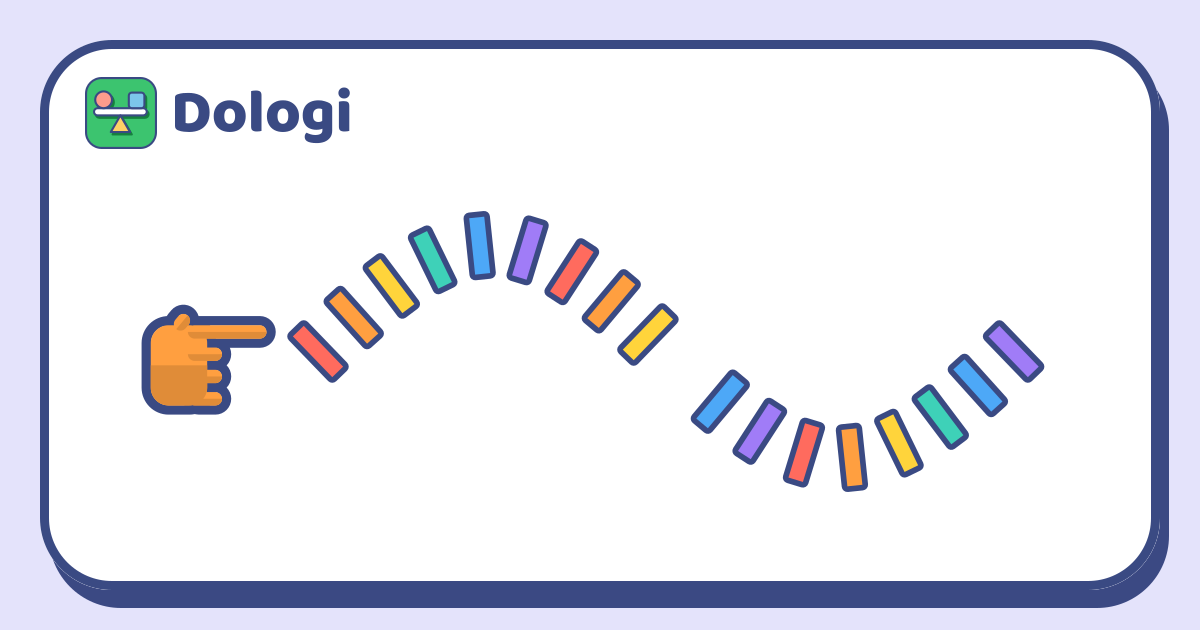
On a curve, every tile has to turn a little more than the one before, as on the cover picture. Each tile should still face the next one almost squarely.
Sharp corners fail, because the falling tile slides past its neighbour. Let your child build a sharp corner anyway, push, and see where the fall stops. Then ask what could help. The usual discoveries are more tiles, smaller turns and slightly smaller gaps.
Safety gaps
The most painful moment in domino building is the accident at tile forty that takes the whole run with it.
Builders have a trick for that. Every ten tiles or so, leave out two tiles. If something goes wrong, only one section falls. When everything else is ready, fill the gaps, and only then push.
This is planning for mistakes before they happen, and children understand it immediately once they have lost a long run.
The numbers in a run
- Counting in tens. With a safety gap after every ten tiles, the run is easy to count: 10, 20, 30.
- Estimating. Suppose ten tiles make a run as long as one ruler.
| Tiles | Length of the run |
|---|---|
| 10 | 1 ruler |
| 20 | 2 rulers |
| 30 | 3 rulers |
| ? | 5 rulers |
- Predicting. "The door is six rulers away. Do we have enough tiles to reach it?" Guess, work it out, then build and check.
Five challenges
| Challenge | What it adds |
|---|---|
| A run with one curve | Turning the tiles a little at a time |
| An S-shape | Two curves in opposite directions |
| Round a table leg and back | Planning the route before building |
| A fork: one tile knocks two lines | Placing two tiles so that one hits both |
| A finish: the last tile rings a bell or knocks a ball off a block | Aiming the end of the run at a target |
| Rough age | What to try |
|---|---|
| 4–5 | A straight line of five to ten tiles with a spacer; pushing and watching |
| 6–7 | Twenty tiles with one curve; safety gaps; counting in tens |
| 8–9 | An S-shape and a fork; estimating how many tiles a distance needs |
| 10 and up | Drawing the route on paper first; a run with a finish; timing the fall |
Ages are only a rough guide, and every child is different.
In Dologi, "Water the flower" puzzles in the Space topic ask children to turn pipes so that water flows from the tank to the flower pot. As in a domino run, the chain only works if every piece lines up with the one before it.
In short
- A gap of about half a tile's height, kept the same with a spacer, makes the fall reliable.
- On a curve each tile turns only a little, and sharp corners need more tiles.
- Safety gaps every ten tiles, filled at the very end, keep an accident small.
- The run offers counting in tens and estimating how many tiles a distance needs.
Read more: The domino effect: teaching children about cause and effect