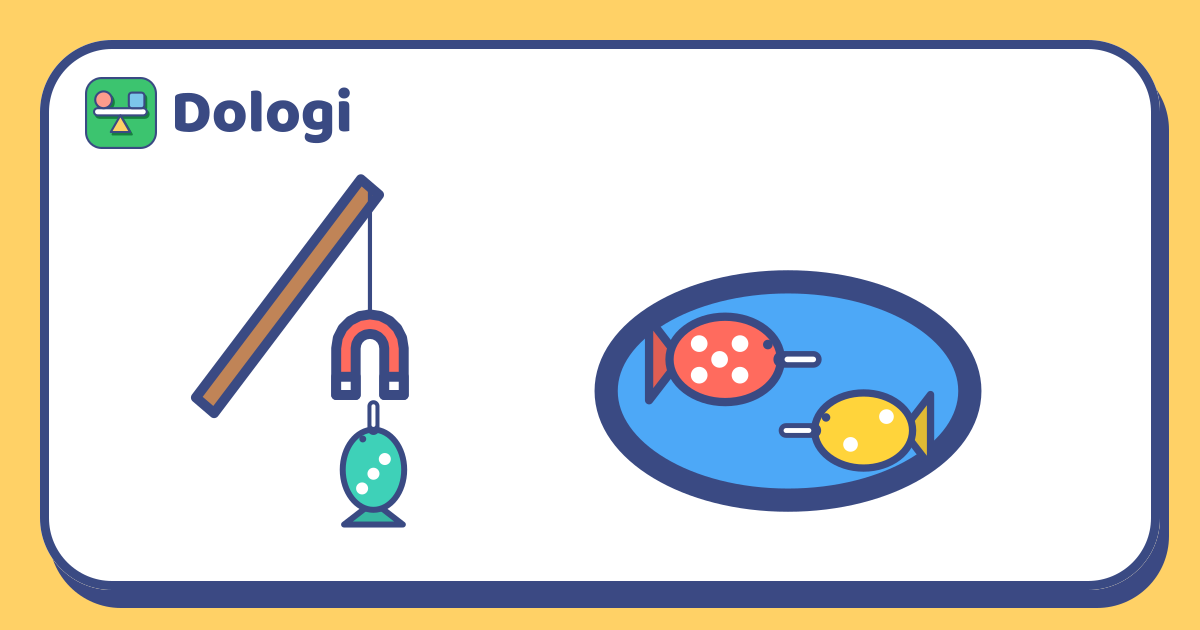
A stick, a piece of string and a magnet. A dozen paper fish, each with a paper clip on its nose. The fish jump onto the line by themselves, and children will happily fish for half an hour.
Give every fish a few dots and each catch becomes a number: something to count, to compare and to add.
Making the game
- The fish. Cut twelve to fifteen fish, about the size of your palm, from coloured paper or thin card. Draw one to six dots on each and slide a metal paper clip onto the nose.
- The rod. A stick, a wooden spoon or a ruler, an arm's length of string, and a magnet tied or taped to the end. A fridge magnet does the job.
- The pond. A dry basin, a hoop on the floor or a blue cloth.
A word on safety. Paper clips and magnets are small. Use one larger magnet fixed firmly to the string, not small loose ones, keep the game for children who no longer put things in their mouths, and put the rod away afterwards.
A basic round
- Lay the fish in the pond with the dots facing down.
- Players take turns. Each turn is one catch.
- The player turns the fish over, counts the dots aloud and keeps the fish.
- When the pond is empty, everyone counts up.
With young children, the winner is whoever has the most fish. Later, it is whoever has the most dots, which means adding.
Six games for the same pond
| Game | Rule | What it practises |
|---|---|---|
| Count the catch | Catch a fish and say how many dots it has | Counting, and seeing small amounts at a glance |
| Bigger fish wins | Two players catch one fish each; the bigger number takes both | Comparing two numbers |
| Running total | Add each new fish to your total; the first to reach 15 wins | Adding on |
| Make seven | Dots face up: catch two fish that make 7 together | Pairs of numbers that make a total |
| Fish by rule | Only even fish count, or only fish with more than three dots | Checking a number against a rule |
| Line them up | After fishing, lay your catch in order from fewest dots to most | Putting numbers in order |
In "Make seven", your child has to plan before lowering the line: if the first fish has two dots, which fish is needed next? That is a small step from counting towards calculating.
Making it harder
- A longer string. The magnet swings more and needs a steadier hand.
- Numerals for dots. Write the numbers on new fish once the dots are easy.
- A shark. One fish is a shark that takes two points away from the total.
- Sums on the fish. A fish says "2 + 3" and can only be kept if the sum is answered.
- Exactly twenty. Dots face up: choose and catch fish to land on exactly 20, not more.
| Rough age | What to try |
|---|---|
| 4–5 | Fish with one to three dots, dots facing up; counting the catch |
| 6–7 | Dots up to six; bigger fish wins; a running total over three catches |
| 8–9 | Make seven; fishing by an odd or even rule; the shark |
| 10 and up | Fish worth tens; planning the catch to reach an exact total |
Ages are only a rough guide, and every child is different.
In Dologi, "Add and answer" puzzles in the Math topic ask children to add small groups of objects and give the total. Magnet fishing practises the same adding with a rod in the hand.
In short
- A stick, string, a magnet and paper fish with paper clips make the whole game.
- Dots on the fish turn every catch into a number.
- The same pond gives games for counting, comparing, adding, ordering and hitting a target.
- A longer string, numerals, a shark and exact totals keep the game growing.
Read more: Dice games for children: counting and mental math with a pair of dice