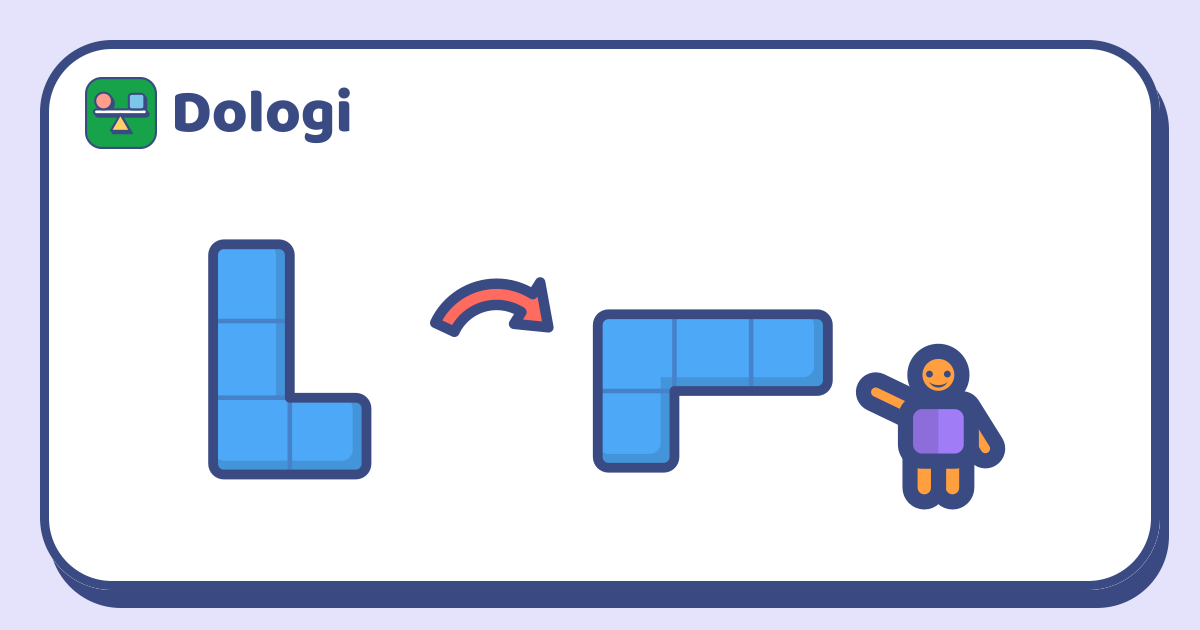
Watch a young child doing a jigsaw. They pick up a piece, try it, and when it doesn't fit, they twist it round and try again, often several times. An older child might glance at the gap, turn the piece once in their hand, and drop it straight in. What changed? The older child has started to turn the piece in their head before turning it in their hand.
This skill is called mental rotation: picturing how a shape will look after it turns. It is one part of spatial thinking, and it grows with age and practice. This article explains what it is and shares simple ways to build it at home.
What mental rotation means
Mental rotation is holding a picture of a shape in mind and turning it, like turning a real object, to see how it would look.
- Turning a shape changes which way it faces, but it is still the same shape.
- Flipping a shape (like seeing it in a mirror) can make a different shape. An L flipped over looks like a backwards L, and no amount of turning will make it match the original.
Children usually find turning easier than telling a turned shape from a flipped one. That second skill comes later, often around school age.
One well-known finding from research on adults: the further a shape has to turn, the longer people take to decide whether two pictures match. It really is as if we turn the picture step by step in our minds.
Why it helps
- Puzzles and building: seeing where a piece will fit before trying it.
- Maps and directions: turning a map in your head to match the way you are facing.
- Geometry later at school: recognising a triangle or square that is lying on its side.
- Everyday life: packing a bag, fitting shoes into a box, setting the table.
Spatial skills, including mental rotation, can improve with practice. Small, regular games at home are enough to make a difference.
Start with real objects
Before turning shapes in their heads, children need lots of practice turning real things.
- Jigsaws and shape sorters: let your child turn pieces freely. Name what they do: "You turned it a little more, and now it fits."
- Blocks: build a simple shape and ask your child to build the same one next to it, but facing a different way.
- Cut-out shapes: cut an L, a T or a simple house shape from card. Turn it on the table and talk about it.
The "guess, then turn" game
This game moves turning from the hands into the head.
- Trace a card shape onto paper.
- Ask your child to guess how it will look after a quarter turn (a turn like the clock hand moving from 12 to 3). They can point, describe it or draw it.
- Turn the card to check. Was the guess right?
- Swap roles: your child turns the shape and you guess.
Start with simple shapes and quarter turns. When that feels easy, try half turns, or shapes with more corners.
Turned or flipped?
For children around 6 and up, add a new question:
- Cut two identical L shapes from card. Turn one over so it is face down.
- Ask: "Can you turn this one until it matches the other?" Your child will find that turning alone doesn't work.
- Talk about it: "This one is flipped, like a mirror. Turning can't fix that."
This connects nicely with letters such as b and d, which are flips of each other.
From flat shapes to solid ones
- Look from another side: build a small block tower and ask, "What will it look like from where I'm sitting?" Then swap seats and check.
- Toy photos: take a photo of a toy from one side, then ask your child to turn the toy until it matches the photo.
- Shadows: shine a torch on an object and turn it slowly. How does the shadow change?
Matching games to age
Every child develops at their own pace, so treat these ages as rough guides only.
| Around age | What to try |
|---|---|
| 4–5 | Jigsaws, shape sorters, turning real pieces to make them fit |
| 5–6 | "Guess, then turn" with simple card shapes and quarter turns |
| 6–8 | Half turns, turned or flipped, building block shapes from a picture |
| 8+ | Shapes with more parts, block pictures from different sides, turning maps |
Words help children think about space:
- "Turn it a quarter turn, like the clock hand going from 12 to 3."
- "It's the same shape, just facing another way."
- "Is it turned, or is it flipped over?"
In Dologi, the Space topic has "Turned block" puzzles where children find which block is the same one, only turned, and "Odd block out" puzzles where they spot the one block that doesn't match the others.
In short
- Mental rotation is picturing how a shape will look after it turns; it grows with age and practice.
- Start with turning real things: jigsaws, blocks and card shapes.
- Play "guess, then turn": predict first, then turn the paper to check.
- Later, explore turned versus flipped shapes and how solid objects look from other sides.
Read more: What is spatial thinking? Building blocks, mazes and paper folding for children