"I'm an even number. I'm more than 20 and less than 30. My two digits add up to 8. What number am I?"
A mystery number puzzle is a set of clues that point to one secret number. Each clue on its own allows lots of numbers; together, they leave only one. The puzzles practise things children meet at school between about 6 and 10 (odd and even, bigger and smaller, tens and ones), but the real skill is reasoning: using every clue, one after another, without forgetting any.
What you need
- A number chart. For 6- and 7-year-olds, write 1 to 20 in two rows of ten. For older children, write 1 to 50 in five rows of ten, or 1 to 100.
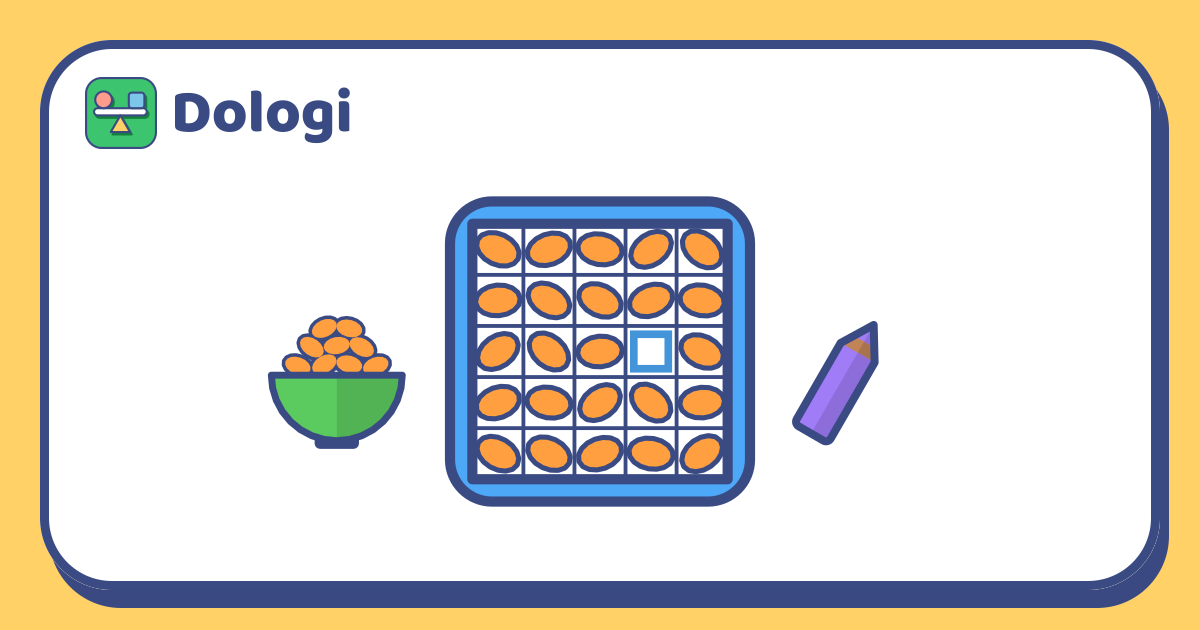
- Something to cover numbers with: dry beans, buttons or small squares of paper (use paper if a toddler is around).
- Paper and a pencil for writing clues.
Covering a number is a small decision: "Can 23 be the answer? No, it's odd." Your child sees what's left after each clue and doesn't have to keep every number in their head.
How to solve one, step by step
Read one clue at a time. After each clue, cover every number that doesn't fit. Here is the puzzle above, on a chart from 1 to 50:
| Clue | Cover | Still open |
|---|---|---|
| I'm more than 20 | 1 to 20 | 21 to 50 |
| I'm less than 30 | 30 to 50 | 21 to 29 |
| I'm even | 21, 23, 25, 27, 29 | 22, 24, 26, 28 |
| My two digits add up to 8 | 22, 24, 28 | 26 |
Only 26 is left. Before saying "done", check the answer against every clue: 26 is more than 20, less than 30, even, and 2 + 6 = 8.
While your child works, ask "Which numbers does this clue cover?" rather than "What's the answer?" Then try reading the clues in a different order: the same number is left at the end.
Seven puzzles by age
Use a chart from 1 to 20 for puzzles 1 and 2, from 1 to 50 for puzzles 3 to 5, and from 1 to 100 for puzzles 6 and 7. "Between 30 and 40" means 31 to 39: the two end numbers don't count.
| Puzzle | Rough age | Clues | Hint |
|---|---|---|---|
| 1 | 6–7 | I'm less than 10. I'm even. I'm more than 6. | Cover 10 and above first |
| 2 | 6–7 | I'm more than 10 and less than 15. I'm odd. I'm more than 12. | After two clues, only two numbers are open |
| 3 | 7–8 | I'm between 30 and 40. I'm even. My ones digit is double my tens digit. | The tens digit of every open number is 3 |
| 4 | 8–9 | I'm less than 50. You say me when you count in fives. I'm odd. My two digits add up to 8. | Count in fives and cover everything else |
| 5 | 8–9 | I'm between 20 and 50. I'm in the 4 times table. My ones digit is 0. | Say the 4 times table from 24 |
| 6 | 9–10 | My two digits are the same. I'm even. I'm between 50 and 80. | Start with 11, 22, 33… |
| 7 | 9–10 | I'm in the 9 times table. I'm odd. I'm between 50 and 70. | Count in nines first |
Ages are only a rough guide; every child is different. Start with the easiest row and move on when it feels easy.
Answers
- 8. Less than 10 leaves 1 to 9. Even leaves 2, 4, 6, 8. More than 6 leaves 8.
- 13. More than 10 and less than 15 leaves 11 to 14. Odd leaves 11 and 13. More than 12 leaves 13.
- 36. Between 30 and 40 leaves 31 to 39. Even leaves 32, 34, 36, 38. Double 3 is 6, so the ones digit is 6.
- 35. Counting in fives below 50 gives 5, 10, 15 … 45. Odd leaves 5, 15, 25, 35, 45. Their digits add up to 5, 6, 7, 8 and 9: only 35 makes 8.
- 40. The 4 times table between 20 and 50 is 24, 28, 32, 36, 40, 44, 48. Only 40 ends in 0.
- 66. The same two digits: 11, 22 … 99. Even leaves 22, 44, 66, 88. Between 50 and 80 leaves 66.
- 63. Counting in nines up to 100: 9, 18, 27, 36, 45, 54, 63, 72, 81, 90, 99. Odd leaves 9, 27, 45, 63, 81, 99. Between 50 and 70 leaves 63.
When a clue does nothing, or too much
- A clue covers nothing. After "I'm between 30 and 40", the clue "I'm less than 60" doesn't move a single bean. Ask: "Did that clue help?" A clue is only useful if it rules something out.
- Everything is covered. Two clues contradict each other, such as "I'm even" and "I'm odd".
- Two numbers are left. The puzzle needs one more clue. Which clue would separate the last two?
Your child writes the clues
Writing a puzzle is harder than solving one: your child has to think from the other side, not "which number fits?" but "which clue rules out the numbers I don't want?"
- Choose a secret number, write it on a scrap of paper and fold it.
- Write a clue that is true for the secret number. On their own chart, cover the numbers it rules out.
- Add clues one at a time until only the secret number is open.
- Read the clues to you. You solve the puzzle with beans, then open the folded paper together.
| Kind of clue | Example |
|---|---|
| Bigger or smaller | I'm more than 40 |
| Odd or even | I'm odd |
| Tens and ones | My tens digit is 7 |
| Adding the digits | My two digits add up to 9 |
| Times tables | You say me when you count in threes |
Many children love watching a parent get stuck when a clue is missing, then fixing their puzzle. At the end, check together that every clue is true for the secret number.
In Dologi, the "Two rings" puzzles in the Logic topic use the same idea: each ring has its own label, and only the things that fit both labels go in the shared middle.
In short
- A mystery number puzzle gives several clues: each rules out some numbers, and together they leave only one.
- Covering numbers on a chart with beans makes each clue visible.
- Check the answer against every clue, and talk about clues that cover nothing or too much.
- Next step: your child writes clues for you, adding them until exactly one number is left.
Read more: Guess my number: the higher-or-lower game for children