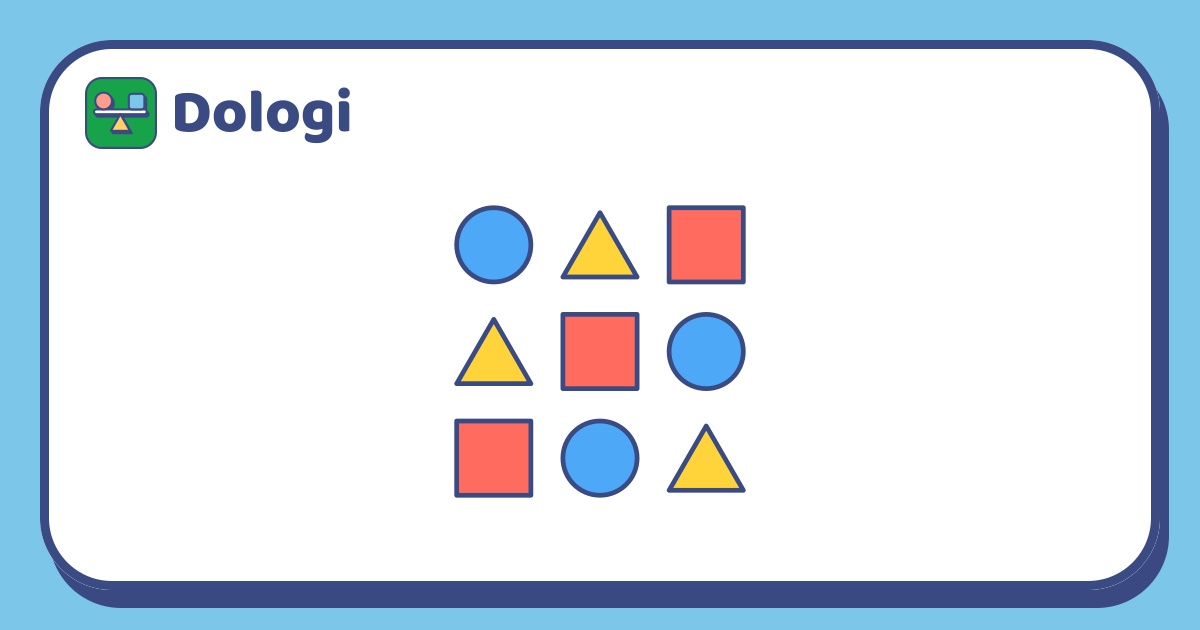
You have probably seen them in newspapers and puzzle books: square grids where each row and each column must contain every number exactly once. Many parents wonder whether these puzzles are too hard for young children. In fact, the idea is simple enough for a five-year-old, as long as you start small and use pictures instead of numbers.
One rule, a lot of thinking
The whole puzzle rests on one rule: in every row and every column, each symbol appears exactly once. That is all. Despite the numbers, there is no adding or subtracting. The numbers are just labels; you could use colours, fruits or animals instead.
What children practise is reasoning by elimination:
- "This row already has a circle and a square, so the empty box must be a triangle."
- "It can't be a 2 here, because there is already a 2 in this column."
- "There is only one place left where the 3 can go."
This kind of step-by-step deduction, checking a rule and ruling out what cannot be true, is at the heart of logical thinking.
When can children start?
Ages are rough guides; every child is different.
| Grid | Symbols | Often around |
|---|---|---|
| 3×3 with one or two gaps | Pictures or colours | 5–6 |
| 3×3 with more gaps | Pictures, then numbers 1–3 | 6–7 |
| 4×4 | Numbers 1–4 | 7–8 |
| 4×4 split into four 2×2 boxes (each box also needs every number) | Numbers 1–4 | 8–9 |
| 6×6 with boxes | Numbers 1–6 | 9–10 |
The classic 9×9 newspaper grid is a big step up. There is no hurry to get there; small grids already offer plenty of thinking.
Starting small at home
- Make a 3×3 grid on paper with large squares.
- Choose three symbols your child knows well: three colours of stickers, three toy animals, three fruit drawings.
- Fill the grid correctly yourself, then remove just one or two symbols.
- Explain the rule with your finger: "Look at this row. What's missing? Now look at this column."
- Let your child check their answer by reading each row and each column out loud.
As your child becomes confident, remove more symbols, then switch to numbers 1 to 3, then move to a 4×4 grid.
Strategies to teach
- What's missing? Look at one row (or column) and name the symbol that is not there yet.
- Row and column together. Some boxes can only be solved by looking at both their row and their column.
- Only one place. Pick a symbol and ask, "Where can the 3 still go in this row?"
- Start with the fullest line. The row or column with the fewest gaps is usually the easiest place to begin.
- Check at the end. Read every row and column once more. Finding your own mistake is a skill too.
Helping without giving the answer
- Hint with questions: "Which numbers are already in this column?" rather than "It's a 2".
- When there is a mistake, point to the row or column with two of the same symbol and let your child find it.
- Use a pencil and eraser, or movable pieces, so trying is not scary.
- Stop while it is still fun. One small grid a day is better than five in a row.
- Solve one together, thinking aloud. Children learn a lot by hearing how an adult reasons.
In Dologi, number-square puzzles start with small 3×3 grids and grow to bigger grids as your child progresses.
In short
- Grid puzzles have one rule: each symbol once in every row and column. No arithmetic needed.
- They train reasoning by elimination, a key part of logical thinking.
- Start around 5–6 with 3×3 grids of pictures and only a few gaps, then grow slowly.
- Teach "what's missing?" and "only one place", hint with questions, and let your child check their own work.
Read more: What is logical thinking, and why start building it at age 4?.