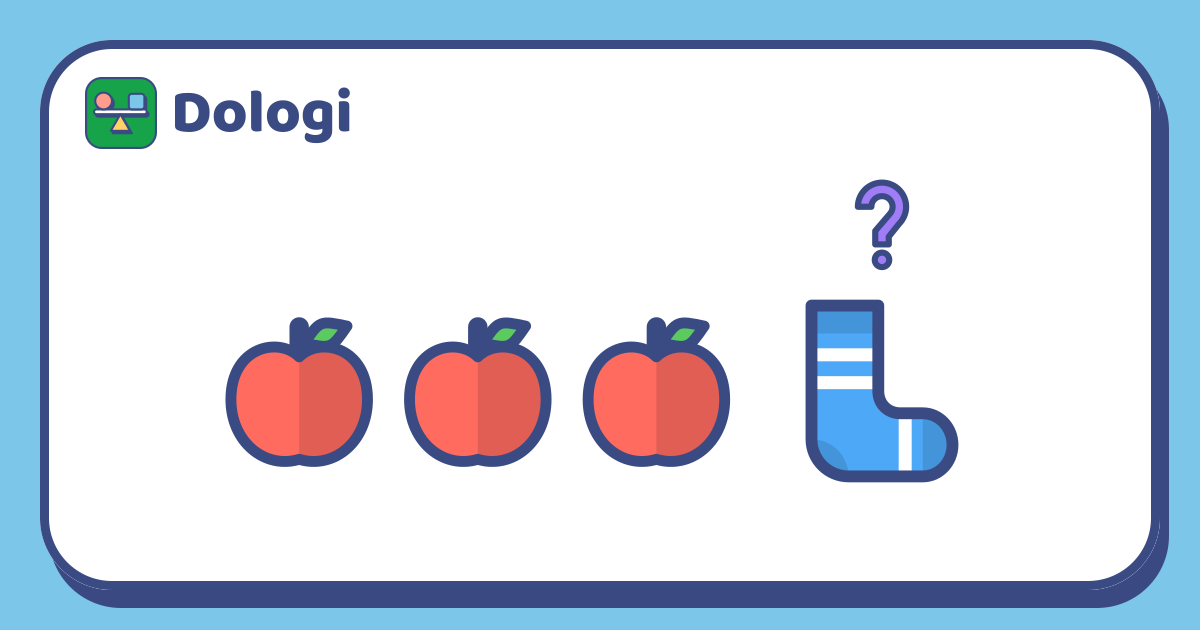
Put three apples and a sock on the table and ask, "Which one doesn't belong?" Most children will point to the sock in a second. Now try a cat, a dog, a hen and a fish. Suddenly there are several good answers, and the interesting part is not which one your child picks, but why.
This is the "which one doesn't belong?" game, also called "odd one out". It is quick, needs nothing special and works almost anywhere. Behind its simplicity is an important thinking skill: generalising, or noticing what several things have in common.
Why such a simple game helps
To find the odd one out, a child has to:
- Look at each item and notice its features: colour, shape, size, what it does, where it lives.
- Find what the others share. "These three are all fruit."
- Explain the difference. "The sock isn't food."
Spotting what things have in common is how we form groups and ideas such as "fruit", "animals" or "even numbers". It is the same skill children use when they sort and compare, and later when they look for rules and patterns in maths.
How to play
- Choose four things, either real objects or pictures. Three should share something; one should not.
- Ask: "Which one doesn't belong?"
- Always ask "why?" The reason is the real answer.
- Accept any answer with a good reason, even if it isn't the one you planned.
- Swap roles once your child gets the idea.
A few rounds at breakfast or on a walk are plenty.
More than one right answer
The best sets have several possible answers. Take a cat, a dog, a hen and a fish:
| Odd one out | A possible reason |
|---|---|
| Fish | It's the only one that lives in water. |
| Hen | It's the only one with feathers and two legs. |
| Cat | It's the only one that climbs trees. |
| Dog | It's the only one that barks. |
When your child gives an answer you didn't expect, ask them to explain. If the reason works, say so: "I hadn't thought of that. That's a great reason!" This teaches children that thinking matters more than guessing what the adult wants.
If a reason doesn't quite hold up, check it together rather than saying "wrong": "Do any of the others climb trees too?"
From easy to tricky
Every child develops at their own pace, so treat the ages as rough guides.
| Around age | Type of set | Example |
|---|---|---|
| 4–5 | Three the same, one very different | Three apples and a sock |
| 5–6 | Category | Banana, pear, grape, toy car |
| 6–7 | One feature | Red ball, red cup, red hat, blue ball (colour) |
| 7–8 | Several possible features | Cat, dog, hen, fish |
| 8+ | Hidden or abstract features | Things that float, words that rhyme, numbers such as 2, 4, 6 and 9 |
With older children, try sets where the obvious answer is a trap. In "spoon, fork, ladle, knife", one is for cutting, but another is much bigger than the rest.
Let your child set the puzzle
Making puzzles is harder than solving them, and children love being the one asking.
- Ask your child to choose four things with one odd one out, and to keep the reason secret.
- Guess, and give your reason. Sometimes give a different, but sensible, reason on purpose. Can your child see that your answer works too?
- Make it a family game: each person sets one puzzle at dinner.
To set a good puzzle, children have to think about features very carefully. That is generalising in action.
Questions that help
- "What do the other three have in common?"
- "Is there another answer? What else is different?"
- "Could we swap one thing so a different one becomes the odd one out?"
- "Can you make a group of three that this one would belong to?"
In Dologi, "Odd block out" puzzles in the Space topic ask children to find the one block that is different from the others, and "Odd note out" puzzles in the Listening topic do the same with sounds.
In short
- The "which one doesn't belong?" game builds generalising: noticing what things have in common.
- Always ask "why?", and accept any answer with a good reason.
- Move from very different items to sets with several possible answers and hidden features.
- Let your child set puzzles for you; making puzzles is excellent thinking practice.
Read more: Sorting and comparing: the first thinking skills children use