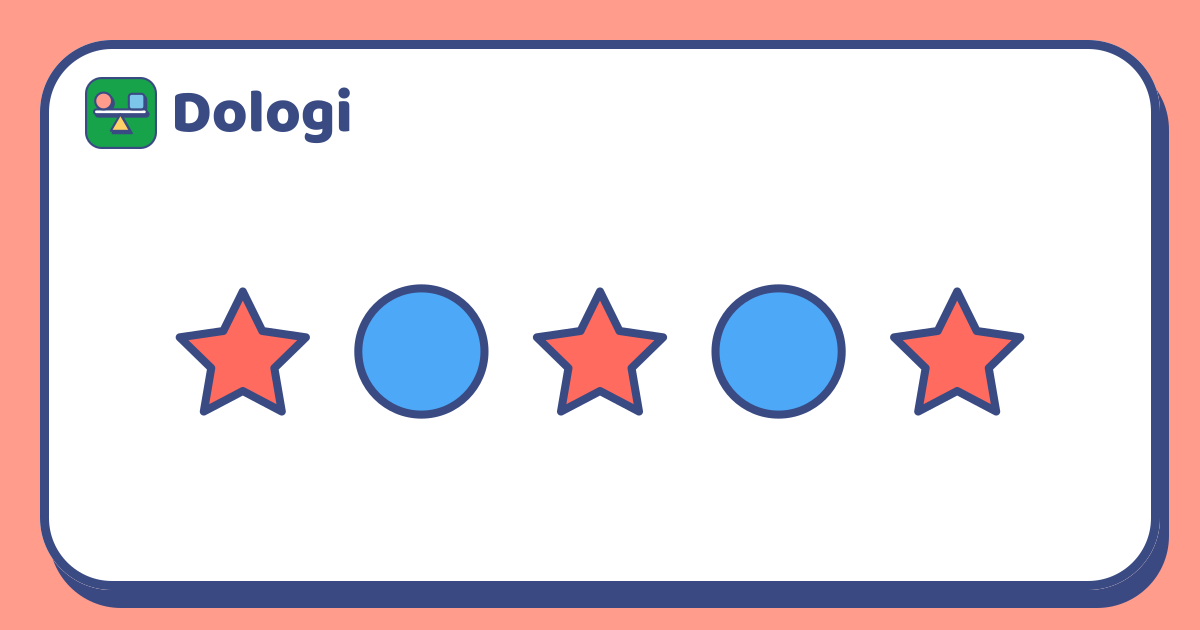
Red, blue, red, blue, … what comes next? Even very young children light up when they guess right. Spotting a pattern feels a little like discovering a secret: once you see the rule, you can tell what will happen before it happens. That feeling is the start of a skill children will use in math, reading, music and everyday life.
What is a pattern?
A pattern is something that repeats or changes by a rule. Some examples:
- Repeating patterns: red, blue, red, blue (AB); clap, clap, stomp (AAB); circle, square, triangle (ABC).
- Growing patterns: one block, two blocks, three blocks; a staircase that gets one step taller.
- Patterns in sound and movement: the rhythm of a song, the steps of a dance.
- Patterns in time: the days of the week, morning, afternoon, evening, the seasons.
- Number patterns for older children: 2, 4, 6, 8; or 5, 10, 15, 20.
Why patterns matter
- Predicting. If you know the rule, you can guess what comes next. Predicting and checking is at the heart of reasoning.
- Math. Counting by twos or fives, times tables, even and odd numbers and many shapes all rest on patterns.
- Reading. Rhymes and repeated sounds help children notice how words are built.
- Music and movement. Rhythms are patterns you can hear and feel.
- Feeling safe. Daily routines are patterns too: children feel calmer when they can predict what happens after dinner.
Patterns you can find at home
- Clothes and fabrics: stripes on a T-shirt, checks on a tablecloth, dots on socks.
- Tiles, fences and railings: often a repeating pattern you can point at on a walk.
- Songs and nursery rhymes: many repeat a line or a chorus.
- The week: "Today is Monday. What comes after Monday?"
- Nature: petals on a flower, leaves along a stem, stripes on some insects.
- Food: arrange slices of banana and apple on a plate in a pattern, then eat the pattern.
Games that build the skill step by step
- What comes next? Line up objects in a simple pattern (spoon, fork, spoon, fork) and ask what comes next. Start with AB and move to ABB, ABC.
- Spot the mistake. Make a pattern with one wrong piece and ask your child to find it.
- Your turn to make one. Ask your child to invent a pattern for you to continue. Explaining their own rule is harder, and more useful, than continuing yours.
- Body patterns. Clap, clap, jump. Clap, clap, jump. Children feel the rule with their whole body.
- Growing towers. Build towers of one, two and three blocks. "How many blocks will the next tower have?"
- Same rule, different things (for older children): turn red, blue, red, blue into clap, stomp, clap, stomp. Seeing that two different patterns share the same rule is a real step in abstract thinking.
| Kind of pattern | Example | Often fits around |
|---|---|---|
| AB | red, blue, red, blue | 4–5 |
| AAB, ABC | clap, clap, stomp; circle, square, triangle | 5–6 |
| Growing | 1 block, 2 blocks, 3 blocks | 6–7 |
| Two features at once | big red, small blue, big red, small blue | 7–8 |
| Number patterns | 3, 6, 9, 12 | 8–10 |
Ages are only rough guides; every child moves at their own pace.
Talk about the rule
The most valuable part of a pattern game is not the answer, it is the explanation.
- Ask "How did you know?" rather than just "Right!".
- Accept more than one answer if your child can explain a different rule that also works.
- Use words like "repeats", "grows", "after" and "every time".
- If your child guesses wrong, go back to the start together: "Let's say it out loud: red, blue, red, blue…"
In Dologi, the Patterns topic has short "what comes next?" puzzles, from simple repeating colours to sequences that turn or grow. They are a nice extra after you have spotted patterns together at home.
In short
- A pattern repeats or changes by a rule, in shapes, sounds, movements, time or numbers.
- Patterns help children predict, count, read and feel secure in routines.
- Start with simple AB patterns and move to growing patterns and number patterns.
- Ask your child to explain the rule and to invent patterns of their own.
Read more: What is logical thinking, and why start building it at age 4?.