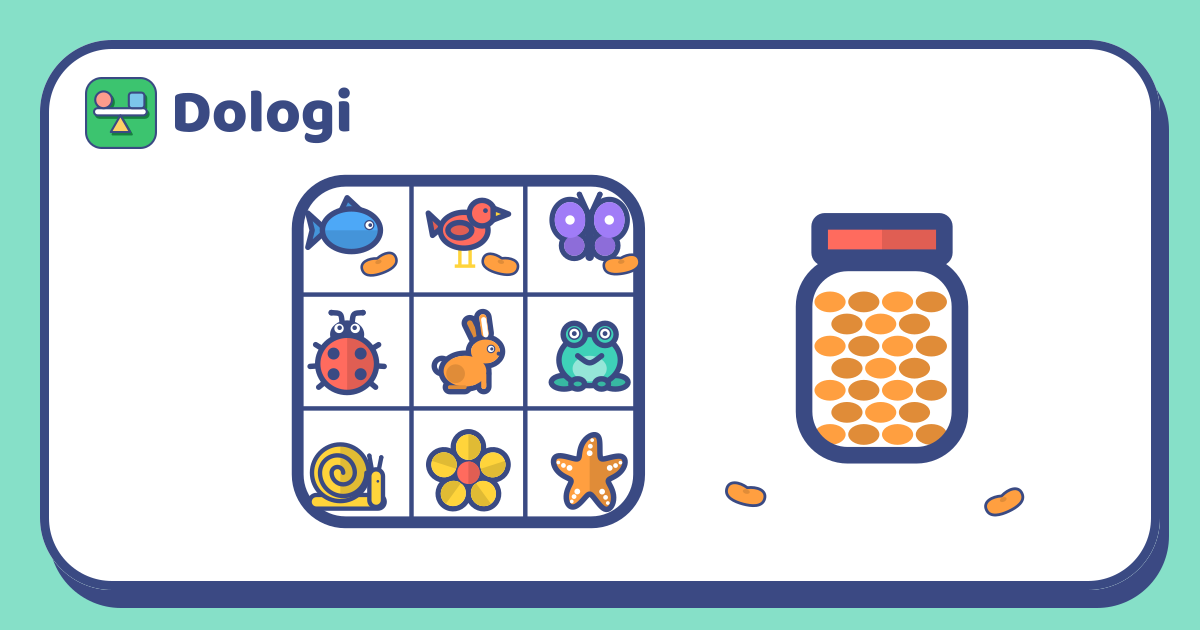
A card with nine pictures, a handful of beans and somebody who calls out what to look for. Bingo works perfectly well without a single letter or number.
And with one small twist it becomes more than a game of luck. When the caller describes a picture instead of naming it, every round is practice in listening to the end and searching a card carefully.
Making the cards
- The grid. Draw three rows of three squares on a sheet of paper, one card per player.
- The pictures. Choose twelve to fifteen simple things: animals, fruit, things from the house. Each card gets nine of them, in a different arrangement. Draw them together with your child or cut them from old leaflets.
- The calling cards. One small card for every picture, kept in a bag.
- The markers. Beans, buttons or bottle caps. Because nothing is crossed out, the cards can be used again and again.
Markers are small, so choose bigger ones for children who still put things in their mouths.
How to play
- Every player gets a card and a pile of markers.
- The caller pulls a calling card out of the bag and announces it.
- Whoever has that picture covers it with a marker.
- The first player with three in a row, across, down or corner to corner, calls "Bingo!"
Before the winner is confirmed, they name the three pictures in their row. This small check keeps everybody honest and gives one more round of naming.
Five levels of calling
| Level | What the caller does | What the players have to do |
|---|---|---|
| 1 | Shows the calling card and names it: "the frog" | Match a picture they can see |
| 2 | Only names it | Keep the word in mind while searching the card |
| 3 | Describes it: "It is green, it lives near water and it jumps" | Listen to all the clues and put them together |
| 4 | Gives a clue with "not": "an animal with no legs" | Rule pictures out as well as in |
| 5 | The child is the caller | Describe a picture without saying its name |
Level 5 is the hardest and the most valuable. To describe a snail without saying "snail", your child has to decide which features set it apart from everything else on the cards.
The habits behind the game
Searching in order. Young children look at a card here and there and miss things. Show them how to run a finger along each row, from left to right, top to bottom.
Listening to the end. With a description, the first clue is rarely enough. "It is green" fits the frog and maybe a leaf. Ask players to wait for the last clue before moving a marker.
Knowing what you are waiting for. When two squares in a row are covered, ask: "Which picture do you need now?" A child who can answer is already planning.
Ways to vary it
- Sound bingo. The caller makes the animal's sound or mimes how it moves.
- Shape and colour bingo. The squares hold a red circle, a blue triangle and so on, and the caller names both features.
- Dot bingo. The squares hold one to nine dots and the caller rolls dice or holds up fingers.
- Bigger cards. Four rows of four for older children, or the rule that the whole card must be covered.
- One team. Everybody shares one card and tries to finish a row within ten calls.
| Rough age | What to try |
|---|---|
| 4–5 | A three-by-three card; pictures shown and named; one row wins |
| 6–7 | Descriptions with two or three clues; taking a turn as caller |
| 8–9 | Four-by-four cards; clues with "not"; two rows to win |
| 10 and up | Making cards and riddle clues for younger children; number bingo with small sums as clues |
Ages are only a rough guide, and every child is different.
In Dologi, the Focus topic has "Tap them all" puzzles, where children search a group of objects and tap every one that matches, such as every star or every flower with five petals. It is the same careful search of a whole picture.
In short
- Nine pictures on a card, calling cards in a bag and beans as markers are all the game needs.
- Three in a row wins, and the winner names the three pictures as a check.
- Calling can grow from showing a picture to describing it and finally to the child describing.
- The game trains searching row by row and listening to the last clue before acting.
Read more: Observation skills: teaching children to look closely before deciding