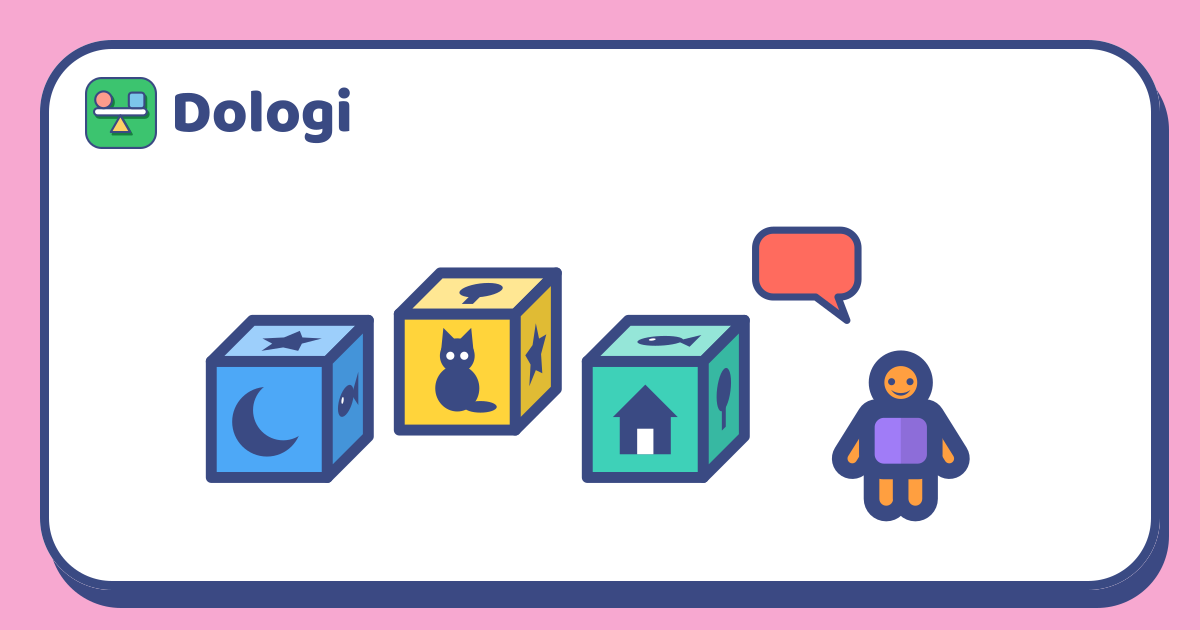
A moon, a cat and a house. "Once upon a time, a cat lived in a little house, and every night it climbed onto the roof to look at the moon…"
Picture dice are cubes with a small drawing on each face. Roll three of them, look at what comes up, and join the pictures into one story. The game costs almost nothing, fits in a pocket and works with children who can't read yet. It also trains something that is harder than it looks: listening to someone else's story and keeping it in your head.
Making the dice
You need three cubes. Any of these will do:
- small square boxes, such as tea boxes or gift boxes, wrapped in plain paper;
- paper cubes folded from a net (draw six squares in a cross, add tabs and glue them);
- large wooden blocks with paper squares taped on.
Then draw one picture on each face. Simple outlines in a thick pen are best. Your child can draw some of them: a story is more fun when they know the pictures. To keep the stories from falling apart, give each die its own kind of picture.
| Die | What goes on it | Six ideas |
|---|---|---|
| Who | A character | Cat, fish, bird, child, grandmother, robot |
| Where | A place | House, tree, sea, mountain, shop, moon |
| What | A thing or an event | Key, rain, ball, cake, boat, lost shoe |
Make a second set later with new pictures, so the dice never run out of surprises.
How to play
- Roll the three dice.
- Put them in a row: who, then where, then what.
- Tell a short story that uses all three pictures.
With young children, start with one sentence for each die: "A cat… lived in a house… and lost its ball." Then ask "And then what?" once or twice. Older children can aim for a story with a beginning, a middle and an end, or a problem that gets solved.
There is no wrong story. If the cat flies to the moon in a cake, that is a good story too. Only one thing is required: every picture that was rolled has to appear somewhere.
Taking turns: tell, listen, retell
The dice become a listening game as soon as there are two players.
- Tell and retell. You tell a short story with the dice. Your child retells it in their own words, in the same order. Then swap roles.
- One die each. Each player rolls one die and adds one sentence to the same story. Before adding yours, repeat the last sentence you heard.
- Spot the change. Retell your child's story with one detail changed (the cat becomes a dog). Can they hear what is different?
- Ask one question. After each story, the listener asks one question about it: "Why did the cat go up on the roof?"
Retelling in order is what makes this more than chatting. To retell, your child has to listen to the whole story, keep it in mind and put it back together in the right sequence. If they get stuck, point at the dice: the pictures in a row are a reminder of what came first.
Easier or harder
| Rough age | What to try |
|---|---|
| 4–5 | Two dice; one sentence per picture; you tell, they point to the right die |
| 6–7 | Three dice; a story with "first, then, in the end"; retelling a short story in order |
| 8–9 | A problem and a solution; one die each, adding a sentence in turn; spotting a changed detail |
| 10 and up | Five or more dice; stories in a fixed style (funny, spooky, a news report); writing down the best ones |
Ages are only a rough guide, and every child is different. If a story turns into a long list of "and then… and then…", that is fine. Ask "How does it end?" to help your child find an ending.
In Dologi, the Listening topic has short sound puzzles such as "Listen and play back", where your child hears a short tune and plays it back in the same order. Remembering what came first and what came next is the same skill they use when retelling a dice story.
In short
- Three homemade dice with a picture on every face are all you need.
- Giving each die a role (who, where, what) keeps the stories together.
- Retelling someone else's story in order turns storytelling into a listening game.
- Fewer dice and one sentence per picture for young children; problems, turns and changed details for older ones.
Read more: Retelling the day in order: helping children practise sequence and expression