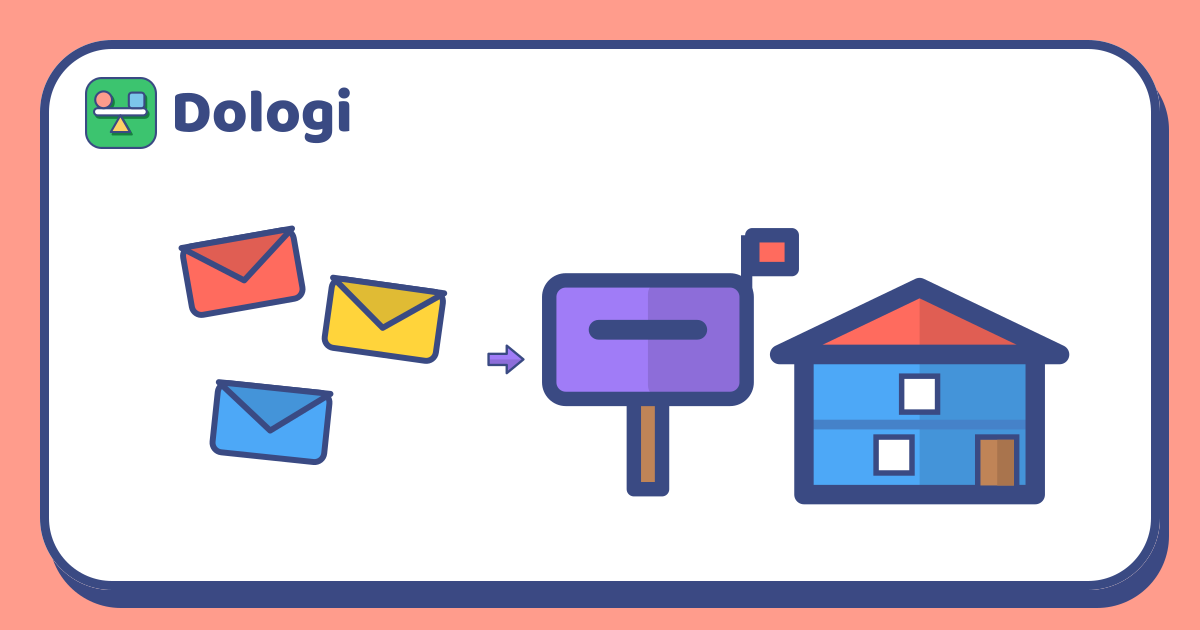
A bag full of letters, a street of little houses and one postman who has to bring every letter to the right door. Children love this job, and it keeps them busy for a long time.
Underneath the play there is a lot of thinking. Every letter has to be read, compared with the houses and matched to exactly one of them, and a clever postman also works out the order in which to walk.
Building the street
- Houses. Four to six shoe boxes, cups or paper bags, lined up along a hallway.
- House signs. Each house gets a colour and a number. Show the number as dots, and add the digit for children who already read numbers.
- Letters. Envelopes or folded pieces of paper. Each one carries an address: a spot of colour, some dots, or both.
- A bag for the postman.
Start small, with three houses and two letters for each.
Four levels of addresses
| Level | Address on the letter | What the postman has to do |
|---|---|---|
| 1 | A colour | Find the house of the same colour |
| 2 | Dots, from one to six | Count the dots and find the same number |
| 3 | A colour and a number together | Get both right: the red street and the blue street each have a house 2 |
| 4 | A clue, such as "one more than 4" or "the house between 2 and 4" | Work out the number before walking |
Move up only when a level has become easy. Level 3 is a real step: your child has to hold two features in mind at once.
Sort first, then deliver
Let your child deliver the first bag just as the letters come out, one by one. There will be a lot of walking up and down the street.
Then show how real postal workers do it. Tip the bag out, make a pile for each house, put the piles in the order of the street, and walk the route once.
Count the steps both ways and compare. Your child sees for themselves why sorting comes before delivering: a little thinking at the start saves a lot of walking.
Small problems for the postman
- A letter that fits nowhere. Slip in an address with no house, such as seven dots on a street that ends at six. What should happen to it?
- Wrong box. You are a resident who finds someone else's letter. Hand it back and ask where it belongs.
- Who got the most post? Empty the boxes at the end and count. Which house got the most letters, which the fewest, and how many were there altogether?
- Two sides of the street. For older children, put the odd numbers on one side and the even numbers on the other, as on many real streets.
| Rough age | What to try |
|---|---|
| 4–5 | Three houses; colour addresses, then dots up to three |
| 6–7 | Six houses with dots or digits; sorting before delivering; counting the letters in each box |
| 8–9 | Colour and number together; clue addresses; odd and even sides of the street |
| 10 and up | Writing clue addresses for a younger child; inventing an address system for the shelves of a room |
Ages are only a rough guide, and every child is different.
In Dologi, "Sort into boxes" puzzles in the Math topic ask children to sort things by a feature, such as the number of dots on a die. It is the same job as getting each letter into the right box.
In short
- Boxes for houses, envelopes with addresses and a bag are enough for a postman game.
- Addresses can grow from a colour to dots, to colour and number together, to clues.
- Sorting the letters before walking the route saves steps, and your child can count the difference.
- A letter that fits nowhere or a wrong delivery gives the postman something to reason about.
Read more: Sorting and comparing: the first thinking skills children use