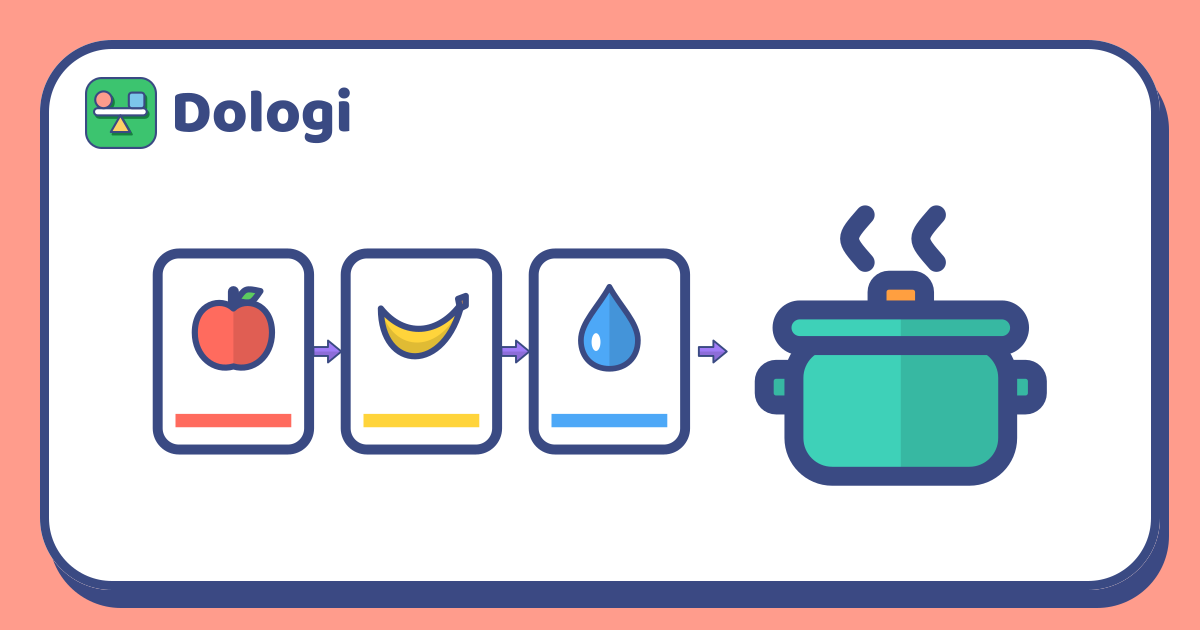
A pot, a wooden spoon and a soup made of blocks and buttons. Pretend cooking is one of the oldest games there is. Add one small thing and it becomes something more: a recipe drawn in pictures.
A picture recipe is a row of symbols with a meaning. Your child reads it from left to right, does what one card says, and only then moves to the next. That is the skill behind following instructions, and no letters are needed for it.
What you need
- A pot or a bowl and a spoon, toy or real.
- Pretend ingredients: blocks, buttons, bottle caps, pompoms, scraps of paper. Sort them into small bowls by colour.
- Blank cards or pieces of paper, and a pen.
Drawing the first recipe
Each card is one step. Draw what goes in, and add dots to show how many. Here is "rainbow soup":
| Card | What is drawn | What it means |
|---|---|---|
| 1 | A red block and three dots | Three red blocks go into the pot |
| 2 | A yellow button and two dots | Two yellow buttons |
| 3 | A drop | One cup of pretend water |
| 4 | A spoon, a curved arrow and five dots | Stir five times |
Lay the cards in a row from left to right, with a small arrow between them.
Cooking by the cards
- Your child points to the first card, says what it means and does it.
- A clothes peg or a coin marks the card they are on, and moves along after each step. It answers the question "where was I?".
- You are the customer. When the soup arrives, check it against the cards together: "Three red ones? Let's count."
Try not to read the cards aloud for your child. The reading is their part of the game.
Making it harder
| Change | What it practises |
|---|---|
| Five or six cards | Keeping your place in a longer sequence |
| Shuffled cards: which order makes sense? | Seeing which steps have to come before others |
| One card secretly removed | Noticing a gap: "Something is missing in this soup" |
| Repeats: one scoop, stir, one scoop, stir | Spotting a pattern and saying what comes next |
| Soup for two customers | Doubling every amount on the cards |
With the shuffled cards, talk about why. The water can go in before or after the buttons, but "stir" makes no sense on an empty pot, and "serve" has to come last.
Your child writes the recipe
Now swap roles. Your child invents a dish and draws the cards, and you cook from them exactly as drawn.
If a card doesn't show how many, ask. If two cards could be read in either order, ask. Your child discovers what was unclear and fixes the card. This is where they learn that instructions have to be precise, because the cook can only know what is on the card.
| Rough age | What to try |
|---|---|
| 4–5 | Three cards with amounts up to three; pointing and doing |
| 6–7 | Five or six cards with a marker; finding the missing card; drawing a recipe of their own |
| 8–9 | Putting shuffled cards in order; repeating steps; doubling a recipe |
| 10 and up | Writing a recipe for a younger child; a card with a choice, such as "if the customer wants it sweet, add two more" |
Ages are only a rough guide, and every child is different.
In Dologi, "Repeating patterns" puzzles in the Patterns topic ask children to find the part that repeats and choose what comes next. It is the same careful reading of a sequence, one step after another.
In short
- A picture recipe turns pretend cooking into reading a sequence of symbols.
- One card is one step, with dots for the amount, read from left to right.
- Shuffled, missing and repeating cards make the same game harder.
- When your child writes the recipe and you follow it exactly, they learn to give clear instructions.
Read more: A recipe is a program: everyday algorithms for children