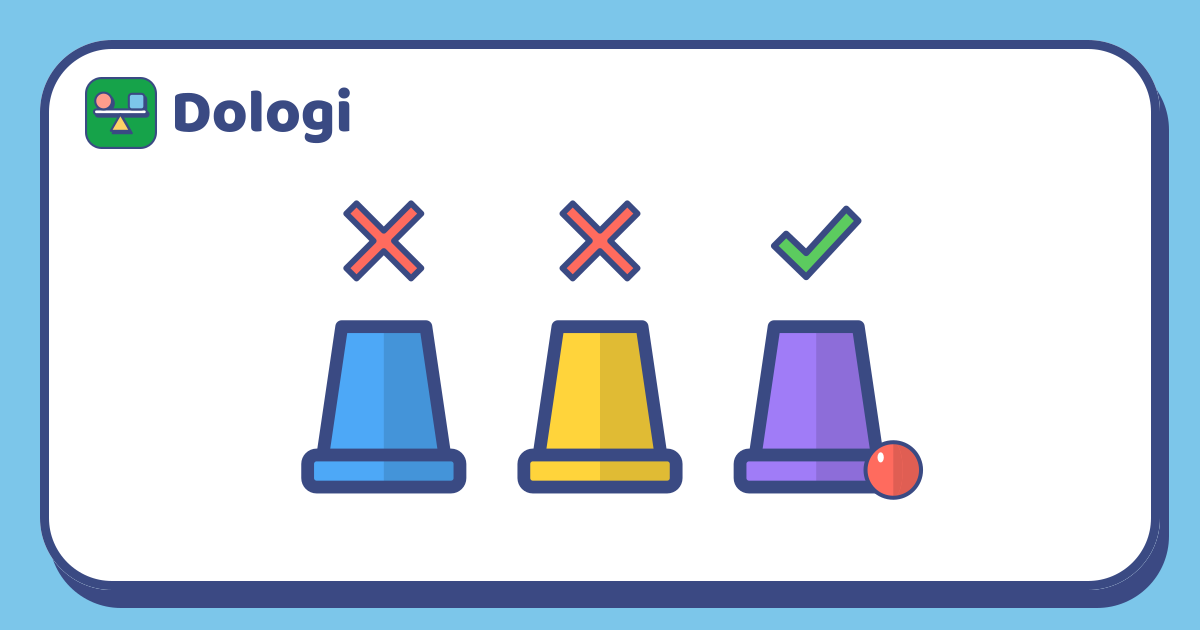
"It's not in my bag, it's not under the bed… so it must be in the car!" Children often reason like this without knowing there's a name for it. Crossing out what can't be true, until only one possibility is left, is called the process of elimination. It's one of the most practical thinking tools there is, and it's easy to practise with games at home.
This article explains the idea simply, offers a classic three-cup game to start with, and suggests ways to help your child explain each step, because saying why something is ruled out is where the real thinking happens.
What is the process of elimination?
When you don't know the answer straight away, you can still look at the options and ask: "Which of these can't be right?" Every option you rule out makes the problem smaller.
- It works without knowing everything. Your child doesn't need to know where the ball is, only where it isn't.
- It's a step-by-step method. One clue, one option crossed out, then the next.
- It needs a reason each time. "It's not the red cup, because I saw you lift it and it was empty."
Many puzzles, quizzes and everyday problems become easier with this one habit.
Start with three cups
You need three cups that you can't see through and one small object, such as a bottle cap or a button.
- Hide the object under one cup while your child watches, then mix the cups slowly.
- Ask your child to point to a cup that is definitely not the right one. Lift it together: "Not this one!"
- Ask again: "There are two left. Which one do you think it isn't?"
- Lift the last cup and celebrate: "Only one was left, so it had to be here."
Then add a twist: lift one cup yourself and show it's empty, and let your child work out what that means. With younger children, keep the mixing slow and the cups few. Older children can play with four or five cups, or take turns hiding.
Say why, out loud
The most valuable part isn't finding the object; it's the reason for each step.
- Ask "How do you know?" after every choice, in a curious tone, not a testing one.
- Accept simple reasons: "Because you lifted it" is a perfectly good reason for a 4-year-old.
- Model it yourself: "I don't think it's the blue one, because I remember it was on the left."
- Use a sentence frame: "It's not ___, because ___." Children quickly start using it on their own.
If your child guesses, that's fine. Gently ask: "Is there one we can rule out first?"
Everyday elimination games
Once your child knows the idea, you'll find chances everywhere.
- Which hand? Hide a small thing in one hand. Show an empty hand: "So where is it?"
- Guess my animal. Think of an animal. Your child asks yes-or-no questions and crosses out animals as you answer: "It can't fly, so it's not a bird."
- Lost and found. When something is missing, make a list of places together and tick them off one by one.
- What's for dinner? Give three options and two clues: "It's not cold, and it's not pasta."
- Who's at the door? "It's not the post, because the post came this morning. Who else could it be?"
Clue puzzles for older children
Children from about 7 or 8 often enjoy small clue puzzles, especially if they help to draw them.
| Clue | What we can cross out |
|---|---|
| Three friends each have a different pet: a cat, a dog and a fish. | Nothing yet. |
| Mia's pet doesn't have legs. | Mia doesn't have the cat or the dog, so Mia has the fish. |
| Leo is allergic to cats. | Leo doesn't have the cat, and the fish is taken, so Leo has the dog. |
| Who has the cat? | Only Sam is left. |
A simple grid with names down the side and pets across the top helps a lot: put a cross in each box that's ruled out, and a tick when only one box is left in a row. You can invent puzzles about your family, your street or your child's favourite toys.
In Dologi, "Who lives where?" puzzles give a few clue cards, and children use them to work out which house belongs to each robot, crossing out possibilities one clue at a time.
When it doesn't work
Sometimes elimination leads nowhere, and that's part of learning too.
- A wrong clue: if a clue was misunderstood, the answer can come out wrong. Go back and check each step together.
- Not enough clues: if two options are still left, say so honestly: "We can't know yet. What else could we find out?"
- Guessing too fast: encourage your child to slow down and check every option before deciding.
In short
- The process of elimination means ruling out what can't be true until one possibility is left.
- Start with three cups and a small object, and keep the mixing slow for younger children.
- Ask "How do you know?" and use the frame "It's not ___, because ___."
- Practise in daily life and, for older children, with small clue puzzles drawn on a grid.
Read more: Logic puzzles for children aged 4 to 10, with answers and hints