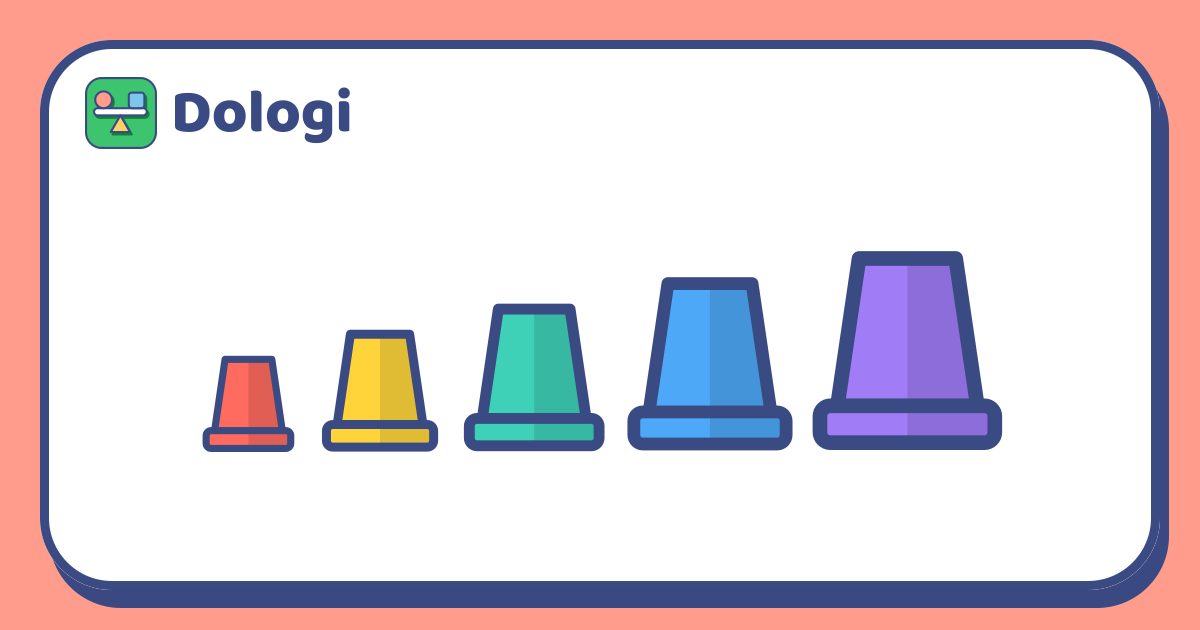
Give a toddler a set of stacking cups and you'll see an early thinking skill at work: which one goes inside which? Putting things in order, from smallest to biggest or lightest to heaviest, is something children practise long before school, and it underpins a lot of what comes later.
Comparing two things is one step. Ordering five things means comparing many times and keeping track of where each one belongs. That's real reasoning, and it can be practised with everyday objects.
Why ordering matters
- Comparing many things. Children move from "this one is bigger" to "this is the biggest of all".
- Logical steps. If the red cup is bigger than the blue one, and the blue one is bigger than the yellow one, then the red one must be bigger than the yellow one, without checking.
- Words for comparing. Small, smaller, smallest; long, longer, longest; first, next, last.
- Foundation for maths. Number lines, measuring and reading charts all build on the idea of putting things in order.
Start small
- Three things first. Three pencils of different lengths, three teddies of different sizes.
- Then five. Five is enough to need a strategy, not just a glance.
- Then more, or closer sizes. Ten objects, or objects that are only slightly different, make it harder.
Stacking cups and rings are great for little ones because they check themselves: if the order is wrong, the cups don't fit.
What to put in order
Size is the obvious start, but almost anything can be ordered:
| Order by… | Try with… |
|---|---|
| Length | Pencils, straws, ribbons, spoons |
| Height | Toy figures, plants, family members |
| Weight | A potato, an apple, a grape (feel first, then check on kitchen scales) |
| Loudness | Clapping, a bell, a whisper, a drum |
| Shade | Paper strips from light blue to dark blue |
| Time | Baby photos to now, the steps of a recipe |
Ordering by weight is especially interesting, because big things aren't always heavier. A large balloon is lighter than a small stone.
Strategies to try
When children order more than three things, a strategy helps:
- Find the smallest first. Pick out the smallest, put it at the start. Then find the smallest of what's left, and so on.
- Where does the new one go? Start with one object. Take the next and decide: before it or after it? Each new object is compared with its neighbours until it finds its place.
- Line up the ends. When comparing lengths, line up one end of everything on the edge of the table. Otherwise a short pencil can look long.
Ask your child which strategy they used. Explaining their method is part of the thinking.
Common mix-ups
- Not lining up the ends. A pencil placed further forward looks longer. Show how to start all of them at the same line.
- Mixing two features. A tall, thin glass and a short, wide one: which is "bigger"? It depends whether you mean height or how much it holds. Talk about which feature you're ordering by.
- Big means heavy. Test it with a balloon and a stone.
Games
- Where does it go? Line up five pencils in order, then give your child a new one to fit in the right place.
- Spot the swap. Your child closes their eyes while you swap two objects in an ordered row. Can they find and fix the mistake?
- Family line-up. Line up by height, then by age. Is it the same order?
- Hands as scales. Hold two objects, guess which is heavier, then check on kitchen scales and put them all in order.
Ideas by age
- Ages 4–5: stacking cups, three to five objects by size, and words like big, bigger, biggest.
- Ages 6–7: five to ten objects, order by length and weight, and the strategy "find the smallest first".
- Ages 8 and up: close sizes, ordering by less obvious features (loudness, time), and explaining the logical steps.
In short
- Putting things in order means comparing many things and keeping track of where each one belongs.
- Start with three objects, then five, then more or closer sizes.
- Order by length, height, weight, loudness, shade and time, not just size.
- Teach strategies like "find the smallest first" and "where does the new one go?", and always line up the ends.
Read more: Sorting and comparing: the first thinking skills children use