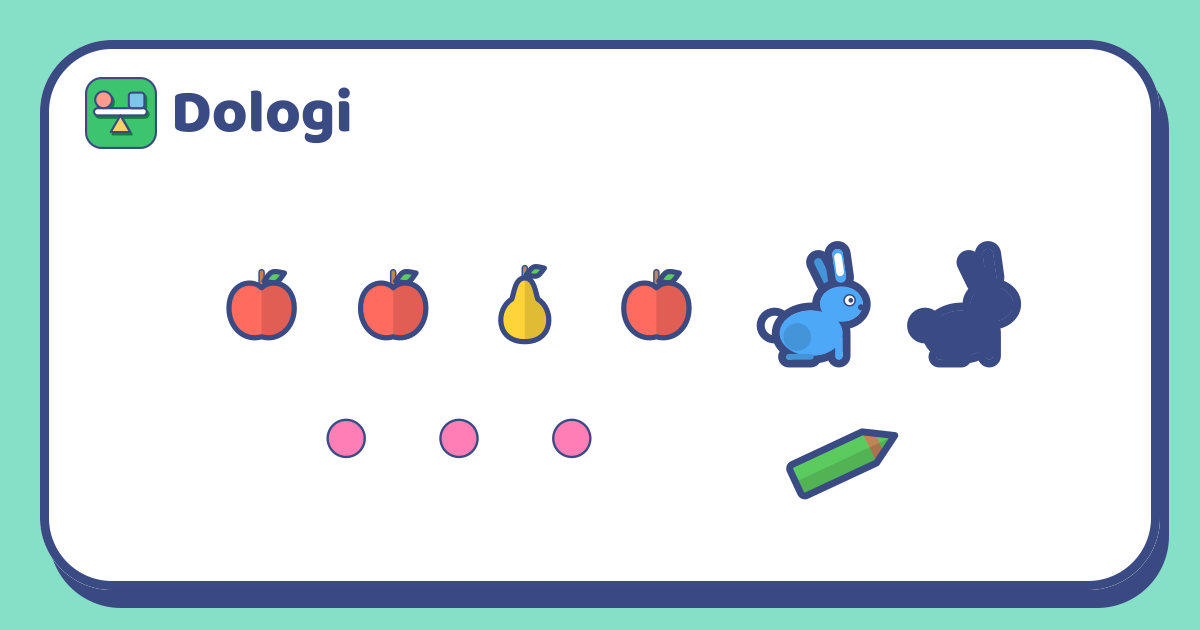
Four- and five-year-olds love a good challenge, but they do not need formal worksheets, flashcards, or written sums. At this age, a scrap piece of paper and a pencil are all you need to create engaging thinking games right at the kitchen table or on the living room rug. Children do not even need to write numbers or letters; they can simply point with a finger or tell you what they notice.
Hand-drawn visual puzzles help young children sharpen their observation, spot subtle similarities and differences, connect small quantities with physical items, and practise simple deduction. Here are ten puzzles you can sketch in less than a minute, along with stepped hints and child-friendly explanations.
Ten 1-minute hand-drawn puzzles
A quick rough drawing is all you need—there is no need for artistic perfection:
| Number | Puzzle name | What to sketch on paper | What to ask your child |
|---|---|---|---|
| 1 | Odd fruit out | Three round apples and one pear with a narrow top | "Which fruit does not belong with the others in this row?" |
| 2 | Counting dots | A small box containing four distinct dots | "How many dots are hiding inside this box?" |
| 3 | Bunny's shadow | A rabbit with tall upright ears on the left; two solid shadows on the right: one with tall ears, one with short round ears | "Which dark shadow belongs to the rabbit on the left?" |
| 4 | Matching socks | Three socks: two with horizontal stripes, one with polka dots | "Can you find the two socks that match each other to make a pair?" |
| 5 | Caterpillar's path | A little caterpillar at a fork in the road: one branch is blocked by a rock, the other leads to a green leaf | "Which path should the caterpillar crawl along to reach the leaf?" |
| 6 | The missing part | A cat's face with two eyes, nose, mouth, whiskers, but only one ear | "Look closely at the cat's face. What part is missing?" |
| 7 | Which cup is bigger? | Two cups side by side: one tall and wide, one short and tiny | "If you wanted to hold the most water, which cup would you choose?" |
| 8 | What comes next? | A row of shapes: circle, square, circle, square, circle, followed by an empty box | "Which shape should go into the empty box at the end?" |
| 9 | Where is the ball? | A table, with a round ball drawn underneath the tabletop on the floor | "Is the ball sitting on top of the table or hiding under the table?" |
| 10 | The three-item memory game | Place three small objects on the table (an eraser, a spoon, a bottle cap), let your child look for five seconds, then hide one under a cup | "Which object just disappeared under the cup?" |
Stepped hints when your child is stuck
When a child looks at a drawing and pauses without an answer, the most common parental reflex is to blur out the solution or repeat the question louder. A gentler and far more rewarding approach is to ask guiding questions that help them discover the answer themselves:
- Level 1: Direct attention to one detail at a time. Rather than asking "Which one is different?", ask: "What shape is this first apple? And what shape is this fruit next to it?". Naming the features aloud helps children notice the contrast on their own.
- Level 2: Narrow the choices. If four items feel overwhelming, gently cover two with your hand: "Between these two pictures, which one looks closer to the real bunny?".
- Level 3: Encourage finger tracing. For path puzzles or dot counting, ask your child to place their index finger on the paper and trace each line or tap each dot. Physical movement anchors focus and makes abstract comparisons tangible.
- Level 4: Celebrate thoughtful reasoning. If your child makes an unexpected choice, do not say "That's wrong." Ask with curiosity: "Why did you pick that one?". Young children often spot genuine connections that adults overlook.
What 4-to-5-year-olds learn from these puzzles
These simple paper games may look like light-hearted amusement, but they build essential cognitive foundations:
- Focused attention and detail scanning: Spotting a missing ear or finding the odd sock requires children to sweep their eyes systematically across an image rather than glancing quickly.
- Early number sense: Touching and counting dots reinforces that numbers represent concrete quantities, well before children are expected to write arithmetic on lined paper.
- Spatial awareness and direction: Words like "over, under, inside, next to, and around" become clear and practical when navigating a path or placing an object.
- Expressing logic in words: Explaining why the pear is different ("Because the pear is skinny on top, but apples are round") turns raw visual perception into structured thought.
In Dologi, the Focus and Space topics feature similar visual puzzles, such as finding the odd item, counting blocks, and matching shadows. They are designed with uncluttered visuals, touch-based interactions, and no reading required, so young children can explore and think at their own rhythm.
Answers and how to explain them
Here are the answers with brief, encouraging explanations to share with your child:
- Puzzle 1 (The pear): The pear is narrow at the top and wide at the bottom, while all three apples are round.
- Puzzle 2 (4 dots): Encourage your child to tap each dot one by one while counting: one, two, three, four.
- Puzzle 3 (The tall-eared shadow): The rabbit has long upright ears, so its shadow must have long ears too. The short-eared shadow belongs to another animal (like a bear).
- Puzzle 4 (The two striped socks): Both striped socks share the same pattern, making them a pair. The polka-dot sock has no match.
- Puzzle 5 (The open path without the rock): The path with the boulder is a dead end. The open trail leads directly to the leaf.
- Puzzle 6 (One ear is missing): Cats have two ears, but this drawing only has an ear on the left side.
- Puzzle 7 (The larger cup): The larger, taller cup has more room inside, so it holds more water.
- Puzzle 8 (A square): The pattern repeats: circle, square, circle, square, circle. A square comes next.
- Puzzle 9 (Under the table): The ball is resting on the floor beneath the tabletop.
- Puzzle 10 (The hidden item): Depends on which of the three items you slipped away during the game.
In short
- Young children do not need formal worksheets; quick hand-drawn sketches on scrap paper are ideal for exercising young minds.
- Let your child point or explain with words rather than worrying about writing.
- When your child hesitates, guide them with smaller questions instead of giving away the answer.
- Five minutes of playful puzzling every day nurtures observation, concentration, and confidence.
Read more: Logic puzzles for children aged 4 to 10, with answers and hints