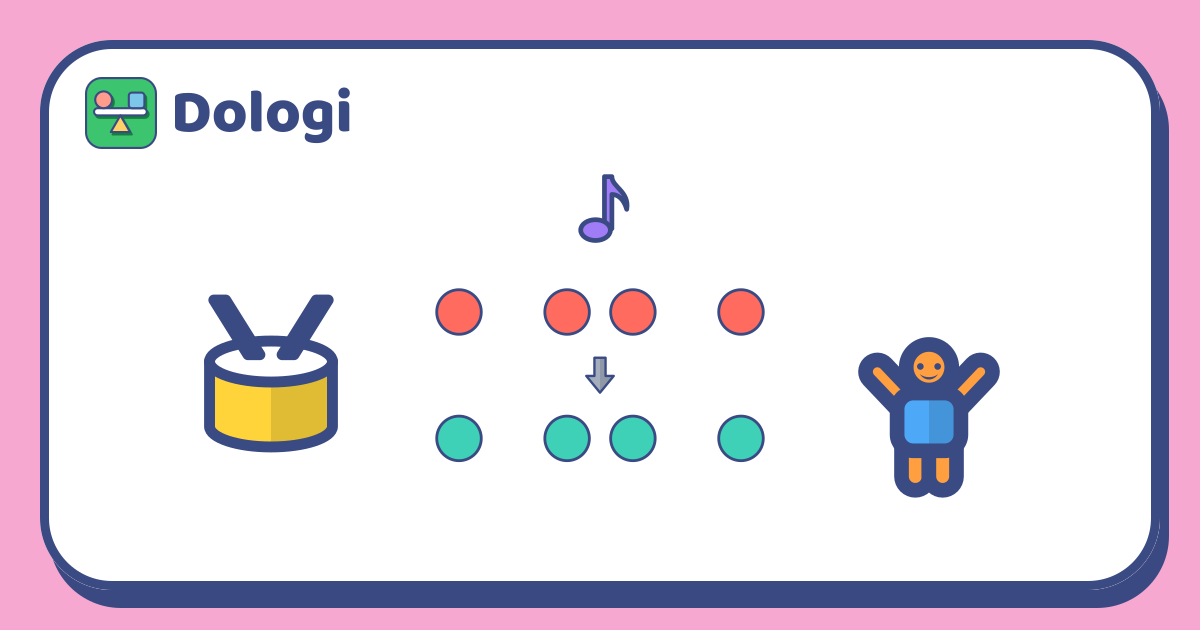
Clap, clap, clap-clap, clap. "Your turn." Clap, clap… clap-clap, clap. "Same!"
Echo games are as simple as music gets. One person plays a short rhythm, the other plays it back. To get it right, your child has to listen to the whole pattern, hold it in mind for a moment and then reproduce it with their hands. It takes a few seconds per round, can be played almost anywhere and needs nothing but hands.
How to play
- Clap a short rhythm: three or four beats to start with.
- Your child claps it back straight away.
- If it matches, play a new one. If not, play the same one again, a little slower.
Start with beats that are all the same length and evenly spaced: clap, clap, clap. Then change just one thing at a time:
- a pause: clap, clap, (rest), clap;
- two quick beats: clap, clap-clap, clap;
- one beat louder than the others.
Keep the rhythms short. A child who gets three beats right every time is ready for four, not for eight.
Kitchen instruments
Hands are enough, but pots and boxes add something: different sounds to listen for.
| Instrument | How to make it | What it adds |
|---|---|---|
| Pot drum | A pot upside down and a wooden spoon | A deep, loud sound |
| Box drum | An empty plastic box with a lid | A softer, hollow sound |
| Spoon clicks | Two metal spoons back to back | A short, sharp sound |
| Shaker | A small bottle with a little rice or dry beans, lid screwed on tight | A long rustle instead of a beat |
| Knee taps | Your own legs | A quiet sound for rooms where others are sleeping |
Check that lids are closed tightly and stay with young children while they play with small grains.
With two instruments, the rhythm becomes a little harder: pot, pot, box, pot. Now your child has to listen to which sound came where, not only when.
Making it harder
Once short rhythms are easy, try one of these:
- Longer patterns. Add one beat at a time.
- Loud and soft. The same rhythm, but the last beat is very soft.
- Fast and slow. Play the same pattern quickly, then slowly. Is it still the same rhythm?
- Body sounds. Clap, tap your knees, stamp your feet: three different sounds in one rhythm.
- Back to back. Sit back to back so your child can only hear, not see, your hands.
- Word rhythms. Clap the syllables of a word or a name ("ba-na-na", "Gran-dad"). Can your child guess the word from the rhythm?
- Swap roles. Your child plays the rhythm and you echo it. Make a mistake now and then and see if they hear it.
When the echo doesn't match
Mismatched echoes are part of the game, not a failure. Some ways to help:
- Play it again, more slowly, and say "Listen to the end before you start."
- Split a longer rhythm into two halves and practise each one.
- Use a word to carry the rhythm: "clap, clap, quick-quick, clap".
- Praise the listening as well as the result: "You got the quick ones exactly right."
There's no need to keep score. Most children enjoy the game more when the rhythms stay just a little hard.
Drawing a rhythm
Rhythms can also be written down without notes or numbers. Draw a big dot for each beat and leave a gap for each pause. Two small dots close together are two quick beats.
Draw a row of dots and ask your child to play it. Then let them draw a rhythm for you. Moving between sound and picture is a small first step towards reading a pattern, in music and elsewhere.
| Rough age | What to try |
|---|---|
| 4–5 | Three or four even beats; knee taps; you play and your child echoes |
| 6–7 | Pauses and quick beats; pot and box drums; word rhythms with names |
| 8–9 | Patterns with two or three sounds; back to back; drawing rhythms as dots |
| 10 and up | Long patterns; loud, soft, fast and slow; inventing rhythms for others to echo |
Ages are only a rough guide, and every child is different.
In Dologi, the Listening topic has puzzles such as "Long and short", where children tell long sounds from short ones. Hearing how long a sound lasts is part of hearing a rhythm.
In short
- You clap a short rhythm, your child claps it back, and the rhythm grows one beat at a time.
- Pots, boxes, spoons and shakers add different sounds to listen for.
- Pauses, quick beats, loud and soft and playing back to back make the game harder.
- Big and small dots let your child draw a rhythm and play it from paper.
Read more: Does learning music help children with maths? Rhythm, patterns and counting