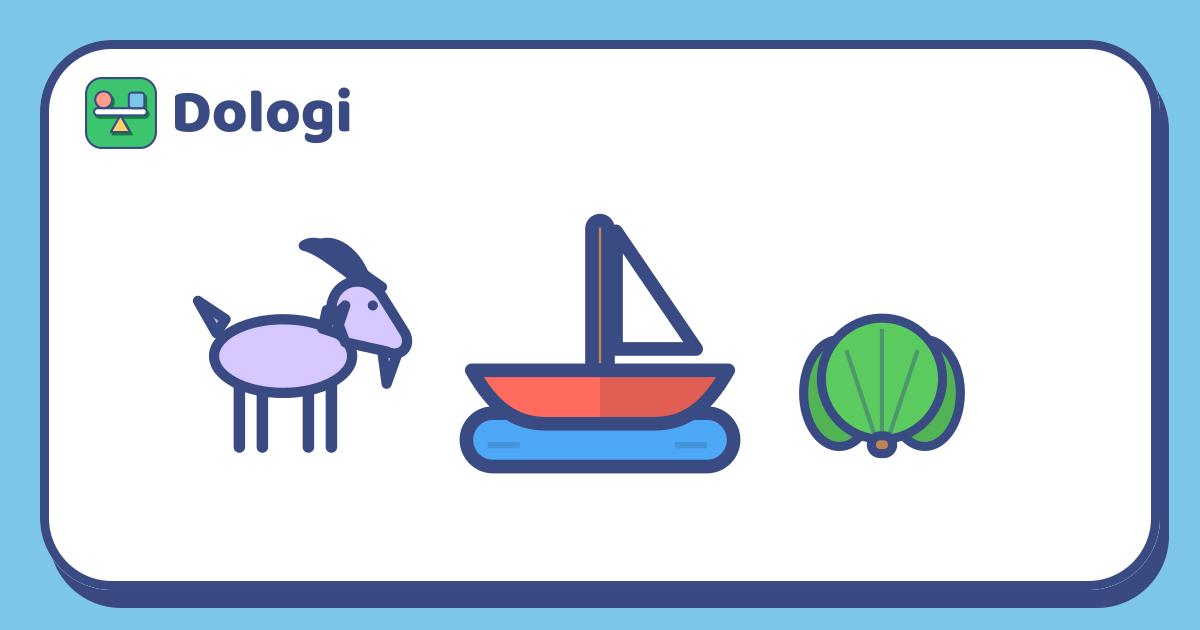
A farmer has a wolf, a goat and a cabbage, and needs to get all three across a river. The boat is tiny: it can carry the farmer and only one other thing. If the farmer leaves the wolf alone with the goat, the wolf will eat the goat. If the goat is left alone with the cabbage, the goat will eat the cabbage. How can the farmer get everything across safely?
This old folk puzzle has been told in many countries for centuries, and it's a wonderful introduction to planning, rules and thinking a few steps ahead. Most children around 7 or 8 can solve it with a bit of help, and younger children enjoy acting it out.
Set it up with toys
The puzzle is much easier to think about when children can move things around.
- The river: a scarf, a towel or a strip of blue paper on the floor or table.
- The boat: a box lid, a shoe or a small plate.
- The characters: any toys will do. A toy dog can be the wolf, a toy animal the goat, a ball of green paper the cabbage, and a figure or a block the farmer.
Before starting, go over the rules together and let your child repeat them in their own words:
- Only the farmer can row the boat.
- The boat holds the farmer and at most one other thing.
- The wolf and the goat can't be left alone together.
- The goat and the cabbage can't be left alone together.
Record each trip
As your child moves the boat back and forth, write down each trip in a simple table. Recording helps them remember what they've tried and spot when they're going round in circles.
| Trip | In the boat | Left bank | Right bank |
|---|---|---|---|
| Start | farmer, wolf, goat, cabbage | ||
| 1 | farmer and goat | wolf, cabbage | farmer, goat |
| 2 | farmer alone | farmer, wolf, cabbage | goat |
| ... |
After each trip, check the rules on both banks: "Is anyone left alone with something they'd eat?"
The key idea: something has to come back
Most children start well: the goat has to go first, because the wolf won't eat the cabbage. Then the farmer comes back and takes the wolf (or the cabbage). And now they're stuck: if the farmer goes back, the wolf and the goat are left together.
The breakthrough is realising that the boat can carry something back as well. Here is one solution:
- Take the goat across.
- Go back alone.
- Take the wolf across.
- Bring the goat back.
- Take the cabbage across, leaving the goat on the first bank.
- Go back alone.
- Take the goat across.
Taking a step that looks like going backwards in order to move forwards is a powerful idea. Talk about it afterwards: "Did it feel strange to bring the goat back? Why did it work?"
If your child takes the cabbage first instead of the wolf on step 3, that works too. It's a nice moment to notice that some puzzles have more than one right answer.
Easier and harder versions
Easier, for ages 5–6:
- Use only two things, for example the goat and the cabbage, so children simply learn the rules.
- Let the farmer carry two things at once and see how much simpler it becomes.
Harder, for ages 9 and up:
- Count the trips: can you do it in exactly seven? Can you prove you can't do it in fewer?
- Add a fourth item, or change who eats what, and see whether it can still be solved.
- Ask your child to invent their own crossing puzzle, with new characters and rules, and test it on you.
Inventing a puzzle is often harder than solving one, because your child has to check that it's possible and that the rules are clear.
Why this puzzle is worth the effort
The river crossing practises several thinking skills at once:
- Following rules carefully and checking them after every move.
- Planning ahead: "If I do this, what happens on the other bank?"
- Keeping track of where everything is.
- Flexible thinking: accepting that a step backwards can be part of the solution.
In Dologi, "Push the boxes" puzzles call on the same kind of planning: a box pushed into a corner can't come back out, so children learn to think a few moves ahead before they push.
In short
- Act the puzzle out with toys and a "river" so children can move things around.
- Agree on the rules and check them on both banks after every trip.
- Record trips in a table to keep track and avoid going round in circles.
- The key insight is that something can travel back; talk about why that works.
Read more: Planning before doing: teaching children to think three steps ahead