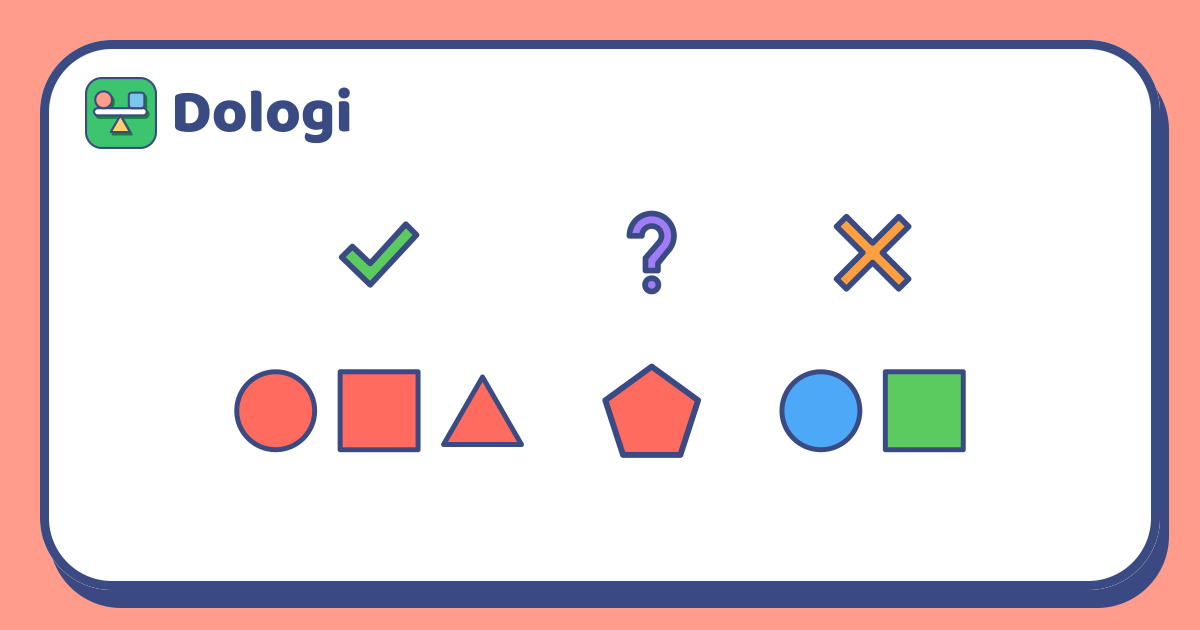
You put a few things on the table in two groups. "I have a secret rule. These ones fit my rule. These ones don't. Can you work out what it is?" Your child picks up a spoon: "Does this one fit?" Every answer is a new clue.
The game needs nothing but a handful of household objects and ten minutes. Along the way your child practises a habit that sits at the heart of good thinking: make a guess, test it, and change your mind when the evidence says so.
How to play
- Gather 10 to 15 small things: buttons, blocks, cutlery, toys, fruit, shapes cut from coloured paper.
- Think of a rule and keep it to yourself, for example "it is red".
- Show some examples. Put two or three things that fit the rule on one side and two that don't on the other.
- Your child tests. They choose any other object and ask, "Does this fit?" You place it on the correct side.
- Your child says the rule when they think they know it. If they're right, swap roles. If not, the testing goes on.
One tip makes the game much better: before saying the rule, your child predicts. "I think this one will fit." Three correct predictions in a row are a good sign that the idea is right.
Rules for each age
| Rough age | Kinds of rule | Examples |
|---|---|---|
| 4–5 | One feature you can see | "is red", "is round", "is big" |
| 6–7 | What it is made of or used for | "is made of wood", "can be eaten", "has wheels", "has a hole" |
| 8–9 | Two features together, or a count | "is red and round", "has exactly four corners" |
| 10 and up | Either-or rules, or something you have to test | "is red or round", "floats in water", "is heavier than this spoon" |
Ages are only a rough guide. If a rule turns out to be too hard, simply offer more examples, and choose an easier one next time.
A version with numbers
For children who know their numbers, all you need is paper. Draw two columns, one for "fits" and one for "doesn't fit", and choose a rule such as "is even", "is greater than 10", "has two digits" or "is in the five times table".
Start with a few examples: 4, 10 and 16 fit; 7 and 13 don't. Your child suggests a number and you write it in the correct column. Is 20 in? Yes. Is 9? No. And 6? If your child's idea is "even numbers", 6 should fit.
Try to prove yourself wrong
This is the most valuable part of the game. Children, and adults too, tend to test only things they expect to fit.
Suppose the "fits" side holds a red apple, a red block and a red button. Your child thinks "red things" and tests another red thing. It fits. And another. It fits again. Everything agrees, but nothing new has been learned: the rule could still be "red", or "not blue", or "red or orange".
A better test is something that should not fit if the idea is right, such as an orange. If the orange fits, that's a surprise, and the rule is wider than "red". Teach your child to ask: "What could I test that would show my idea is wrong?" A "no" tells you just as much as a "yes".
Tips for the rule keeper
- Choose a clear rule. For every object the answer must be a definite yes or no. "Is pretty" doesn't work.
- Only say whether it fits. No hints from your face or voice. If your child is stuck, add one telling example rather than revealing the rule.
- Praise a different rule that works. Sometimes your child finds a rule that matches everything on the table but isn't yours. Say so: "Your rule fits all of these. Mine is different. What could you test to tell them apart?"
- Swap roles often. Keeping a rule is practice too: your child has to apply it the same way every time.
In Dologi, "Guess the rule" puzzles in the Logic topic show one card of things that belong to a group and one card of things that don't. Children work out what the group has in common, then choose which of the options belongs.
In short
- One player sorts objects by a secret rule; the other tests objects to find the rule.
- Start with one visible feature, then move on to two features, numbers and either-or rules.
- Predict before stating the rule, and test things that could prove the idea wrong.
- Swap roles often: making a rule is as good for thinking as guessing one.
Read more: The 20 questions game: guessing an object with yes-or-no questions