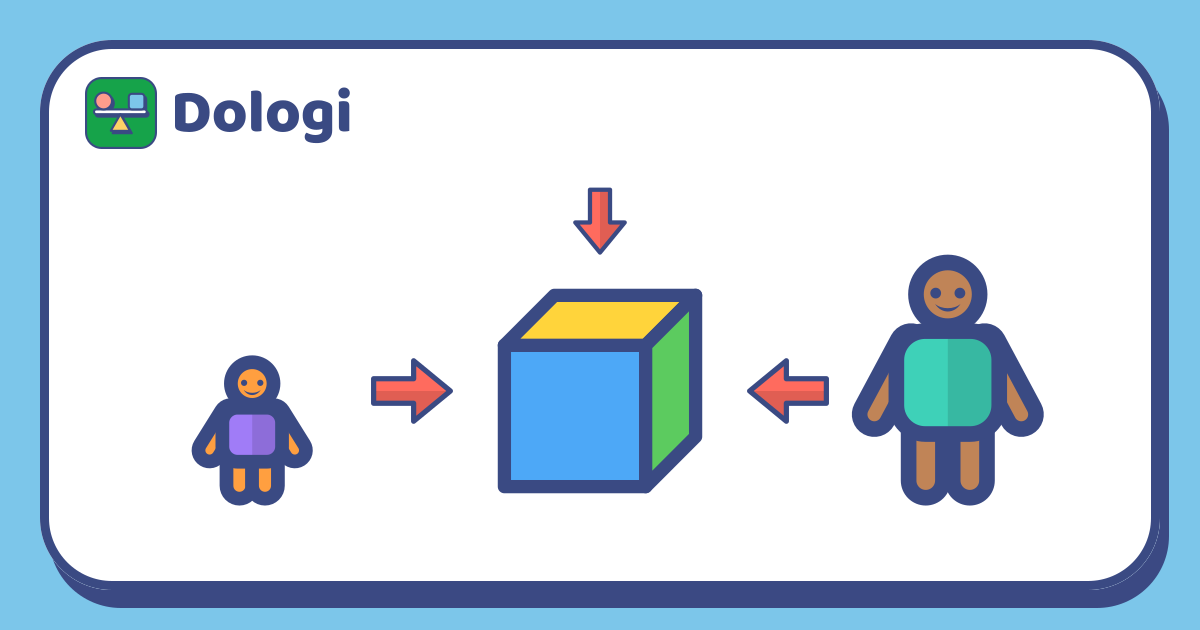
Put a toy between you and your child and ask, "What can I see from here?" Many young children will describe what they see. That's not selfishness; it's a normal stage. Understanding that other people see things differently, both with their eyes and with their minds, is a skill children build gradually.
Being able to look at something from more than one side helps children solve puzzles, get along with friends and think more fairly. This article suggests games for two kinds of seeing: the physical kind (what you see from where you stand) and the social kind (how a situation looks to someone else).
Two kinds of "seeing"
- Seeing with your eyes: from the front, a house shows its door; from the back, its garden. Each position gives a different view of the same thing.
- Seeing with your mind: in the same argument over a toy, one child sees "I had it first" while the other sees "It's my turn". Both are looking at the same moment.
The two are linked. Practising the first, with real objects, gives children words and pictures they can use for the second.
The coloured cube game
You need a box or block with a different colour on each side. Stick coloured paper on a tissue box or a large cardboard cube.
- Put the cube on a table between you. Sit on opposite sides.
- Ask: "What colour do you see? What colour do I see?"
- Swap seats and check. "Were you right?"
- Add a third viewer: a teddy at the end of the table. "What does teddy see?"
- Make it harder: put two objects side by side and ask which one is on teddy's left.
Many children around 4 or 5 find it hard to describe another person's view; by around 6 or 7, many manage it well. Ages are rough guides only. Let your child walk round and check rather than telling them the answer.
Retelling a story through each character's eyes
The same events can feel very different to each person involved. After reading a story, or after something happens at home, try retelling it from different points of view.
Take a simple example: the ball rolled into the neighbour's garden.
- The child: "I was sad because my ball was gone."
- The neighbour: "I was surprised to find a ball in my flowers."
- The dog: "I thought it was a new toy just for me!"
Ask questions such as "How do you think the neighbour felt?", "What did the dog think was happening?" and "Is there anyone else in the story?" Children often enjoy giving funny voices to each character, which makes the perspective feel real.
Everyday disagreements
Disagreements are perfect moments to practise, once everyone is calm.
| Instead of… | Try… |
|---|---|
| "Stop arguing." | "Can each of you tell me what happened, from your side?" |
| "You're wrong." | "What does it look like from her side?" |
| "Just share." | "What could make this fair for both of you?" |
| "Say sorry." | "How do you think he feels right now?" |
You're not deciding who is right straight away. You're helping each child notice that the other person's view exists, which is often enough to find a solution together.
Games for stepping into someone else's place
- Photo detective: take photos of a toy from the front, back, top and side. Mix them up and ask your child to stand where each photo was taken.
- Guess what I see: sit back to back, each holding a picture. Take turns describing details for the other to guess.
- Swap roles in pretend play: if your child usually plays the shopkeeper, let them be the customer, and talk about what's different.
- Map the room: draw the living room from above, then from the door. "Where is the sofa in each drawing?"
In Dologi, "Seen from each side" puzzles in the Space topic ask children to picture how a set of blocks looks from a particular side, the same kind of thinking as the cube game, practised in short steps.
In short
- Seeing from many sides means understanding that a view depends on where you stand, with your eyes and with your mind.
- Start with physical views: a coloured cube, toys on a table, photos from different sides.
- Retell stories and everyday events from each person's point of view.
- In disagreements, ask each child to describe their side, and help them imagine how the other person feels.
Read more: Critical thinking for children: when your child asks "why?" all day long