Ask a young child to put all the red blocks in one pile, and most can do it quickly. Now ask them to find the blocks that are red and round. Suddenly it's much harder: they have to keep two features in mind at once and check both for every block.
Sorting by two features at the same time is an important step in children's thinking. It builds flexible attention, careful checking and the idea that one thing can belong to more than one group. This article explains a simple two-hoop game, a gentle progression to follow, and ways to talk about the results.
Why two features are harder
When children sort by one feature, they only need to ask one question: "Is it red?" With two features, every object needs two questions: "Is it red? Is it round?" And the answers combine into four possibilities:
- red and round,
- red but not round,
- round but not red,
- neither red nor round.
Young children often focus on the feature that stands out most and forget the other. That's normal. With practice, many children from around 5 or 6 start to manage both, and older children can handle more complex combinations.
The two-hoop game
You can make the hoops from two hula hoops, two loops of string or skipping rope on the floor, or two circles drawn on a big sheet of paper.
- Overlap the two hoops so there's a shared middle zone.
- Label each hoop with a picture card: for example, a circle shape for one hoop and a red dot for the other.
- Gather a mix of objects: blocks, buttons, toys or paper shapes in different colours and shapes.
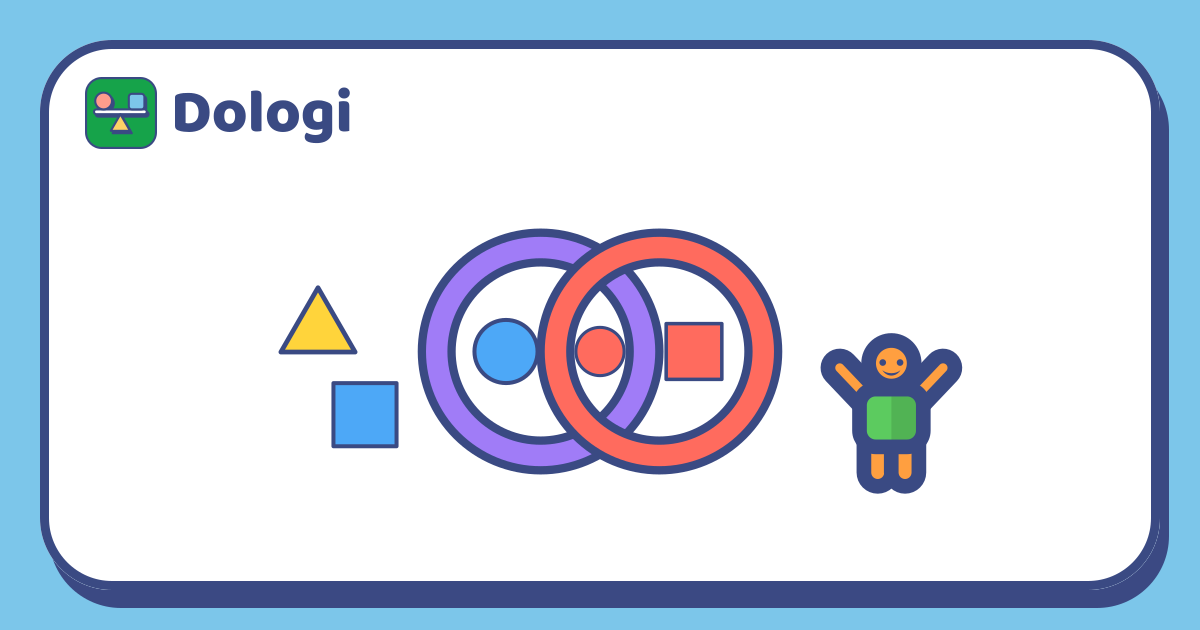
- Take turns placing objects. A red circle goes in the middle, because it belongs in both hoops. A blue circle goes in the circle hoop only. A red square goes in the red hoop only.
- Anything that fits neither stays outside both hoops: a yellow triangle, for example.
The outside zone surprises many children. "Where does this go?" "Nowhere!" is a perfectly good answer, and an important idea.
A step-by-step path
You don't have to jump straight to overlapping hoops. Here's a gentle progression; ages are rough guides only.
| Step | What children do | Approximate age |
|---|---|---|
| 1 | Sort by one feature: all the red things together | 3–4 |
| 2 | Sort the same objects again by a different feature: now by shape | 4–5 |
| 3 | Use two separate hoops, then notice some objects "want" to go in both | 5–6 |
| 4 | Overlap the hoops to make a middle zone | 5–7 |
| 5 | Use a sorting table with rows and columns | 6–8 |
Step 2 is underrated: sorting the same pile in a new way trains children to see that objects have many features, not just one.
The sorting table
For older children, a sorting table shows all four combinations at once. Draw a grid with two rows and two columns:
| Round | Not round | |
|---|---|---|
| Red | red circle | red square |
| Not red | blue circle | yellow triangle |
Ask your child to place each object in the right box. Then ask questions: "Which box has the most? Is any box empty? Can you find something for the empty box?" Later, try new features: big and small, soft and hard, animals that fly and animals with four legs.
Talking about the middle
The shared zone is where the real thinking happens. Helpful questions include:
- "Why did you put it in the middle?"
- "Does it belong to this hoop? And this one?"
- "What would we need to change for it to go outside?"
- "Can you find something that goes in the middle?"
Let your child invent the rules too: "You choose what the hoops mean, and I'll guess."
In Dologi, "Sort into groups" puzzles in the Logic topic ask children to put things together by what they have in common, and noticing which feature matters is the same skill as choosing the right hoop.
In short
- Sorting by two features means checking two questions for every object, which is harder than it looks.
- Play the two-hoop game with a middle zone for "both" and an outside zone for "neither".
- Follow a gentle path: one feature, re-sorting by a new feature, two hoops, overlapping hoops, then sorting tables.
- Ask children to explain where things go, especially in the middle, and let them invent the rules.
Read more: Sorting and comparing: the first thinking skills children use