Your child works out 52 − 17 and writes 45. You can see straight away that it is wrong, but your child seems sure of it. Ask how they got there and you may hear: "You can't take 7 from 2, so I did 7 take away 2, that's 5. Then 5 take away 1 is 4."
This is one of the most common mistakes when children start subtracting with regrouping (also called borrowing or exchanging), usually somewhere around 7 to 9, depending on the school. It is not carelessness: your child is following a rule that sounds perfectly sensible. This article explains where that rule comes from and how to fix it with real objects first, and pencil and paper later.
Why your child got 45
When children first learn to subtract, they meet sums like 7 − 2 or 9 − 4. The bigger number always comes first, so they work out a rule: "take the smaller number from the bigger one". For a long time, that rule works.
With 52 − 17, your child treats each column as a separate sum: the ones column has 2 and 7, the tens column has 5 and 1. Using the old rule, they do 7 − 2 and 5 − 1. What they have not yet seen is this:
- 52 is not "a 5 and a 2" side by side. It is 5 tens and 2 ones.
- In the ones column, the 2 belongs to 52 and the 7 belongs to 17. Swapping them changes the whole problem.
- When there are not enough ones to take away, you exchange one ten for ten ones. That is what regrouping means.
One question helps children notice that something is off: "If you take nearly 20 away from 52, about how much is left?" If your child says "about 30", then 45 already sounds strange.
Bundles of ten sticks
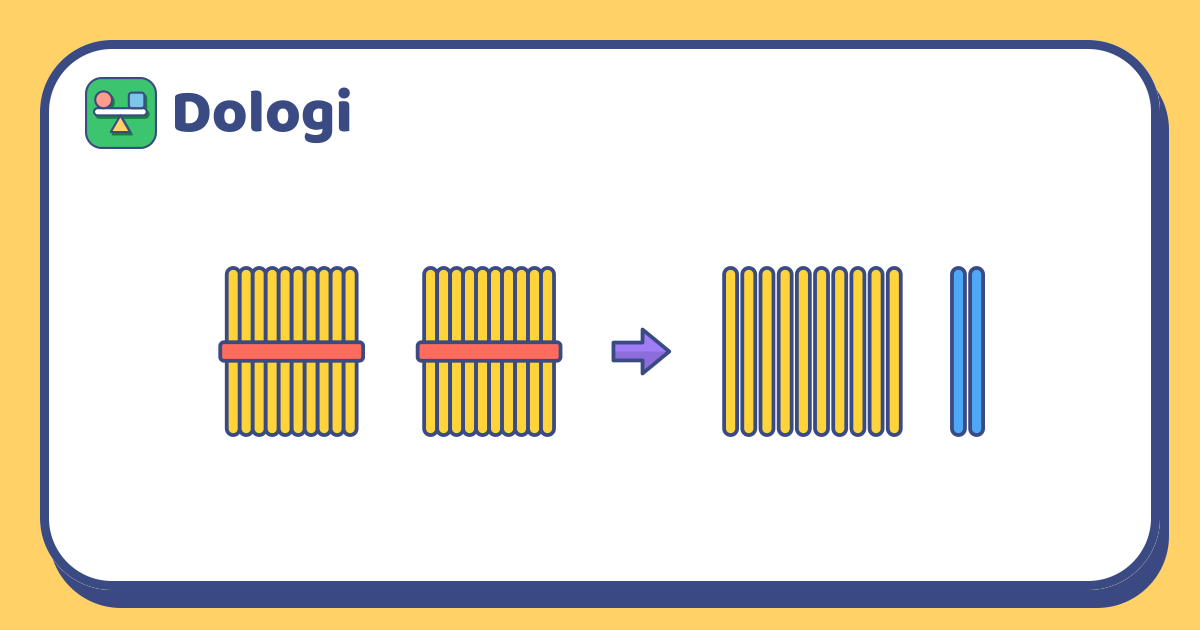
Gather a few dozen sticks (lolly sticks, thick toothpicks or straws cut short) and some rubber bands. Together, bundle the sticks in groups of ten. Making the bundles by hand helps your child remember that one bundle really is ten sticks.
Here is 52 − 17:
| Step | What your child does | On the table |
|---|---|---|
| 1 | Set out 52: five bundles and two loose sticks | 5 bundles, 2 sticks |
| 2 | Seven loose sticks need to go, but there are only 2. Undo one bundle | 4 bundles, 12 sticks |
| 3 | Take away 7 loose sticks | 4 bundles, 5 sticks |
| 4 | Take away 1 bundle | 3 bundles, 5 sticks |
| 5 | Count what is left: three bundles and five sticks | 35 |
Step 2 matters most. Let your child notice "there aren't enough sticks" before you suggest undoing a bundle. Afterwards, ask: "Has the number of sticks on the table changed?" It hasn't. It is still 52, just arranged differently.
Start with easy ones that need only one bundle undone and take away a single digit, such as 32 − 5 or 41 − 8. Once those feel solid, move on to 52 − 17 and 63 − 29.
From sticks to paper
Don't jump straight from sticks to written column subtraction. Add a drawing step in between:
- Draw tens and ones. Each ten is a long line, each one is a dot. 52 is five lines and two dots.
- Break a ten in the drawing. Cross out one long line and draw ten dots beside the others.
- Take away. Cross out seven dots and one long line. Count what is left.
- Write the column sum. Only now does your child write it, and each written step matches something they have already done by hand.
Before each column, practise one fixed question: "Is there enough on top to take away?" If not, regroup; if yes, subtract as usual. This question replaces the "bigger minus smaller" rule.
Schools write regrouping in different ways. Some cross out the 5 in the tens column and write 4. Others say "12 take away 7 is 5", then add the extra ten to the tens digit of the bottom number: "1 and 1 more is 2, 5 take away 2 is 3". Both give the same answer. When your child writes their work, follow the method their teacher uses; the sticks are there to show why regrouping is needed.
Check with addition
Subtraction has a neat built-in check: add the answer to the number you took away, and you should get the number you started with.
- 35 + 17 = 52. Correct.
- 45 + 17 = 62, not 52. So 45 is wrong.
Help your child build a two-part habit for every regrouping subtraction: estimate first ("52 take away nearly 20 leaves about 30") and check afterwards with addition. Once children can catch their own mistakes, they need you checking every sum much less.
If the mistakes keep coming
- Go back to real objects. Repeated mistakes usually mean your child is writing faster than they understand. A few sessions with sticks is not a step backwards.
- Do fewer at a time. Three to five sums done carefully help more than a page done in a rush.
- Ask rather than correct. Instead of "That's wrong", ask: "In this column, is there enough on top to take away?" Let your child find the mistake.
- Check sums without regrouping too. If your child also gets 58 − 23 wrong, tens and ones may not be secure yet. Spend more time bundling and swapping sticks.
If your child is still finding arithmetic very hard after several weeks, it is worth talking to their teacher so you can work out together how to help.
In the Math topic of Dologi, the "Number line hops" puzzle includes backward hops. Each hop back is a subtraction your child can see: the number gets smaller by exactly as many steps as the rabbit goes back.
In short
- Your child gets 52 − 17 = 45 because they are applying the old "bigger minus smaller" rule to each column.
- Bundles of ten sticks show that when there are not enough ones, you exchange a ten for ten ones.
- Move from real objects to drawings, and only then to column subtraction; write it the way the teacher does.
- Estimate first and check with addition afterwards, so your child can catch their own mistakes.
Read more: School teaches maths differently from how you learned: what to do when your child gets confused