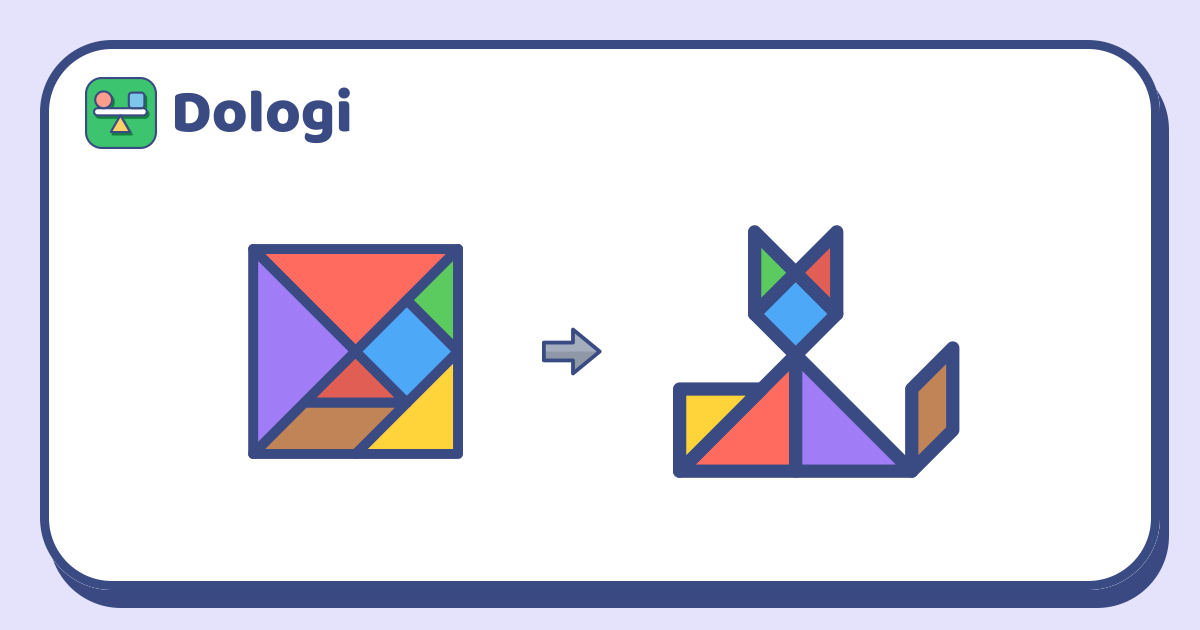
Two large triangles, one medium triangle, two small triangles, a square and a parallelogram. With just these seven pieces you can make a cat, a house, a boat, a running person and hundreds of other pictures. This old puzzle, often called a tangram, costs almost nothing to make and grows with your child for years.
The pieces and the rules
A tangram set is a square cut into seven pieces. The rules are simple:
- Use all seven pieces for each picture.
- Pieces must touch each other.
- No overlapping. Pieces lie flat next to each other, never on top.
Pieces can be turned and flipped over. The parallelogram in particular often has to be flipped, which surprises many children.
Make your own set
You need a square of thick paper or card, a ruler and scissors.
- Draw a diagonal from the top-right corner to the bottom-left corner.
- Mark the middle of the right side and the middle of the bottom side, and join them with a line.
- Draw a line from the top-left corner towards the bottom-right corner, and stop where it meets the line from step 2.
- From the middle of the right side, draw a line parallel to the one from step 3 until it meets the first diagonal.
- From the end of the step 3 line, draw a line parallel to the bottom edge until it meets the first diagonal.
- Cut along all the lines. You now have seven pieces.
Colouring each piece differently makes them easier to talk about: "Where does the blue square go?"
From easy to hard
Tangram puzzles can be adjusted to almost any level:
| Level | What your child sees | Often fits around |
|---|---|---|
| Fill the pieces | An outline with every piece drawn inside | 4–5 |
| A few hints | The outline with only one or two pieces drawn in | 5–7 |
| Silhouette only | Just the outside shape, filled in one colour | 7 and up |
| Back to the square | Put all seven pieces back into the starting square | A challenge at any age |
Start by drawing around the pieces yourself to make outlines: lay out a cat, trace around it, and give your child the drawing. Later, colour the outline in solid so the inside lines disappear.
Shapes to try
- House: the square as a window or chimney, two large triangles as the roof.
- Cat: the square as the head, two small triangles as ears, the large triangles as the body and the parallelogram as a tail.
- Boat: large triangles as sails, the parallelogram as the hull.
- Fish, rabbit, candle, running person: try making them, and invent your own names for shapes you discover by accident.
What tangram trains
- Seeing shapes inside shapes. A big triangle can be made from two smaller ones; a square hides two triangles.
- Turning and flipping in your head. Children learn to imagine a piece turned before they try it.
- Part and whole. Each picture is made of parts that fit together exactly.
- Patience and trying again. When a piece doesn't fit, turning it or swapping it with another is part of the game.
Surprising maths in seven pieces
Older children enjoy discovering that:
- Two small triangles can make the square, the medium triangle and the parallelogram. So these three pieces all have the same area, even though they look different.
- Two small triangles plus the square (or the medium triangle) make one large triangle.
- The whole set is the same area whatever picture you make: a cat and a boat take up exactly as much paper.
Let your child find these by putting pieces on top of each other, rather than telling them.
Ideas by age
Ages are rough guides; follow your child.
- Around 4–5: play freely, fill outlines with the pieces drawn in, make simple pictures with three or four pieces.
- Around 6–7: outlines with fewer hints, the classic animals and houses with all seven pieces.
- Around 8 and up: solid silhouettes, inventing new shapes for others to solve, the maths of the pieces, putting the square back together.
In Dologi, the Space topic has "Fill it up" puzzles: children turn blocks and drag them onto a board until every empty square is filled, with no gaps and no overlaps. It's the same idea of making pieces fit a shape exactly.
In short
- A tangram is a square cut into seven pieces; use all seven, touching, without overlapping.
- Make your own set from card in a few minutes.
- Move from outlines with every piece drawn in, to silhouettes, to your own inventions.
- It trains seeing shapes, turning and flipping in your head, patience, and even area.
Read more: Stick puzzles for children: move a stick, make a new shape