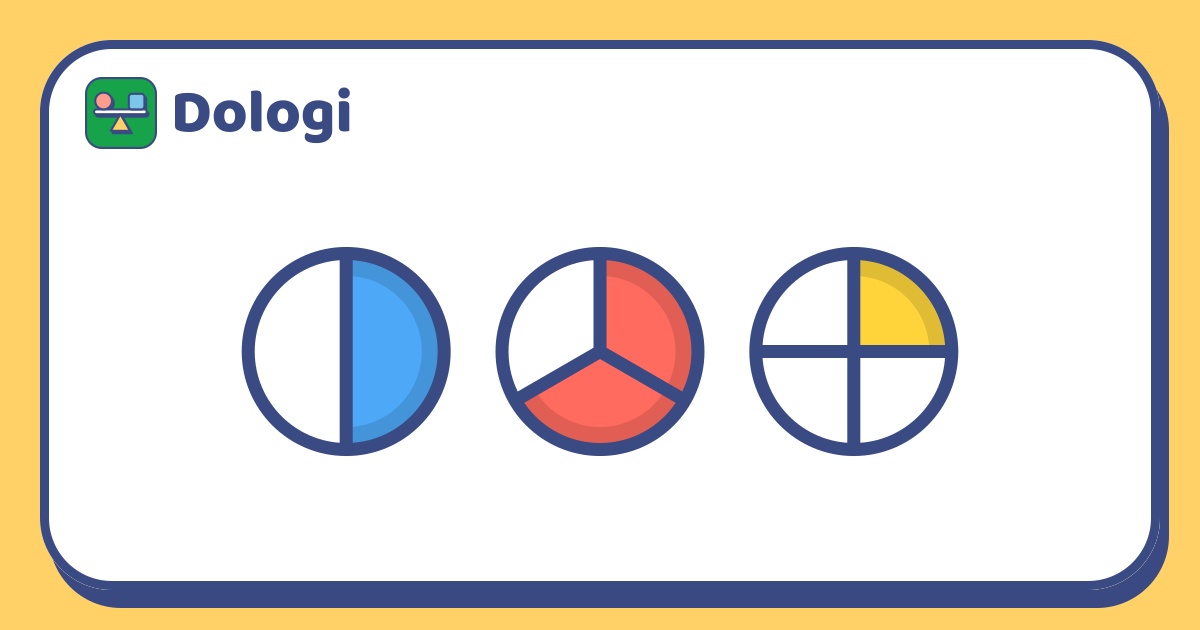
Fractions have a reputation for being difficult. On paper, ½ and ¼ are just numbers with a line between them. At the table, they become something every child cares about: "Is my piece the same as yours?" Starting with real sharing gives children a picture of what fractions mean before they meet the symbols.
What children need to understand first
Before writing ½, children need three ideas:
- Equal parts. A half is not "one of two pieces", it is "one of two equal pieces". Children are very sensitive to fairness, which makes this a natural starting point.
- The whole. Half of a small pizza and half of a big pizza are not the same amount. A fraction is always a part of something.
- More parts, smaller pieces. Cutting a cake into 8 pieces makes each piece smaller than cutting it into 4. This feels backwards to many children, because 8 is bigger than 4.
Introducing ideas step by step
Ages are rough guides only; every child moves at their own pace.
| Step | Example | Often around |
|---|---|---|
| Fair sharing | "Share these crackers so we each have the same." | 5–6 |
| Halves | Cut a sandwich in half. Are both halves the same size? | 6–7 |
| Quarters | Cut each half in half again. | 6–7 |
| Thirds and other parts | Share a pancake between three people. | 7–8 |
| Writing fractions | ½ means 1 of 2 equal parts; ¾ means 3 of 4 | 7–8 |
| Comparing | Which is bigger, ⅓ or ¼? Draw both. | 8–9 |
| Same amount, different names | 2/4 is the same as ½ | 8–10 |
| Fractions of a group | Half of 8 strawberries, a quarter of 12 | 8–10 |
Spend longer on the early steps than you think you need. Children who really understand halves and quarters with their hands find the written work much easier.
Activities in the kitchen and at the table
- Cake, pizza and pancakes. Let your child decide how to cut so everyone gets the same. Name the pieces: halves, thirds, quarters.
- Paper folding. Fold a strip of paper in half, then in half again, and open it. How many parts? Colour one. "This is one quarter of the strip."
- Measuring cups. Fill a full cup using two half cups or four quarter cups. Hands-on proof that two halves make a whole.
- Sharing a group. "We have 12 grapes and 3 people. What is one third of the grapes?" Share them out one by one and count.
- Fraction walls. Draw strips of the same length divided into 2, 3, 4, 6 and 8 parts, one above the other. Comparing pieces side by side makes "⅓ is bigger than ¼" visible.
- Is it fair? Cut a sandwich into two unequal pieces on purpose and ask "Are these halves?" Children love catching adults out.
Common mix-ups
- "¼ is bigger than ½ because 4 is bigger than 2." Go back to real food: would you rather have half of the cake or a quarter?
- Unequal pieces. Children may call any two pieces "halves". Keep asking whether the parts are equal.
- Forgetting the whole. Half of 10 and half of 4 are different. Always ask "half of what?"
- Shapes versus groups. A quarter of a pizza is one slice, but a quarter of 12 grapes is 3 grapes. Practise both.
Talk before you write
- Say "one of four equal parts" before saying "one quarter", and only then write ¼.
- Ask your child to explain why two pieces are or are not fair.
- Use the same words every time: whole, part, equal, half, third, quarter.
- Keep it light. Fractions learned while sharing dessert tend to stick.
In short
- Start with fair sharing: equal parts of a whole.
- Introduce halves, then quarters and thirds, then the written form, then comparing.
- Kitchen activities, paper folding and fraction walls make fractions visible.
- Watch for the "bigger number, bigger piece" mix-up and always ask "part of what?".
Read more: Math with everyday things: counting, comparing and sharing at home.