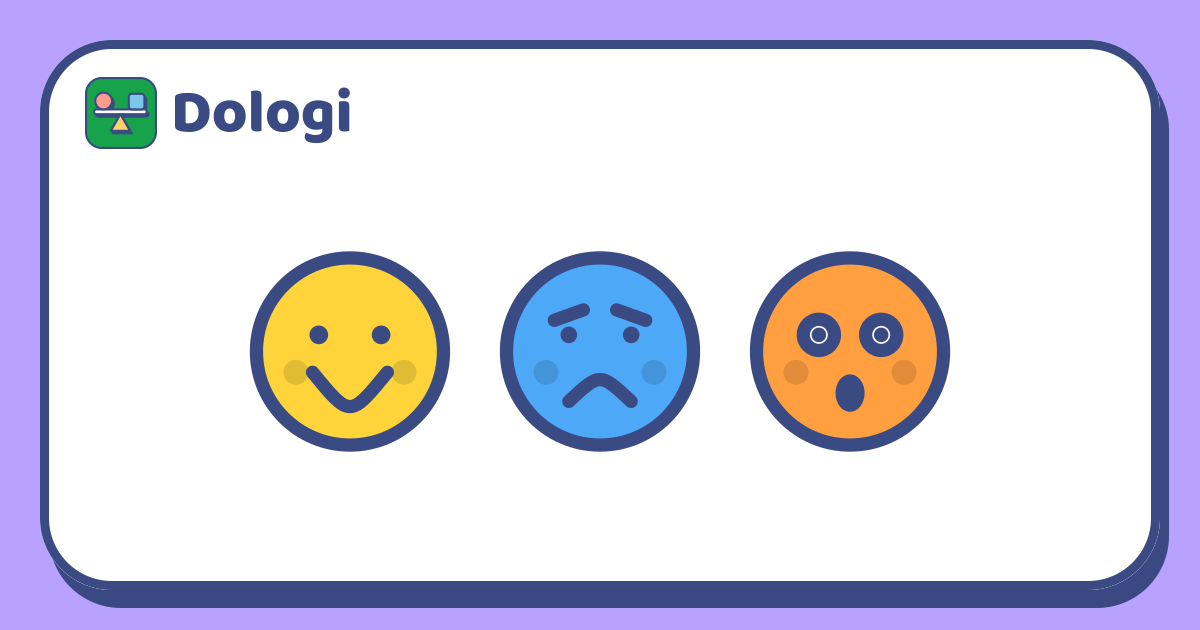
A child who throws a toy across the room may not yet have the words for "I'm frustrated because the tower keeps falling". Recognising a feeling, in yourself or in someone else, and putting a name to it is a skill, and like any skill it is learned bit by bit. The good news: everyday moments offer plenty of practice.
Why words for feelings matter
- Words can replace actions. A child who can say "I'm angry" has another option besides shouting or hitting.
- Naming is the first step to calming down. It is hard to deal with something you cannot describe.
- It helps with friends. Noticing that a friend looks sad is where kindness starts.
- It makes asking for help easier. "I'm scared of the dark" is something an adult can respond to.
Start with four feelings
Four feelings are a good place to begin, because children meet them early and often.
| Feeling | Clues on the face | Clues in the body | When it might show up |
|---|---|---|---|
| Happy | Smile, bright eyes | Bouncy, relaxed | Playing with a friend |
| Sad | Corners of the mouth down, tears | Slow, slumped | A toy breaks |
| Angry | Frown, tight lips | Clenched fists, stamping | Someone takes their turn |
| Scared | Wide eyes, raised eyebrows | Freezing, hiding, holding on | A loud noise in the night |
Talk about the clues, not just the names: "How can we tell this character is sad? Look at the mouth."
Growing the list of feeling words
As children get older, more words help them say exactly what they feel. A rough guide, since every child is different:
- Younger children: happy, sad, angry, scared, tired.
- A little older: excited, proud, worried, bored, frustrated, embarrassed.
- Older children: disappointed, jealous, nervous, relieved, and the idea that two feelings can be there at once ("I'm excited and nervous about the new class").
Older children can also talk about size: a little annoyed is different from furious.
Games for spotting feelings
- Guess my face. Take turns making a face for a feeling. The other person guesses. Then swap.
- Mirror, mirror. Sit in front of a mirror together and make a happy face, then a scared one. What changes? The eyebrows, the mouth?
- Story pause. While reading, stop and ask: "How do you think the character feels now? How can you tell? What would you do?"
- Feelings pairs. Draw simple faces on paper cards, two of each feeling. Lay them face down and play a matching game, saying the feeling's name for each pair found.
- Feelings thermometer. Draw a thermometer from 1 to 5. "How big is your worry today? A 2 or a 4?"
- Act it out. Act a feeling with your body only, no face: stamping feet, slumped shoulders, jumping up and down.
Everyday habits that help
- Name your own feelings out loud. "I feel disappointed because the park is closed. I'll take a deep breath and think of something else."
- Name your child's feelings without judging. "You look angry. Your tower fell down." Naming is not agreeing with what they did next.
- All feelings are OK, not all actions are. "It's OK to feel angry. It's not OK to hit. You can stamp your feet or squeeze a cushion."
- Offer a way to calm down. After naming the feeling: a hug, a few slow breaths, a quiet corner, a drink of water.
- Don't rush to fix it. Sometimes listening and naming is enough. "That sounds really disappointing."
What tends not to help
- "Don't cry", "Stop being silly" or "You're fine" tell a child that the feeling is wrong, not that it can be handled.
- Laughing at a feeling, even kindly, can make a child less likely to share it next time.
- Labels such as "crybaby" or "scaredy-cat" stick to the child instead of the moment.
When to ask for advice
All children have big feelings, and learning to handle them takes years. If strong feelings seem to happen very often, last a long time or get in the way of daily life at home or school, it is worth talking to your child's doctor, teacher or another professional who can look at the whole picture.
In Dologi, the "Match the pairs" puzzles include a version where children match faces that show the same feeling, a small way to practise reading faces.
In short
- Recognising and naming feelings is a skill learned bit by bit.
- Start with happy, sad, angry and scared, and talk about the clues on faces and bodies.
- Games such as guessing faces, story pauses and feelings pairs make practice fun.
- Name your own feelings and your child's, accept every feeling and set limits on actions.
Read more: When your child gives up on hard problems: helping children keep trying and not fear mistakes