Search for "thinking activities for 5-year-olds" and you will mostly find printable worksheets: join the dots, colour by number, spot the difference. Worksheets have their place, but at this age children usually learn more when their hands are busy holding, arranging and moving things, with an adult playing alongside.
This article goes through the thinking skills that often show up around age 5. For each skill there is one game of about 10 minutes, made with things you already have at home.
What many 5-year-olds can do
The table shows what many children can do at around 5. These are rough guides only: every child has their own pace, ahead in some skills and needing more time in others.
| Skill | Around age 5, many children can | Suggested game |
|---|---|---|
| Patterns | Continue a repeating pattern like ABB or ABC | Bottle-cap patterns |
| Memory | Remember four objects they have just seen | Four-item tray |
| Spatial thinking | Get through a short maze, fill in a shape puzzle with outlines | Tape maze, seven-piece puzzle |
| Listening | Follow a two-step instruction | Two-step instructions |
| Numbers | Compare more and fewer up to 10 | Two piles of beans |
If your child can't manage one of these yet, there's no need to worry. Just play an easier version for a while.
Patterns and memory: bottle caps and a four-item tray
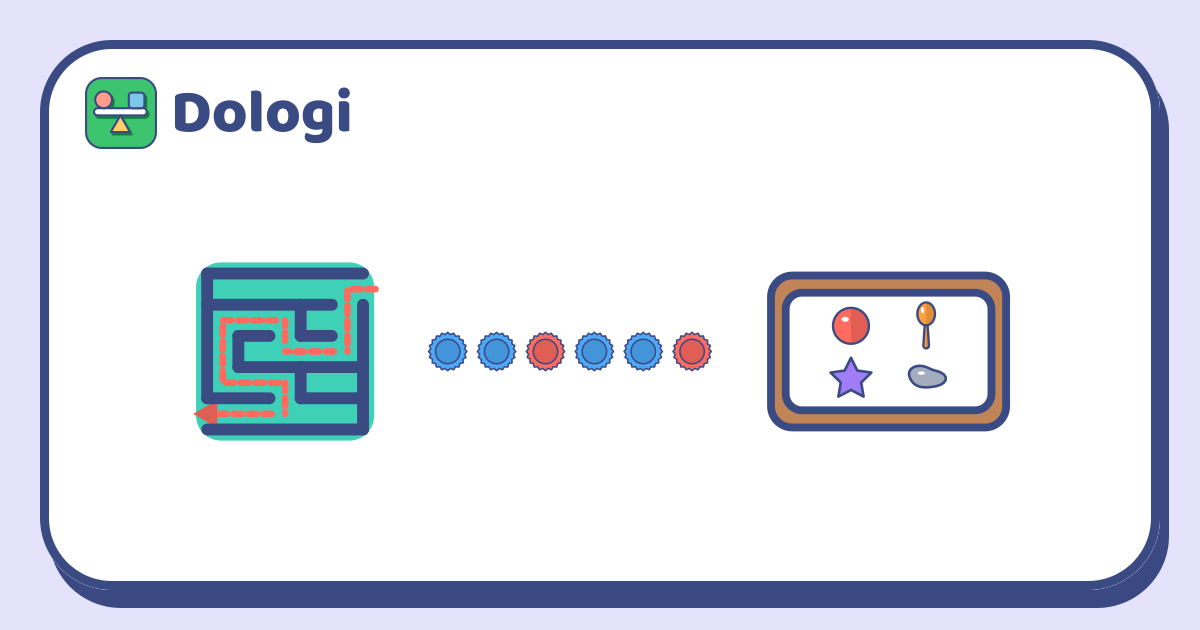
Bottle-cap patterns. Collect bottle caps in two or three colours. Lay out a row: blue, blue, red, blue, blue, red, and ask, "What colour comes next?" Once ABB is easy, move on to ABC (blue, red, yellow) or AABB.
Three ways to keep the game fresh:
- Find the mistake. Put one cap in the wrong place on purpose. Your child finds it and fixes it.
- Your child sets the puzzle. They make a pattern and you guess what comes next. To set a puzzle, they have to understand the rule.
- Same rule, different things. Use the ABB rule with spoons and forks: spoon, spoon, fork. Your child sees that the pattern isn't about colour.
The four-item tray. Put four small things on a tray: a round bead, a spoon, a star and a pebble. Let your child look for about ten seconds, then cover the tray with a cloth. Secretly remove one item, lift the cloth and ask, "What's missing?"
When that becomes easy, add a fifth item, or remove nothing and swap two items around instead. Then swap roles so your child hides and you guess. Most children love being the one who sets the challenge.
Spatial thinking: a tape maze and a seven-piece puzzle
A tape maze on the floor. Use masking tape to make a path on the floor with two or three turns and one dead end. Your child walks from the entrance to the exit. Then change the game:
- Push a toy car through the maze without letting the wheels touch the tape.
- Your child stands outside the maze and guides you with words: "Go straight, now turn this way." They practise describing directions.
- Draw the same maze together on paper. Going from a real path to a drawing is a big step in picturing space.
A seven-piece puzzle. This classic puzzle is a large square cut into a smaller square, a parallelogram and several triangles. For 5-year-olds, start with picture cards that show the outline of every piece, so your child places each piece in its spot. Later, use cards that show only the outer shape. You can cut your own set from thick card.
Listening and comparing numbers
Two-step instructions. Give one sentence with two actions: "Pick up the cup, then put it on the chair." Wait until your child has done both before giving the next one. Make it harder step by step:
- Two actions in one place: "Clap your hands, then sit down."
- Two actions in two places: "Get the ball from the living room, then put it in the basket."
- Add a small condition: "Bring me the blue spoon, not the red one."
Turn it into a "listening robot" game: your child is a robot that only does exactly what it's told. Swap roles so your child gives the instructions, and now and then get one wrong on purpose so they can catch you out.
Two piles of beans. Make two piles of beans, each with no more than 10. Ask which pile has more. Your child guesses by looking first, then lines up the beans in two rows, one opposite the other, to check. The row with beans left over has more. Once counting feels secure, play with two dice: whoever rolls more dots takes a bean.
How to keep your child wanting more
- One game at a time, about 10 minutes. Stop while your child still wants to play, and they will ask for it again tomorrow.
- Play, don't test. No scores, no comparing with other children. When your child gets it wrong, say "Shall we try again?" rather than "That's wrong."
- Talk it through. Ask "How did you know?" When children can explain how they worked something out, they are really thinking.
- Let your child set the puzzle. Almost every game here works with roles swapped. Making a puzzle for someone else deepens their understanding of the rule.
- Step back a level when needed. If your child is struggling, go back to a shorter pattern, fewer items on the tray, or a maze with fewer turns.
If your child enjoys these games, the Patterns, Memory and Space topics in Dologi have similar puzzles that start easy and get gradually harder. A few minutes on a screen each day is one more way to practise, not a replacement for playing with real things.
In short
- Around age 5, games with real things usually build thinking skills more than worksheets.
- One game per skill: bottle caps for patterns, a four-item tray for memory, a tape maze for spatial thinking, two-step instructions for listening.
- Keep games short, swap roles so your child sets the puzzle, and ask "How did you know?"
- Age milestones are only rough guides; if your child isn't ready, step back a level.
Read more: What can children do at each age? Thinking milestones from 4 to 10