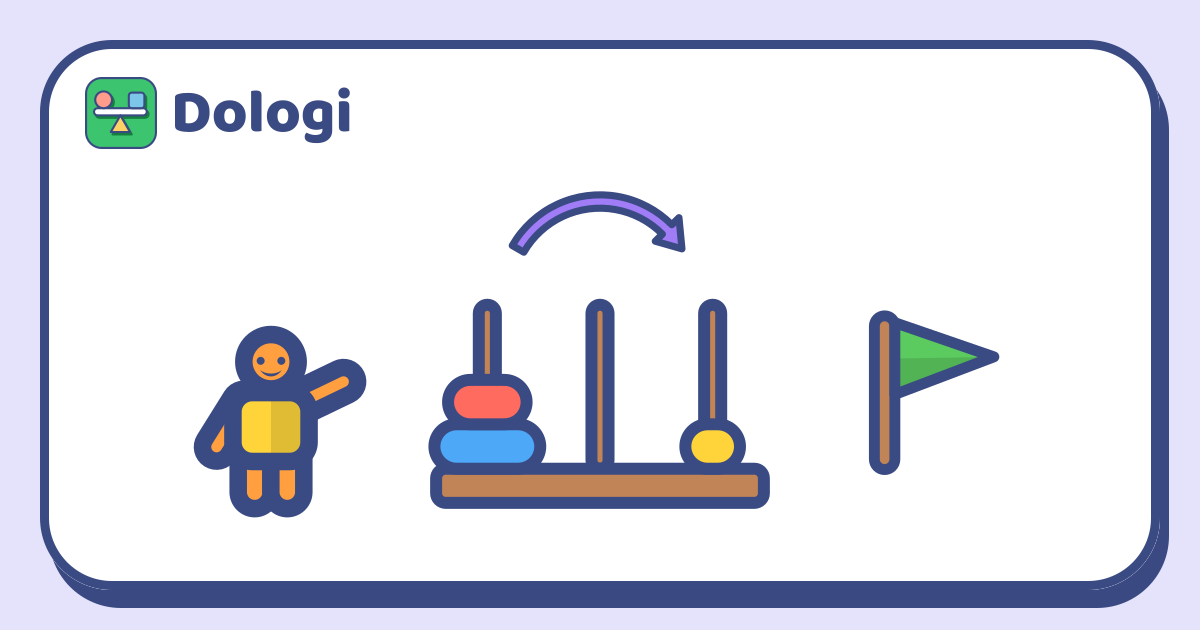
Three pegs, a few discs of different sizes and two simple rules: the three-peg tower puzzle has been around for well over a century, and it's still one of the best games for practising planning. It looks easy, and with two or three discs it is. Then you add one more disc and suddenly you need a strategy.
This post explains how to make the puzzle at home, how to introduce it in small steps, and how to help your child discover the clever idea behind it.
The rules
All the discs start on one peg, biggest at the bottom, smallest at the top. The goal is to move the whole tower to another peg.
- Move one disc at a time.
- Only the top disc of a stack can move.
- Never put a bigger disc on top of a smaller one.
That's it. The third rule is the one that makes the puzzle interesting.
Make it at home
You don't need a wooden set:
- Pegs: three plates, three sheets of paper or three marked spots on the table.
- Discs: coins of different sizes, plastic lids, books of different sizes, or circles cut from cardboard (number them on the back if you like, but colours work too).
- The goal peg: put a small flag or sticker on the peg you're aiming for.
Using things your child can stack and see makes the rules easy to check: "Is a bigger one on a smaller one? Oops, that's not allowed."
Start small
- One disc: move it to the goal. One move. Children laugh at how easy it is, and that's fine.
- Two discs: this needs three moves: small to the spare peg, big to the goal, small on top of the big one. Let your child find it.
- Three discs: this takes at least seven moves and is the first real challenge. Many children around 6 or 7 can solve it with patience.
Only move to four discs when three discs feel comfortable. Four discs need at least 15 moves, and that's a big jump in planning.
The key idea
With three or more discs, children often get stuck moving discs back and forth. The breakthrough is to think about the biggest disc first:
- "To move the biggest disc to the goal, where must all the other discs be?"
- The answer: stacked on the spare peg, out of the way.
- So the job becomes: move the smaller tower to the spare peg, move the big disc, then move the smaller tower on top of it.
Notice that "move the smaller tower" is the same puzzle, just with one disc fewer. Your child already knows how to solve that. This idea of solving a big problem by solving a smaller version of it is a powerful thinking tool, and it's lovely when children discover it themselves. Ask guiding questions rather than explaining it straight away.
Count the moves and find the pattern
For children around 8 and older, record the smallest number of moves for each tower size:
| Discs | Fewest moves |
|---|---|
| 1 | 1 |
| 2 | 3 |
| 3 | 7 |
| 4 | 15 |
Ask: "Can you see a pattern? How many moves do you think 5 discs will need?" Some children spot that each number is double the one before, plus one. Others notice the numbers are one less than 2, 4, 8, 16. Both are right, and both come from the key idea above.
Tips for playing together
- Let your child make mistakes and undo them. Backtracking is part of the learning.
- Talk through moves aloud: "Where can the small disc go now?"
- Count moves for older children, and try to beat the previous count.
- Take breaks. If frustration rises, go back to fewer discs and build up again.
In Dologi, "Move the tower" puzzles use the same rules with discs on three pegs, starting with small towers and moving on to mixed-up starting positions as children get more confident.
In short
- The three-peg tower puzzle has three rules: one disc at a time, top disc only, never big on small.
- Make it at home with coins, lids or cardboard circles, and start with two discs.
- The key idea: to move the biggest disc, first move all the others out of the way.
- Count the fewest moves for each size and look for the pattern.
Read more: Planning before doing: teaching children to think three steps ahead