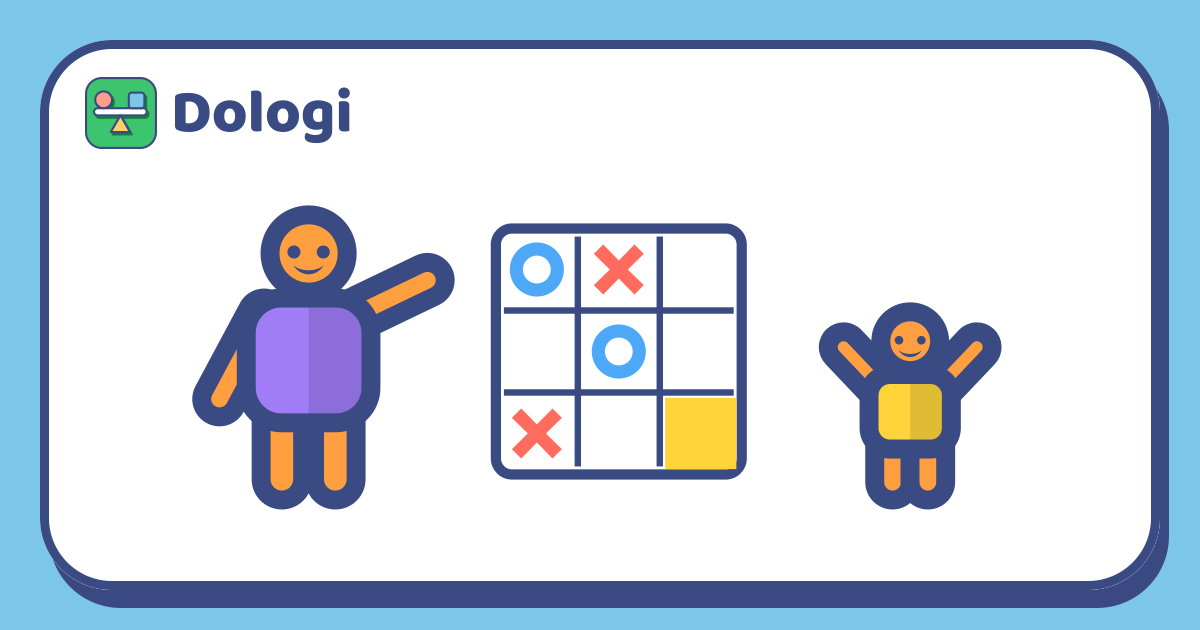
A pencil, a scrap of paper and nine squares: noughts and crosses (also called tic-tac-toe) is probably the simplest strategy game there is. Many children learn the rules by age 4 or 5, and for a while they play it just by putting their mark anywhere.
That's exactly what makes it such a good first lesson in strategy. With a few simple questions, children move from "I'll go here" to "if I go here, what will you do?", which is the beginning of thinking one move ahead.
The rules in one minute
- Two players take turns: one draws circles, the other draws crosses.
- The first to get three of their marks in a row, across, down or diagonally, wins.
- If all nine squares are full and nobody has three in a row, it's a draw.
Agree who goes first and swap each game, so things stay fair.
Three questions before every move
The heart of the game is a short checklist. Teach it as three questions your child asks before each move:
- "Can I win right now?" If two of my marks are in a line and the third square is empty, I take it.
- "Can you win on your next turn?" If the other player has two in a line, I must block the third square.
- "If not, where's a good square?" The centre and the corners are usually stronger than the edges.
At first, ask these questions out loud for your child. "Hmm, can you win? Can I win next time?" After a while, they'll start asking themselves, sometimes muttering the questions under their breath.
Why the centre and corners matter
Count how many lines go through each square:
| Square | Lines through it |
|---|---|
| Centre | 4 (across, down and both diagonals) |
| Each corner | 3 (across, down and one diagonal) |
| Each edge | 2 (across and down) |
You don't need to explain the table to young children. Instead, ask: "Which square is part of the most lines?" and let them count with a finger. Discovering that the centre is the busiest square is far more memorable than being told.
The double threat (for older children)
Around age 7 or 8, many children are ready for a clever idea: making two threats at once. If you have two different lines that each need just one more mark, the other player can only block one of them, so you win with the other.
Set up a position on paper and ask: "Where could you go to make two lines at the same time?" Then swap roles and see if your child can spot your double threat in time to stop it.
Why good players always draw
After many games, older children often notice something surprising: when both players follow the three questions carefully, nobody wins. Every game ends in a draw.
This is a lovely thing to discover for themselves. Ask: "Why do you think we keep drawing?" It opens a conversation about how some games can be "solved", and about why we play more complex games like draughts or chess when we want more of a challenge.
Ways to vary the game
- Think aloud together: play as a team against an imaginary opponent, discussing every move.
- Take back a move: occasionally allow "what if?" moves, then undo them and talk about what would have happened.
- Bigger board: play on a 4 by 4 or 5 by 5 grid and try to get four in a row.
- Upside-down rules: whoever gets three in a row loses. Suddenly the three questions work the other way round.
Keep the mood light. If your child finds losing hard, play a few games where you think aloud about your own mistakes.
Dologi doesn't have games against another player, but "Lights on" puzzles train the same habit: tapping one square also switches the squares next to it, so children learn to ask "what will this tap change?" before they tap.
In short
- Noughts and crosses is a simple first strategy game for children from around 4 or 5.
- Teach three questions: can I win, can you win, where's a good square?
- Count lines to discover why the centre and corners are strong.
- Older children can learn double threats and find out why careful players always draw.
Read more: My child cries every time they lose: teaching children to win and lose well