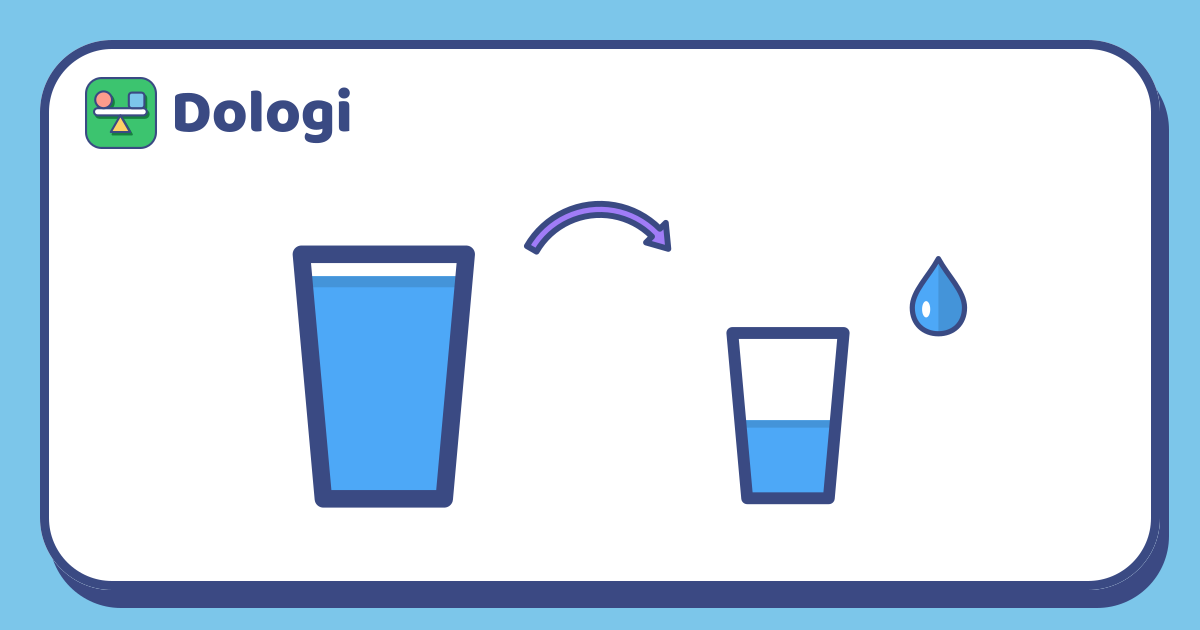
You have two jugs: one holds exactly 3 cups of water, the other exactly 5 cups. There are no markings on them. How can you end up with exactly 4 cups? This is one of the oldest puzzles around, and it's a fantastic one to try with real water.
Water jug puzzles practise planning, keeping track of amounts and thinking a few steps ahead. They're also great fun in the bath, the garden or at the sink, because children can test every idea and see the result straight away.
Set it up with real water
You'll need:
- Two containers of different sizes, such as a small cup and a bigger jug or bottle.
- A unit to measure with, like a small measuring cup or a yoghurt pot. Use it to find out how many "cups" each container holds, and mark the full line with tape if needed.
- A tap or a bucket as your water supply, and a sink or bowl to pour away water.
For the classic puzzle, look for containers that hold 3 and 5 of your small cups. If yours are different, that's fine: just adapt the numbers.
The three moves
Agree on the only moves allowed:
- Fill a container completely from the tap.
- Empty a container completely.
- Pour from one container into the other until the first is empty or the second is full, whichever comes first.
No guessing "about half". Every move gives an exact amount, which is what makes the puzzle work.
Start with an easy one
Before the classic, try this: "Using the 3-cup and 5-cup containers, make exactly 2 cups."
Most children find it quickly: fill the 5, pour into the 3 until it's full, and 2 cups are left in the big one. That first success shows the key trick: pouring until one container is full leaves a known amount behind.
Record each step
For the harder puzzles, a table helps children keep track and avoid going in circles. Each row shows how much is in each container after a move.
| Move | 5-cup jug | 3-cup jug |
|---|---|---|
| Start | 0 | 0 |
| Fill the 5 | 5 | 0 |
| Pour 5 into 3 | 2 | 3 |
| Empty the 3 | 2 | 0 |
| Pour 5 into 3 | 0 | 2 |
| Fill the 5 | 5 | 2 |
| Pour 5 into 3 | 4 | 3 |
And there are 4 cups in the big jug. Let your child find it with their own table before showing this one. Ask: "Is there another way? Can you do it in fewer moves?" (There is another route, starting by filling the 3.)
Why some amounts are impossible
For children around 9 and older, try a puzzle that can't be solved: "With a 2-cup and a 4-cup container, make exactly 3 cups."
After a few tries, ask: "What amounts can we make?" Children may notice that every amount is even: 0, 2 and 4. Since you can only fill, empty and pour, you can never get an odd number. Discovering that a puzzle is impossible, and explaining why, is a big step in logical thinking.
Variations
- Different sizes: 4 and 7 cups, aim for 5. Or 3 and 7, aim for 1.
- Three containers: the classic 8, 5 and 3 version, sharing 8 cups equally into two lots of 4.
- On paper: once children understand the moves, they can solve puzzles in a table without water.
- Invent a puzzle: your child chooses the container sizes and the target, then checks it can be done.
In Dologi, "Put in order" puzzles sometimes show glasses with different amounts of water to line up from the least to the most, a simpler way of comparing amounts by eye.
In short
- Water jug puzzles: two containers, three moves (fill, empty, pour), and an exact target amount.
- Try them with real water and a small measuring cup, starting with an easy target.
- Record each move in a table to keep track and avoid going round in circles.
- Older children can explore which amounts are impossible and explain why.
Read more: Teaching children to measure: long and short, heavy and light, full and empty