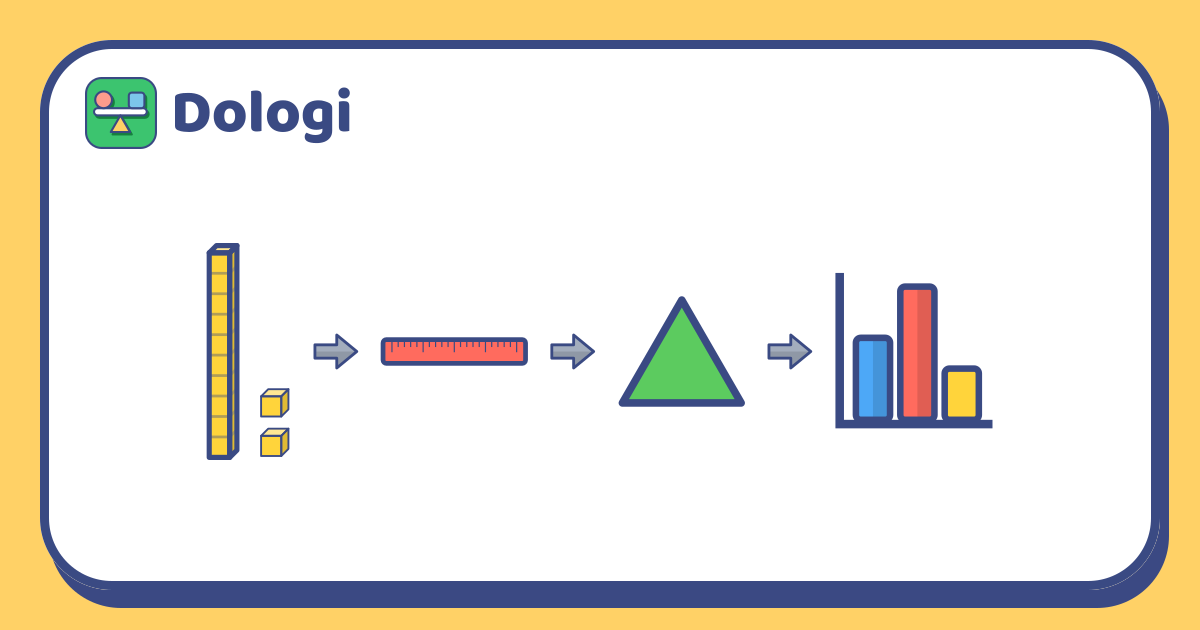
Primary maths can look like a long list of separate topics: sums one week, clocks the next, then shapes, then charts. For parents, it is hard to see how it all fits together, or whether a child is roughly where they should be. In fact, almost every school system builds primary maths from the same four big areas, and each area grows step by step over the years.
This article gives you a simple map of those areas, what many children can do at different ages, and a few quick questions to try at home. It does not follow any particular country's curriculum: schools differ in order and pace, and so do children.
Four big areas of primary maths
- Number and calculation. Counting, reading and writing numbers, place value (tens, hundreds…), adding, subtracting, multiplying, dividing, then fractions and decimals.
- Measurement. Length, weight, capacity, time and money: comparing first, then measuring with units, then converting between units.
- Shape and space. Naming shapes, describing their properties, symmetry, angles, position and direction.
- Data. Sorting, counting and recording information in tallies, tables and charts, then reading what the chart tells us.
Number usually takes the most time, but the other three areas matter too. A child who struggles with sums may be very good at shapes, and the reverse.
What children often do at around 6, 8, 10 and 12
The table below gives a rough picture. Ages are approximate: many children will be ahead in one area and behind in another, and that is normal.
| Area | Around 6 | Around 8 | Around 10 | Around 12 |
|---|---|---|---|---|
| Number | Counts objects to 20 and beyond, adds and takes away small numbers with objects | Understands tens and hundreds, adds and subtracts two-digit numbers, starts multiplying as equal groups | Knows most times tables, works with thousands, divides, meets simple fractions | Uses fractions, decimals and percentages, compares them, solves problems with several steps |
| Measurement | Compares longer, heavier, fuller | Measures with a ruler, reads the time to five minutes, counts money | Converts between units, finds the perimeter, counts squares for area | Uses formulas for area, meets volume, solves time and money problems |
| Shape | Names common flat and solid shapes, uses words like above and next to | Counts sides and corners, spots symmetry | Recognises right angles and parallel lines, sorts four-sided shapes | Measures angles, uses coordinates, folds nets into solids |
| Data | Sorts and counts objects, makes tallies | Draws and reads simple bar charts | Reads tables and line graphs | Finds an average, describes chance with words like likely and unlikely |
Quick questions to see where your child is
Ask casually, during a walk or a meal, not as a test. Pick the question that fits your child's age, and note how they answer, not only what they answer.
- Number. Younger: "I have 7 grapes and eat 3. How many are left?" (4) Older: "I have 47 stickers and get 8 more. How many now?" (55) Even older: "Which is bigger, 0.5 or 0.45?" (0.5, because 0.5 is the same as 0.50)
- Measurement. Younger: "Which is longer, this spoon or your hand? Let's check." Older: "We leave at 3:45 and arrive at 4:20. How long was the trip?" (35 minutes)
- Shape. Younger: "Can you find something round and something with corners?" Older: "How many corners does a cereal box have?" (8) Even older: "Where can you see a right angle in this room?"
- Data. Younger: "Let's sort the socks by colour. Which pile has the most?" Older: "Let's count the colours of cars that pass for five minutes. Can you draw a bar chart?"
If your child explains how they worked something out, even with a wrong answer, you learn more than from a right answer alone.
Reading the map without worry
- Uneven is normal. Children often race ahead in one area and move slowly in another.
- Gaps can be filled. If an earlier step is missing, going back to it with objects and drawings usually helps more than pushing forward.
- Talk to the teacher. They know what your child's class is working on and can tell you which skills are solid. If you have wider concerns about your child's learning, ask the school or a professional for advice.
How to support each area at home
- Number: board games with dice, card games, shopping, counting in twos and fives.
- Measurement: cooking with scales and cups, measuring heights on a door frame, reading clocks, paying with coins.
- Shape: building blocks, paper folding, spotting shapes on a walk, drawing maps of a room.
- Data: surveys of the family ("Which fruit do you like best?"), weather charts, counting birds at a window.
Dologi groups its puzzles into seven topics. Math covers counting, number sense and measuring, while Space works on shapes, positions and views. Short, varied puzzles like these are a gentle way to visit several areas of the map.
In short
- Primary maths grows from four big areas: number, measurement, shape and space, and data.
- The age table is a rough guide only; schools and children follow different paces.
- A few casual questions show where your child is better than a test does.
- Support each area with everyday play, and talk to the teacher if a gap seems to last.
Read more: What is mathematical thinking? How it differs from school math, and whether your child needs extra classes.