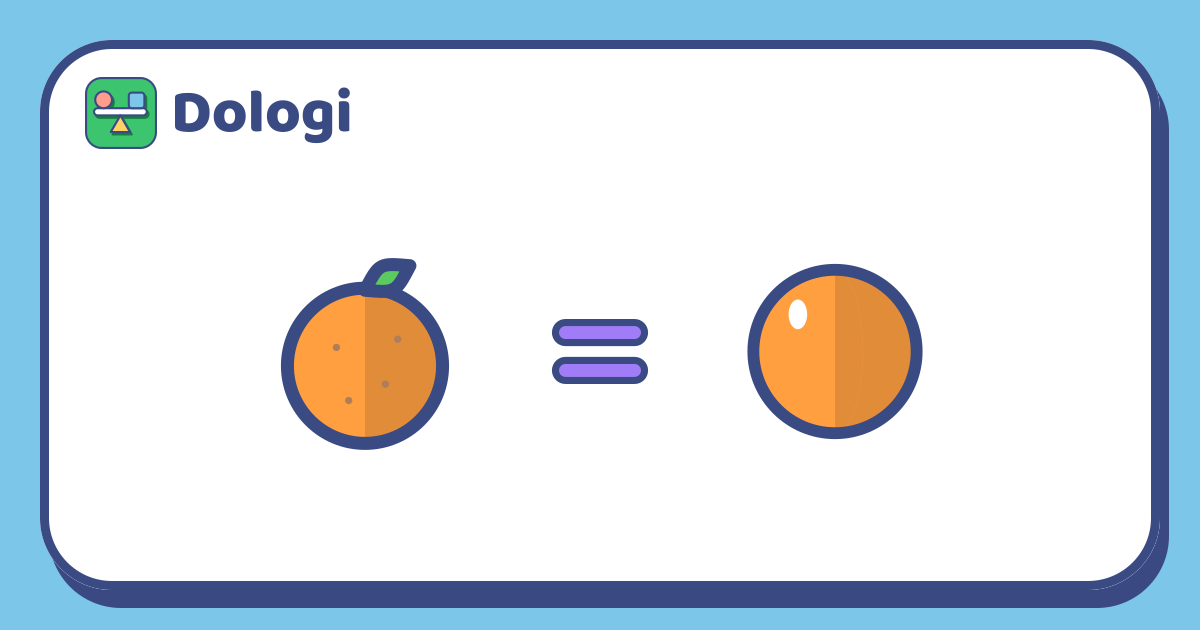
What do an orange and a ball have in common? They're both round. They're both orange. They both roll. You can throw both of them. You might find both in a child's lunchbox, or at least in their hands at lunchtime.
Finding what two different things have in common is a simple game with deep roots. To play it, children have to look closely at features, think about what things do and where they belong, and make connections between ideas. It's also great fun, because the strangest pairs often give the most surprising answers.
Why this game is good for thinking
- Looking at features. Colour, shape, size, material: children learn to notice the properties of things, not just their names.
- Thinking in categories. "Both are fruit", "both are toys", "both are animals" helps organise what children know.
- Flexible thinking. One pair can be linked in many ways, so there's always another answer to find.
- Understanding comparisons. Later at school, comparisons and analogies ("a leaf is to a tree as a feather is to a bird") build on exactly this skill.
Kinds of links to look for
When your child gets stuck, suggest a kind of link to look for:
| Kind of link | Question | Example: an orange and a ball |
|---|---|---|
| Looks | "What do they look like?" | Both round, both orange |
| What it does | "What can you do with them?" | Both roll, both can be thrown |
| Made of | "What are they made of?" | Both have a skin or outer layer |
| Where it's found | "Where would you see them?" | Both in the kitchen or the garden |
| Group | "What group could both belong to?" | Both are things a child might hold |
Children usually start with how things look. Gently moving to what things do, or where they belong, is where the thinking gets deeper.
Pairs from easy to tricky
Start with pairs that are obviously alike and work towards surprising ones:
- Easy: a cat and a dog, a cup and a bowl, an apple and a pear.
- Medium: a cat and a chair (both have four legs), a pencil and a tree (both are long, both have wood), a bicycle and a car (both have wheels, both carry people), a book and a television (both tell stories).
- Tricky: a cloud and a sheep (both white and fluffy), a clock and a face (both have "hands" or features in a circle), a fish and an aeroplane (both have fins or wings, both move through something).
The tricky pairs are where children often surprise adults. Accept any link they can explain.
Ways to play
- Taking turns. Pick a pair, then take turns saying one thing they have in common. When nobody can find another, pick a new pair.
- Points game. One point for each link, and a bonus point for a link nobody else thought of.
- Mystery pair. One person secretly picks two objects in the room and says one thing they have in common. The others guess the pair.
- Lucky dip. Put small objects in a bag. Pull out two without looking and find what links them.
- The opposite. Once your child is good at finding links, ask for differences too. "Same and different" together is powerful.
Ideas by age
- Ages 4–5: use real objects, start with easy pairs, and focus on how things look and what they do.
- Ages 6–7: try medium pairs, play the points game, and introduce group names ("both are vehicles").
- Ages 8 and up: tackle tricky pairs, try the mystery pair game, and explore simple analogies.
In short
- Finding what two different things have in common trains looking, grouping and flexible thinking.
- Look for links in how things look, what they do, what they're made of, where they're found and what group they belong to.
- Move from easy pairs to tricky ones, and accept any link your child can explain.
- Play it as a turn-taking game, a points game or a guessing game.
Read more: Sorting and comparing: the first thinking skills children use